
OOBThaiAmulets
Por Sala Tan
Por Sala Tan
Couldn't load pickup availability
PST02
Nang Kwak
Por Sala Tan
1.5 Inches
Mainstream Artifact
Sacred Craftsmanship
This Nang Kwak belongs to an earlier period of Por Sala Tan’s ritual work, from approximately the same general era as his older Bo Bo Aung pieces. It reflects a period when many specialised artifacts were still individually carved and assembled by hand rather than produced from standardised commercial moulds.
Each artifact was individually hand-carved and assembled from prepared sacred materials. Natural variations in the Graduk, colour, carving, Takrut arrangement, Ploi Sek and ritual compound make every surviving piece unique.
Personal Experiences Shared by Luksits
Among followers, pieces of this type were primarily kept for livelihood and smoother commercial circumstances.
Nang Kwak was naturally favoured by people involved in selling, trading or running their own businesses, but the addition of Salika and Sivali-related materials gave this particular version a broader reputation.
Owners did not approach it merely with the idea of “calling customers”.
The Salika aspect was valued when speaking with customers, negotiating prices, presenting an offer or trying to resolve a difficult conversation. The intention was that people would be more receptive, communication would proceed more smoothly and unnecessary resistance could be reduced.
The Sivali aspect was regarded differently. Rather than charm alone, it concerned the circumstances surrounding livelihood — useful opportunities appearing, journeys proceeding smoothly, assistance arriving when required and sufficient resources being available.
For business owners, these qualities naturally complemented Nang Kwak.
The traditional idea was therefore a complete cycle: attract the opportunity, communicate effectively when it arrives, and create favourable conditions for that opportunity to develop into livelihood.
Summary
This is a hand-carved Nang Kwak made from Graduk Chang Graden during the earlier period of Por Sala Tan’s ritual work.
Its importance lies not only in the sacred material but in its construction.
The front carries the traditional Nang Kwak symbolism of calling customers, attracting trade and encouraging prosperity. Behind the carving, Por Sala Tan installed multiple Takruts and sacred substances associated with Salika and Phra Sivali, together with Ploi Sek.
Salika contributes speech, persuasion, Metta and harmonious communication.
Sivali contributes livelihood, opportunities, provisions, benefactors and smoother journeys.
Nang Kwak provides the central direction of customer attraction and commercial prosperity.
Together they form a carefully considered artifact for those whose livelihood depends upon people, opportunities and the continuing circulation of business.
Historical Background
Nang Kwak — The Caller of Customers
Nang Kwak is one of the most recognisable prosperity figures in Thai popular religious culture.
Her defining gesture is the raised hand with the fingers curling inward towards herself.
This is the kwak — beckoning gesture.
Traditionally, the gesture represents calling beneficial things towards the owner: customers towards a shop, buyers towards merchandise, opportunities towards one's livelihood and favourable people towards the household.
For this reason, images of Nang Kwak have long been associated with shops, restaurants, market stalls and family businesses.
Yet the traditional meaning extends beyond simply increasing sales.
Nang Kwak is also connected with Metta Maha Niyom — the ability to receive goodwill and favourable treatment from others. For a merchant, attracting a customer means little if the customer immediately feels uncomfortable or distrustful.
The complete principle is therefore one of attraction followed by favourable human interaction.
Por Sala Tan's construction of this particular artifact develops precisely that idea through the addition of Salika and Sivali elements.
Origins of the Materials
Graduk Chang Graden
The principal body was carved from Graduk Chang Graden.
Within the older ritual understanding followed by Por Sala Tan, certain aged organic materials were regarded as capable of holding the accumulated influence of chanting and ceremonial work particularly well.
Por Sala Tan preferred materials that were considered to possess history and memory.
The belief was that repeated exposure to prayer, incense, handling, sacred substances and mantra did not merely affect the surface of the material. Over time, the material itself became increasingly responsive to ritual preparation.
The same Graduk Chang Graden was therefore not limited to one type of artifact. Por Sala Tan carved it into several different sacred forms according to the intended wicha.
For this limited group, the chosen form was Nang Kwak.
Salika Takrut Components
The reverse contains Takrut components associated with Salika.
Salika wicha traditionally concerns beautiful and persuasive speech, social receptiveness, negotiation and the ability to communicate without creating unnecessary resistance.
This makes Salika particularly complementary to Nang Kwak.
Nang Kwak calls the customer; Salika assists with the conversation that follows.
Sivali-Related Sacred Substances
Sivali-related relic substances were incorporated into the backing compound.
Phra Sivali is traditionally associated with abundance, provisions, benefactors, travel and obtaining what is necessary along one's path.
Within a business-oriented Nang Kwak, the symbolism extends beyond attracting money. It concerns creating the conditions through which livelihood can continue steadily.
Ploi Sek
The two reddish stones visible on the reverse are Ploi Sek — gemstone fragments that underwent ritual blessing before being incorporated into the artifact.
Their significance lies in the consecration they received and their role as additional ritual elements within the completed assembly.
Ritual
Older followers recalled that Por Sala Tan often preferred a quiet and prolonged method of consecration for small, specialised batches such as this.
Rather than depending upon a single large public ceremony, individual pieces could be worked upon repeatedly over several nights.
The hand-carved Nang Kwak figures were subjected to chanting, mantra recitation and candle offerings according to the intended purpose of the batch.
The Graduk Chang Graden therefore functioned as more than a carving material. Within Por Sala Tan’s method, it acted as a substance capable of gradually receiving and retaining the accumulated ritual work.
Importantly, the Takruts were inserted only after the principal chanting process had been completed.
Por Sala Tan regarded the internal construction as a form of carrier for the accumulated force of the ritual. The Takruts and other sacred substances were therefore assembled deliberately rather than added simply for appearance.
The Salika, Sivali and prosperity-related elements were brought together behind Nang Kwak to reinforce a common purpose: bringing opportunity towards the owner and helping that opportunity develop favourably once it arrives.
Blessings and Effects
Customer Attraction — Kwak Sap, Kwak Lap
The raised hand of Nang Kwak traditionally calls customers, opportunities and favourable circumstances towards the owner.
Kha Khai Dee — Successful Trade
Particularly associated with people who depend upon buying, selling, commissions or regular customer activity.
Metta Maha Niyom
Supports goodwill, trust, popularity and favourable treatment from customers, colleagues and people encountered through work.
Salika — Persuasive Communication
The Salika components reinforce speech, negotiation and the ability to communicate ideas in a manner others find easier to accept.
Maha Lap — Fortune and Opportunity
Associated with favourable opportunities and circumstances that can contribute towards livelihood.
Sivali — Sustenance and Support
Traditionally connected with provisions, benefactors, useful assistance and smoother circumstances when travelling or conducting one's affairs.
Financial Prosperity
The multiple Takruts were included to strengthen the overall wealth and livelihood direction of the piece, particularly for owners involved in business.
The emphasis is therefore not simply upon sudden wealth, but upon attracting customers, communicating successfully, recognising opportunities and maintaining a smoother flow of livelihood.
Modern Application
This Nang Kwak is particularly appropriate for business owners, shopkeepers, salespeople, entrepreneurs and those whose income depends upon dealing directly with customers.
A shop owner may approach the Nang Kwak aspect for customer flow and continued trade.
A salesperson may place greater emphasis upon the Salika components, particularly when presenting proposals, negotiating terms or dealing with difficult clients.
Those who travel regularly for business may find the Sivali aspect particularly relevant because of its traditional association with provisions, helpful people and smoother journeys.
The piece may also suit people whose work does not involve a physical shop.
In modern commerce, the “customer entering the shop” may instead be an enquiry, telephone call, online order, referral, introduction or business opportunity.
The underlying symbolism remains the same: bringing useful people and opportunities towards one's livelihood.
Physical Details
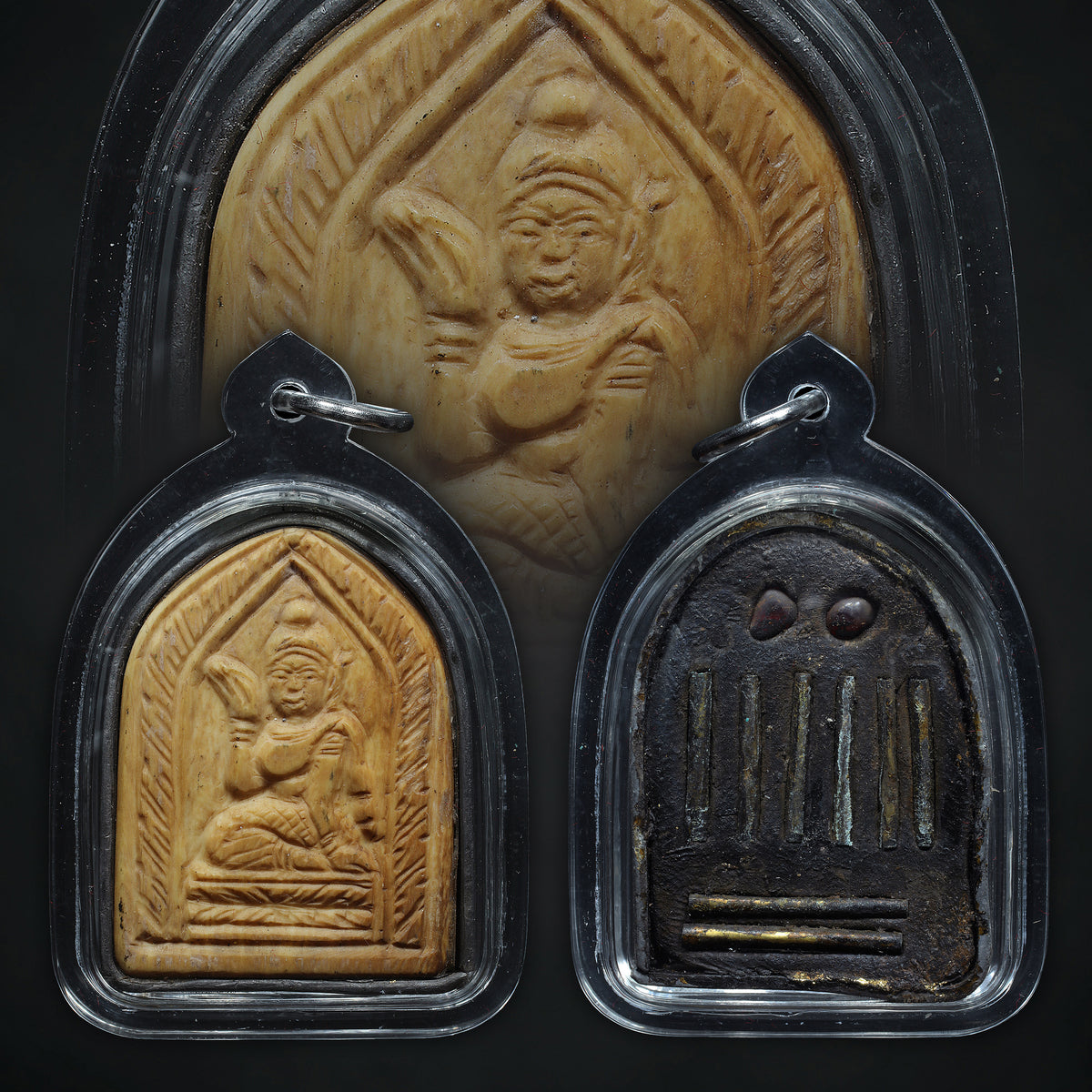
This is a compact, individually hand-carved Nang Kwak fashioned from pale aged Graduk Chang Graden.
The front depicts Nang Kwak seated beneath a pointed arch, with one arm raised in the characteristic beckoning position. Hand-cut lines form the surrounding frame, clothing and decorative details. The carving retains the softer irregularity expected of individually worked organic material rather than mould production.
The reverse is filled with a dark sacred compound and contains an unusually elaborate arrangement of ritual inserts.
Several narrow Takruts are positioned vertically through the centre, while two longer Takruts are arranged horizontally towards the lower section. Two reddish Ploi Sek are embedded above them.
Small remnants of gold leaf and natural ageing remain visible throughout the backing compound.
The artifact is presently preserved within a fitted clear protective casing.
Recommended Pairing
A Phra Sivali is the most natural pairing where livelihood, business travel, provisions and continued prosperity are the owner's main priorities.
A dedicated Salika can strengthen the communication side of the combination, particularly for salespeople, negotiators and those working in customer-facing professions.
A Phra Somdej provides a complementary emphasis upon Buddhist Baramee, stability and composure.
For shopkeepers, pairing this piece with another traditional prosperity artifact such as a wealth Takrut or appropriately consecrated Loop Om can place greater emphasis upon accumulation and financial stability rather than customer attraction alone.
Personal Notes
What makes this Nang Kwak particularly interesting is the way Por Sala Tan constructed the artifact as a complete system of livelihood rather than a simple wealth charm.
Nang Kwak calls.
Salika communicates.
Sivali sustains.
The Graduk Chang Graden forms the physical foundation capable, within Por Sala Tan's tradition, of receiving prolonged mantra work. The Takruts direct that work towards particular purposes, while the Ploi Sek add another layer of ritually prepared material.
This also reflects an earlier period of Por Sala Tan's work when small batches could still be made in an intimate manner.
The figure was carved individually. The chanting was carried out repeatedly. The reverse materials were deliberately assembled after the principal consecration rather than simply pressed into a mass-produced mould.
No two pieces were expected to look exactly alike.
That individuality is part of its character.
At its centre remains the familiar raised hand of Nang Kwak — calling customers and opportunities inward — while behind the figure sits an unusually complex arrangement intended to help the owner make something worthwhile from what has been called towards them.
-
Free Shipping for Singapore| $15 Worldwide | $60 USA For Items Below $350