
OOBThaiAmulets
Por Sala Tan / Ac Ji
Por Sala Tan / Ac Ji
Couldn't load pickup availability
PST02
Mai Prai Nii
Por Sala Tan / Ajarn Ji
B.E. 2550 (2007)
4cm
Barang Artifact
Sacred Craftsmanship
Mai Prai Nii is one of the more unusual spirit-based works associated with Por Sala Tan and Ajarn Ji, created from Black Mai Takien wood connected to a deeply unusual incident during the monsoon season.
Each Mai Prai Nii was individually carved from this naturally irregular sacred wood. Variations in grain, surface, carving, Sai Sin and form are therefore part of the character of each piece, making every surviving example distinct.
Personal Experiences Shared by Luksits
According to accounts preserved among the local followers, only around seven people in the village and surrounding town were known to possess examples from this group.
Interestingly, several were small-business owners.
Over the years, followers observed that these owners generally did well in their businesses, and the pieces gradually acquired a local reputation particularly connected with customers, trade, communication and wish fulfilment. One owner reportedly valued his Mai Prai Nii sufficiently to have the piece framed in gold.
Those who carried the amulet also spoke about a noticeably softer aspect to its influence.
Rather than describing only strong attraction, some associated it with an improvement in the way they communicated with family members, friends, partners and customers. Situations that had previously been difficult to discuss were said to become easier to approach, while interactions with customers appeared warmer and more receptive.
Others associated Mai Prai Nii with saneh, particularly in matters of companionship and relationships. Single owners sometimes carried the piece with the intention of meeting a suitable partner, while those already in relationships used it when seeking reconciliation or greater understanding.
Summary
Mai Prai Nii represents a particularly intimate part of Por Sala Tan and Ajarn Ji's spirit tradition.
Its importance lies not simply in Black Mai Takien wood, but in the complete history of the material: a disturbing death, repeated spiritual manifestations, the careful removal of the deceased and branch, a proper funeral, and months of subsequent ritual work intended to pacify the spirit.
Within the tradition surrounding the piece, its principal qualities became associated with saneh, Metta Maha Niyom, communication, business support, relationship harmony and wish fulfilment.
With only a small number traditionally known among local owners, it is also a piece whose history has remained closely connected to the original circle surrounding its creation.
Historical Background
The story begins during the monsoon season, when Ajarn Ji was staying close to Por Sala Tan.
One rainy night, his sleep was interrupted after villagers contacted him about repeated sightings of what they believed to be a female spirit.
Such incidents were not necessarily regarded as exceptional in the rural spiritual traditions within which Ajarn Ji and Por Sala Tan worked. In many cases, a master might perform merit transfer, chant for the deceased and encourage the presence to move onwards.
This case did not settle so easily.
The following day, Ajarn Ji began searching for the source of the disturbance. Traditional accounts state that he meditated using a piece of coffin wood as a means of seeking direction.
The search eventually led to the discovery of the body of a young woman who had died by hanging from a tree.
Adding to the unusual circumstances, the tree had subsequently been struck by lightning.
Within the spiritual understanding of the practitioners involved, such a combination of sudden death, the tree and a lightning strike created particularly difficult circumstances. The spirit was believed to have remained strongly connected with the location, explaining the disturbances reported by nearby villagers.
Ajarn Ji therefore did not simply remove the body.
A specific rite was performed before the branch was cut. His intention was to remove the deceased together with the section of tree to which the death had been connected, rather than risk leaving what practitioners understood as a residual attachment within the tree itself.
The woman was subsequently given a proper funeral.
The branch removed during the recovery was preserved.
It later became the principal material for Mai Prai Nii.
Origins of the Materials
The principal material is Black Mai Takien wood taken from the branch directly associated with the incident.
Mai Takien occupies an important position in Thai folk belief. Old Takien trees have long been associated with female tree spirits and are treated cautiously within many local animist traditions. For practitioners working with spirit-based wicha, wood connected with an unusual death could therefore acquire a very different ritual significance from ordinary timber.
In this instance, the material was considered important because its history could not be separated from the deceased.
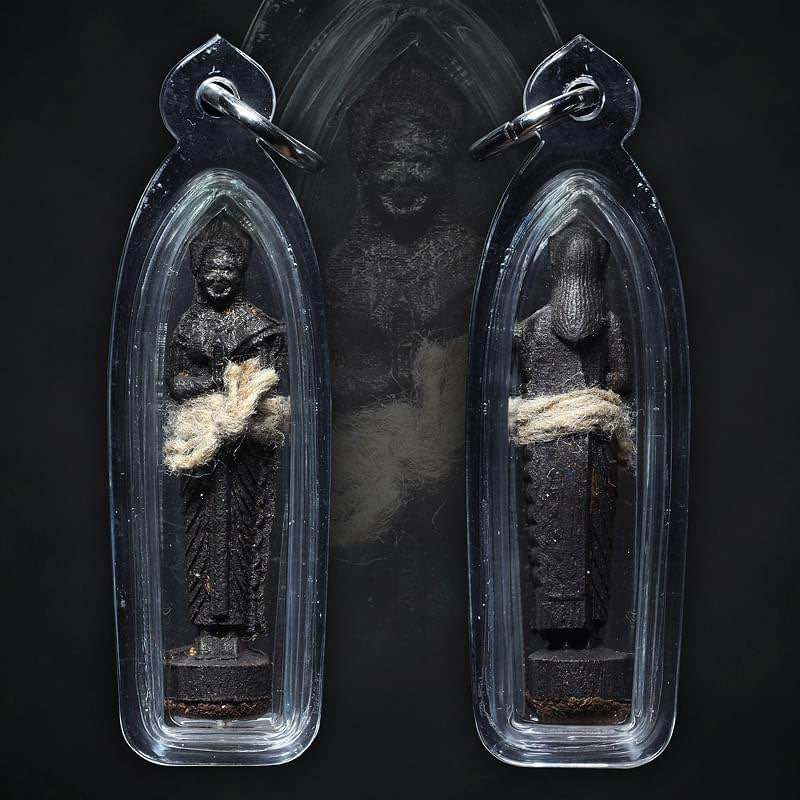
The finished carving also incorporates bone ash and ritual soil beneath the figure, maintaining a material connection to the rites performed for the woman.
Original Sai Sin from the ceremonies remains tied around the body.
Together, the wood, ash, soil and ceremonial thread make the object more than a representation of Mae Prai. Within Por Sala Tan and Ajarn Ji's tradition, they establish continuity between the original event, the funeral rites and the subsequent consecration.
Ritual
Ajarn Ji first dealt with the physical site and the removal of the deceased, including the ritual cutting of the branch.
Por Sala Tan later assisted with the spiritual work.
Rather than immediately attempting to turn the material into a charm, Por Sala Tan is said to have chanted for the woman's spirit over a period of months.
The purpose was pacification.
Accounts from the lineage describe the process as gradually returning her from the distressed condition associated with her death towards what was remembered as her former, warmer disposition.
Only after this process was the material treated as suitable for the finished Mae Prai work.
The Sai Sin tied around the carving originates from this ceremonial context, while the bone ash and soil placed beneath it strengthen the ritual connection. The completed piece therefore reflects an extended process rather than a single blessing ceremony.
Blessings and Effects
Mai Prai Nii is principally associated with saneh and Metta Maha Niyom, but its traditional reputation extends beyond romantic attraction.
Owners particularly associate it with:
- Saneh — personal attraction, warmth and increased notice from others.
- Metta Maha Niyom — goodwill, kindness and favourable treatment.
- Communication — helping conversations proceed more smoothly with partners, relatives, customers and associates.
- Relationship harmony — traditionally carried when attempting to repair strained relationships or encourage mutual understanding.
- Business and customers — attraction of customers, repeat business and improved interpersonal dealings.
- Wish fulfilment — assistance towards reasonable personal intentions and opportunities.
Its reputation is therefore not centred purely upon sexual attraction. Among its owners, the more distinctive quality has often been described as an ability to bring people closer and make interaction easier.
Modern Application
For modern owners, Mai Prai Nii is particularly relevant to situations where relationships directly affect everyday life.
A shopkeeper may carry it with the intention of encouraging customers to feel comfortable and return. Someone working in sales or service may value its traditional Metta and communication qualities. Others may approach it for romantic attraction, reconciliation or simply greater harmony within their personal circle.
For a single person, its saneh aspect has traditionally been associated with opening opportunities to meet a suitable partner rather than forcing the affection of a particular individual.
Because the piece originates from spirit-based practice, respectful conduct and merit-making remain appropriate within the tradition surrounding it.
Physical Details
The amulet measures approximately 4 cm and is carved from Black Mai Takien wood. The front depicts a standing female figure in a simple hand-carved form, while original Sai Sin is visibly tied around the body.
Bone ash and soil connected with the rites were placed beneath the carving to reinforce its spiritual association. The piece is presently protected within a clear plastic casing.
Its handmade construction means that carving depth, wood grain, surface texture and the placement of ritual materials may differ between individual examples.
Recommended Pairing
Mai Prai Nii may be paired with a Buddha image or other Baramee-based Buddhist amulet to provide a complementary merit-centred foundation.
For business use, it may also be carried alongside an established Chok Lap or Maha Pokasap piece, allowing the Mai Prai Nii to remain focused upon saneh, goodwill and interpersonal relationships while the accompanying amulet represents prosperity and financial opportunity.
For relationship purposes, a Metta Maha Niyom amulet provides the most natural pairing, reinforcing gentleness, communication and mutual goodwill rather than relying solely upon attraction.
-
Free Shipping for Singapore| $15 Worldwide | $60 USA For Items Below $350