
OOBThaiAmulets
Por Sala Tan
Por Sala Tan
Couldn't load pickup availability
PST05
Yant Baramee
Por Sala Tan
Mainstream Artifact
2 inches
Sacred Craftsmanship
Each piece was individually prepared and inscribed by hand, so variations in the Bai Lan, handwriting, herbal filling and wax are natural characteristics that make every artifact unique.
Personal Experiences Shared by Luksits
Luksits who keep Yant Baramee generally speak of it less as a shortcut to authority and more as an artifact for developing the qualities that allow authority and respect to arise naturally.
Some use it during difficult periods as a reminder to remain patient, composed and thoughtful, particularly when circumstances cannot be changed immediately.
Others associate it with becoming more confident when dealing with colleagues, customers or people in positions of authority. Rather than making others fearful, they describe its Baramee quality as being taken more seriously, listened to and treated with greater goodwill.
For this reason, the artifact has also been kept by people carrying greater responsibilities at work, managing businesses or entering situations where calm judgement and personal credibility are important.
Summary
Por Sala Tan's Yant Baramee is a handwritten Bai Lan talisman centred upon the traditional concept of Baramee — accumulated virtue, moral strength, dignity and respected presence.
The Bai Lan carries the handwritten yantra, while its upper and lower sections contain 108 sacred herbal powders sealed with Metta wax.
Traditionally, the artifact is associated with wisdom, patience, good conduct, confidence, protection, goodwill and the strength to overcome difficult periods.
Its deeper meaning is straightforward: genuine Baramee is something that must be cultivated.
Historical Background
The Thai word บารมี — Baramee, from the Pali pāramī, refers to spiritual qualities or perfections developed through practice.
Within Buddhist tradition, these are commonly expressed through the Ten Perfections:
generosity, morality, renunciation, wisdom, effort, patience, truthfulness, determination, loving-kindness and equanimity.
When these ten are understood at three levels of development, they form the well-known concept of the Thirty Perfections — Baramee 30 That.
Over time, Baramee also acquired a broader everyday meaning in Thai culture. A person possessing Baramee may be understood as someone whose character, experience and conduct create a natural sense of dignity, credibility and influence.
This is important when understanding a Yant Baramee.
Its ideal is not domination over others. It represents the development of the qualities that cause people to trust, respect and willingly follow someone.
Origins of the Materials
Bai Lan
Bai Lan is prepared palm leaf traditionally used for manuscripts throughout Thailand and neighbouring Southeast Asian cultures.
Long before modern printing became widespread, palm leaves preserved Buddhist scripture, teachings, medicine, astrology, ritual manuals, histories and other bodies of knowledge.
Within sacred-object traditions, Bai Lan consequently carries a strong association with Khru, inherited knowledge, wisdom and continuity of lineage.
Por Sala Tan selected Bai Lan as the writing surface for this Yant Baramee and inscribed the yantra directly onto it.
108 Sacred Herbs
The upper and lower portions contain Por Sala Tan's prepared mixture of 108 sacred herbal powders.
The number 108 carries longstanding auspicious significance within Buddhist and regional sacred traditions and is frequently encountered in prayer beads, ritual enumerations and sacred preparations.
Metta Wax
The herbal mixture was sealed with Metta wax, reinforcing the artifact's emphasis upon goodwill, harmonious relations and being favourably received by others.
Ritual
The central element of this artifact is Por Sala Tan's handwritten yantra.
The Bai Lan was prepared before the Yant Baramee was written directly onto the leaf. The 108-herb mixture was then incorporated into the upper and lower sections and sealed into place with Metta wax.
The construction therefore combines three related ideas:
Bai Lan for knowledge.
Yant Baramee for cultivated spiritual strength.
Metta and sacred herbs for goodwill and supportive circumstances.
Rather than being mass stamped or mechanically reproduced, the yantra retains the direct handwriting of Por Sala Tan.
Blessings and Effects
Yant Baramee is traditionally associated with strengthening the owner's personal presence and inner qualities.
Its commonly sought purposes include:
- Baramee — dignity, moral strength and respected presence.
- Metta Maha Niyom — goodwill, popularity and favourable reception.
- Panya — wisdom and clearer judgement.
- Khanti — patience and endurance through difficult circumstances.
- Sati — composure and awareness before making decisions.
- Khum Khrong — traditional devotional protection and avoidance of danger.
- Khwam Man Khong — confidence, emotional stability and perseverance.
For business and professional use, Baramee is traditionally associated with being trusted, maintaining one's reputation and developing the personal standing needed to lead others responsibly.
Modern Application
This is particularly suitable for someone whose success depends upon trust and personal credibility.
A manager may keep it as a reminder to lead fairly rather than through intimidation. A business owner may use it as a focus for maintaining good relationships with customers and employees. Someone beginning a new position may regard it as support for confidence and steady progress.
It is equally relevant during difficult periods.
When circumstances become uncertain, Baramee represents the ability to remain patient, make considered decisions and continue doing what is necessary without allowing temporary setbacks to dictate one's conduct.
In this sense, the artifact's strongest lesson is perhaps also its simplest:
Baramee is built through what a person repeatedly chooses to do.
Physical Details
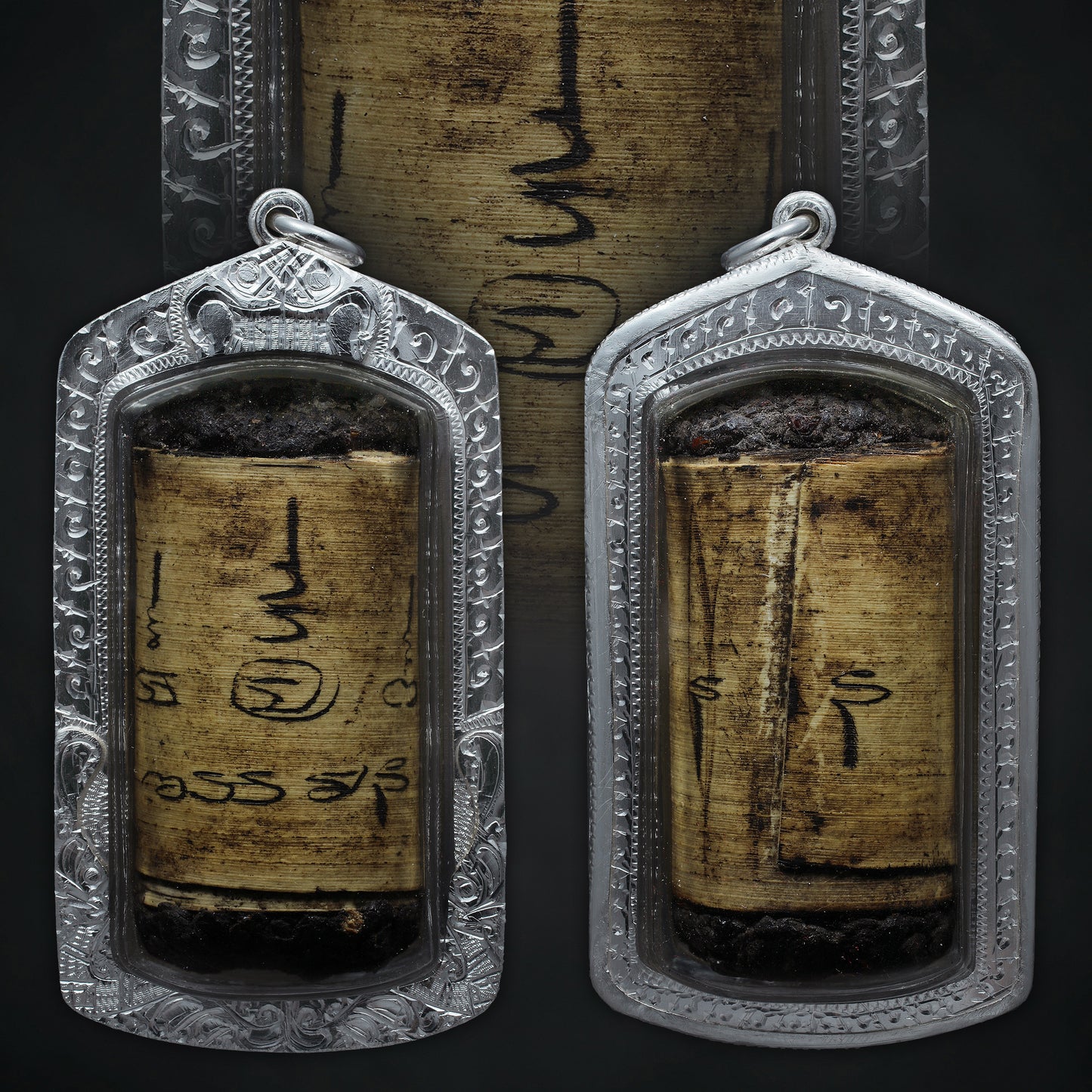
A rectangular Bai Lan palm-leaf talisman, handwritten by Por Sala Tan and preserved within a protective casing.
The natural fibres and horizontal grain of the palm leaf remain clearly visible beneath the handwritten sacred characters. Both faces carry individual inscriptions rather than a printed design.
Dark ritual material containing the 108 sacred herbal preparation is visible at the upper and lower ends, where it has been sealed with Metta wax.
Its simple construction is characteristic of an older form of talisman making: leaf, handwriting, sacred herbal material and wax, with the spiritual emphasis placed upon the written wicha rather than elaborate decoration.
Recommended Pairing
Yant Baramee pairs naturally with artifacts centred upon Khru, Lersi or Buddha imagery, particularly where the owner's intention concerns learning, leadership and personal development.
A Lersi pairing can strengthen the theme of wisdom and guidance from teachers, while a Buddha image complements the Baramee principles of mindfulness, ethical conduct and compassion.
For business owners or those in leadership positions, it may also be paired with a Metta or wealth-oriented artifact, allowing Yant Baramee to remain the foundation of character and respected presence, while the accompanying piece addresses livelihood and opportunity.
Personal Notes
What makes this artifact interesting is its simplicity.
There is no elaborate carved figure and no large collection of visible ritual components. The principal object is simply an old traditional writing material carrying Por Sala Tan's own handwritten yantra.
That simplicity suits the meaning of Baramee.
A person's Baramee cannot be created merely by appearing powerful. It develops through patience when circumstances are difficult, truthfulness when dishonesty would be easier, generosity when others need assistance, and wisdom when an important decision must be made.
The Yant Baramee can therefore be understood not simply as something carried for respect, but as a reminder of how that respect should be earned:
through wisdom, patience, good conduct, confidence, compassion and consistency.
-
Free Shipping for Singapore| $15 Worldwide | $60 USA For Items Below $350