
OOBThaiAmulets
Por Sala Tan
Por Sala Tan
Couldn't load pickup availability
PST05
Lersi Chiwok
The Healer Hermit
Por Sala Tan
Mainstream artifact
2.5 inches
Sacred Craftsmanship
The casting retains the dark, naturally irregular character of mixed old metal. Each image was individually prepared from accumulated sacred materials, so variations in surface, patina and casting are part of the character of every artifact.
Personal Experiences Shared by Luksits
Among devotees of Lersi Chiwok, the artifact is generally approached very differently from pieces centred upon wealth, attraction or authority.
Owners commonly keep the image during periods when health, recovery and personal strength become more important than worldly matters.
Some luksits speak of wearing Lersi Chiwok while recovering from sickness or undergoing medical treatment, using the image as a spiritual focus for patience, resilience and encouragement during recovery. Importantly, it is traditionally regarded as supporting proper medical care rather than replacing it.
The image is also meaningful to those caring for others.
Doctors, nurses, pharmacists, traditional healers, massage practitioners and caregivers may regard Lersi Chiwok as a Khru of the healing profession—a reminder that knowledge must always be accompanied by compassion and responsibility.
Summary
Lersi Chiwok, associated with Jivaka Komarabhacca, represents healing knowledge, medicine, compassion and the preservation of life.
Por Sala Tan's interpretation is particularly direct.
The Lersi is shown seated with his mortar and pestle, preparing medicine. The image therefore does not merely portray a sacred teacher; it depicts the teacher actively practising his healing craft.
The artifact was cast from old sacred metals originating from different spiritual sources across Thailand, Burma and Laos. Por Sala Tan inscribed yantras onto the materials before melting them together and casting the final image.
Its traditional focus is health, recovery, vitality, mental resilience, medical knowledge and support for those who care for others.
Historical Background
Lersi Chiwok is associated in Thai tradition with Jivaka Komarabhacca, remembered in Buddhist literature as a celebrated physician during the Buddha's lifetime.
Jivaka became associated with the royal court of King Bimbisara and is remembered particularly for providing medical care to the Buddha and members of the early Sangha.
Traditional accounts describe him studying medicine at Taxila, one of the great centres of learning of the ancient world, before establishing his reputation as a highly capable physician.
As his tradition developed in Thailand, Jivaka became deeply connected with the lineage of traditional medicine and massage. He is honoured by many practitioners as a Pathom Khru or Borom Khru — a founding or supreme teacher of the healing arts.
This explains why his image remains important beyond ordinary amulet culture.
He represents the principle that a healer requires knowledge, careful observation, patience, ethics and Metta towards the person being treated.
Origins of the Materials
Por Sala Tan accumulated the metals for these images through donations and his own collection over a long period.
The mixture included old metal alloys from sacred and spiritually significant places, including materials connected with temples and places of worship.
He also incorporated old artifact metals originating from Burma and Laos, bringing together materials from several regional traditions into a single casting.
Before melting, Por Sala Tan wrote sacred yantras directly onto the individual pieces.
This is an important part of the construction.
The visible Lersi may appear to be a straightforward metal casting, but within the alloy are the metals upon which the earlier inscriptions had been written. Once melted, those separate pieces became physically united within the body of Lersi Chiwok.
Ritual
The ritual preparation began before the casting itself.
Por Sala Tan selected the old metals, prepared them and inscribed yantras onto the individual components. Only afterwards were the pieces placed together and melted.
The molten sacred alloy was then cast into the form of Lersi Chiwok.
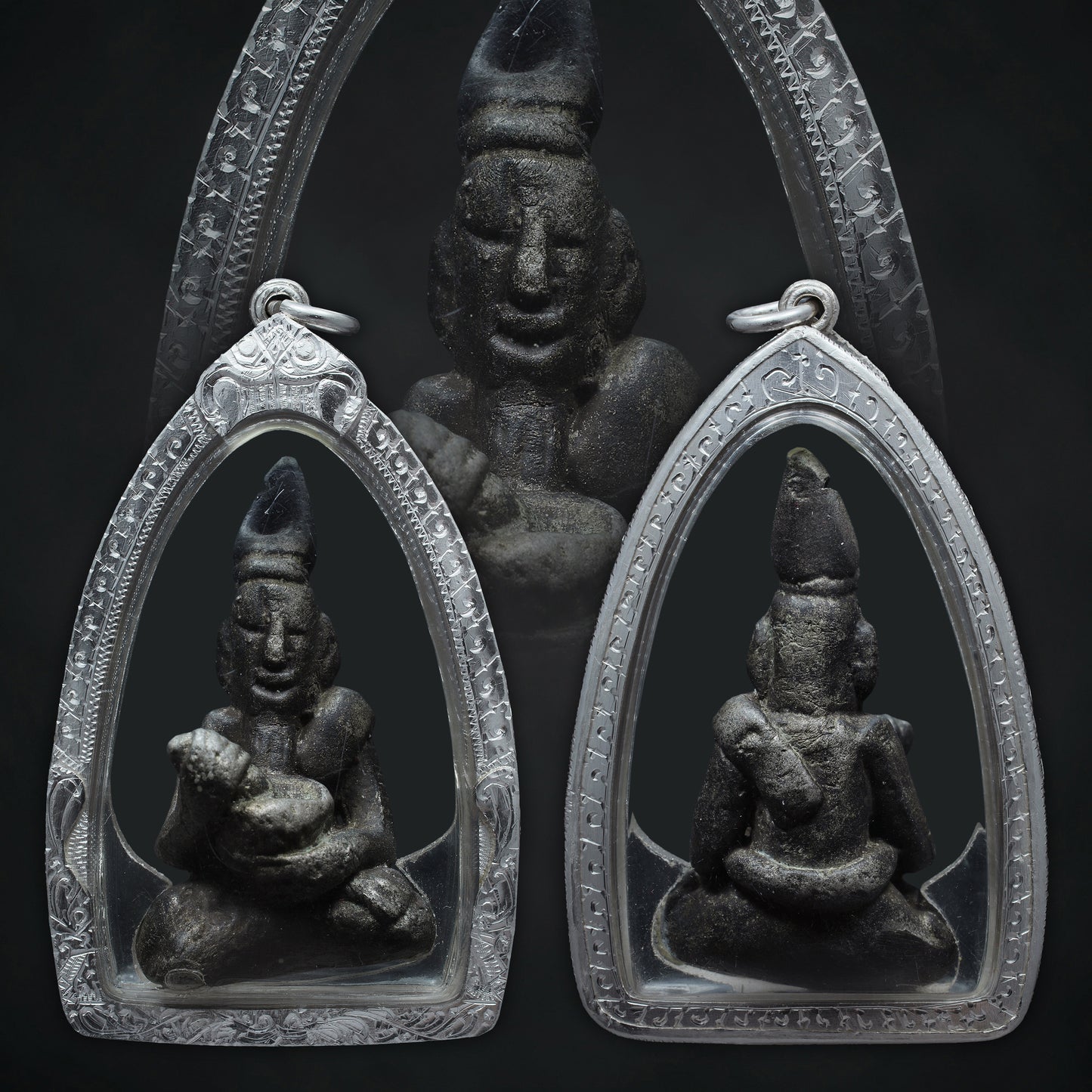
The chosen image shows the healer seated cross-legged, holding and working with the traditional mortar and pestle used for preparing medicinal ingredients.
This iconography is especially appropriate because traditional herbal medicine frequently involves grinding, pounding and combining plant materials before their preparation.
The artifact therefore brings together three elements:
the Khru, the healing wicha, and the tools of medicine.
Blessings and Effects
Lersi Chiwok is traditionally approached primarily for health and healing-related blessings.
Devotees associate his image with strength during recovery, protection of health, vitality and the patience required when healing takes time.
For those experiencing prolonged periods of physical or emotional strain, the Lersi may also serve as a focus for mental steadiness, hope and resilience alongside appropriate professional care.
Another important aspect concerns the healer rather than the patient.
For people studying or practising medicine, nursing, pharmacy, Thai traditional medicine, herbalism, massage, physiotherapy or caregiving, Lersi Chiwok represents respect for the teacher and responsibility towards those placed under one's care.
His broader traditional qualities include wisdom, compassion, careful judgement, knowledge of medicine and dedication to helping others.
Modern Application
Lersi Chiwok has an unusually clear place in modern life because his symbolism remains immediately relevant.
Someone recovering from illness may keep the image as a source of encouragement while following medical advice, taking prescribed treatment and allowing the body sufficient time to recover.
For healthcare students, the Lersi represents the discipline required to study thoroughly rather than search for shortcuts.
For working healthcare professionals and caregivers, he represents another lesson: technical ability alone is insufficient. A person who treats the sick must also possess patience, observation, kindness and ethical responsibility.
Traditional healers, herbalists and Thai massage practitioners may additionally recognise Lersi Chiwok as part of the wider Khru lineage behind their craft.
Physical Details
This is a three-dimensional image of Lersi Chiwok, cast from Por Sala Tan's mixture of old sacred metal alloys. The figure has a naturally dark aged surface, with subtle variations created by the different metals incorporated into the casting.
Lersi Chiwok is seated cross-legged with the characteristic tall hermit's headdress. Most importantly, he is depicted holding a mortar and pestle, immediately identifying the image with medicine, herbal preparation and the healing arts.
The reverse preserves the simple sculptural form of the seated Lersi rather than carrying an additional external composition.
Key points: old sacred metal alloy, temple and worship-place materials, old artifact metals from Burma and Laos, yantras written before melting, hand-prepared casting, and Lersi Chiwok depicted actively preparing medicine.
Recommended Pairing
Lersi Chiwok can be kept independently because his purpose is already very specific.
For someone studying a healing profession, pairing him with another Lersi or Khru artifact can emphasise learning, discipline and guidance from teachers.
For an elderly person or someone recovering from illness, a gentle Buddha or Metta-based artifact may complement the themes of calmness, encouragement and wellbeing.
The Lersi Chiwok itself, however, should remain the central piece when the primary intention concerns health, healing knowledge and recovery.
Personal Notes
What I find particularly meaningful about Por Sala Tan's Lersi Chiwok is the way the image was designed.
The Lersi is not sitting upon a throne displaying authority.
He is not surrounded by symbols of wealth.
He is working.
The mortar and pestle in his hands show a healer preparing what is needed for another person.
Even the construction follows this idea. Old sacred metals from different places were gathered, individually inscribed, melted together and transformed into something with a new purpose.
That gives this Lersi a simple but important message:
healing is not merely something we ask for. It is something that requires knowledge, proper treatment, patience, compassion and the willingness to keep working towards recovery.
-
Free Shipping for Singapore| $15 Worldwide | $60 USA For Items Below $350