
OOBThaiAmulets
Por Sala Tan
Por Sala Tan
Couldn't load pickup availability
PST05
Yant Phueng Maha Saneh
Por Sala Tan
Mainstream Artifact
7cm
Sacred Craftsmanship
Each plate was individually prepared and written by hand, so differences in line work, inscriptions, proportions and surface character are natural to every artifact.
Personal Experiences Shared by Luksits
One memorable account concerned a schoolboy who carried one of Por Sala Tan's attraction yantras.
After he began keeping it with him, his classmates seemed noticeably more drawn towards him. He described the experience almost as “bees coming to honey.”
Other students frequently approached him, included him in conversations and voluntarily offered small gestures of kindness. Every now and then, classmates would bring him food, small gifts or offer help without him having to ask.
What stood out was not simply romantic attention.
The broader change was that people appeared to enjoy being around him and were more willing to treat him favourably.
This reflects the combination of the different formulas within the plate: Maha Saneh for attraction, Metta for goodwill, and Maha Niyom for popularity and favourable reception.
Summary
This large hand-written lead plate is one of Por Sala Tan's dedicated Maha Saneh and Metta Mahaniyom yantras.
Its principal intentions are:
strong attraction · opposite charm · popularity · goodwill · social magnetism · favourable attention · customer attraction
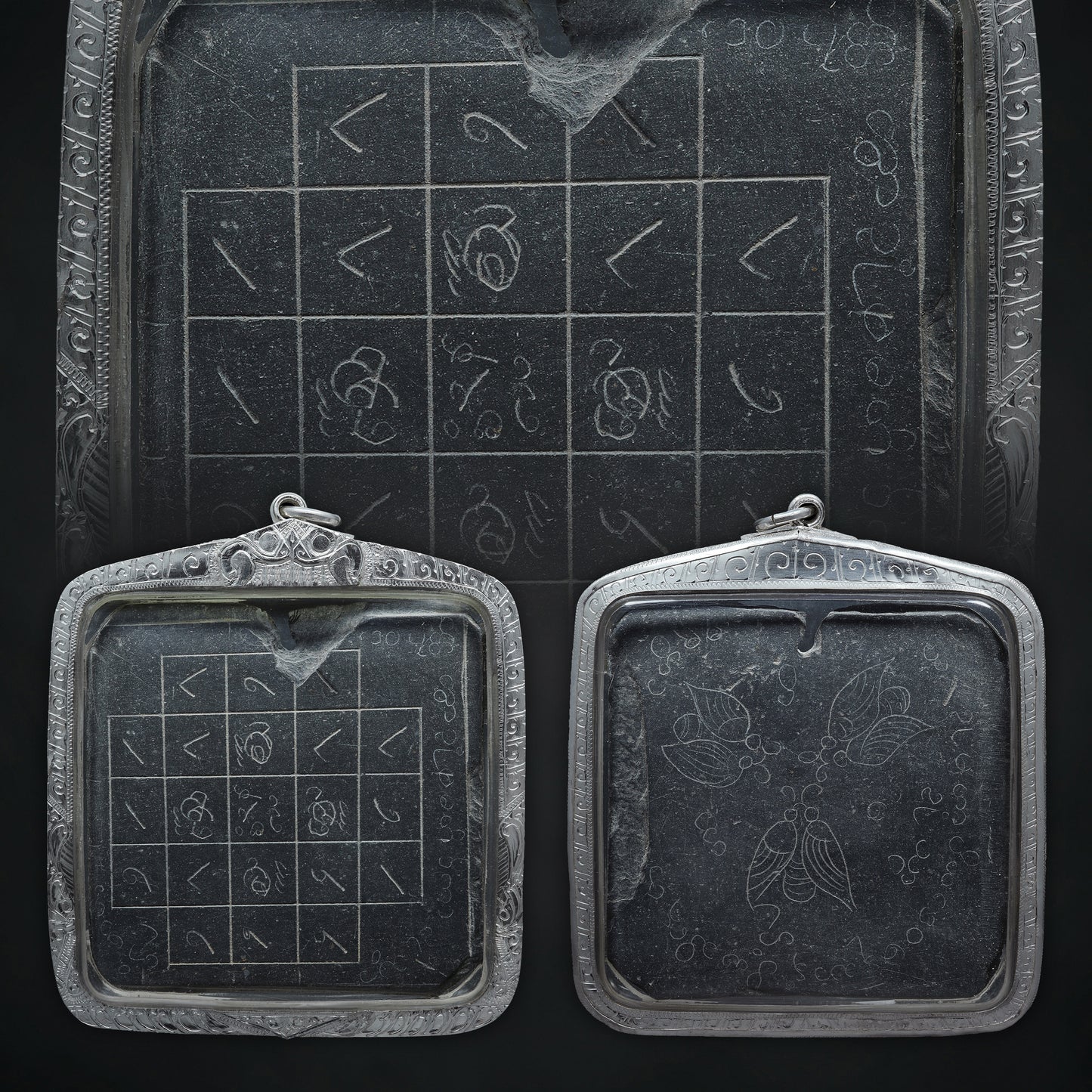
The most distinctive feature is the three-bee yantra on the reverse, a wicha Por Sala Tan learnt through exchanges of knowledge with another practitioner.
The symbolism is straightforward: just as bees naturally gather around sweetness and repeatedly return to their hive, the yantra represents people being naturally drawn towards the owner.
Historical Background
The bee is a particularly suitable symbol within traditional attraction and prosperity wicha.
A bee does not need to be forced towards honey. It approaches naturally.
For this reason, Phueng — the bee — can represent attraction without pursuit. Applied to Maha Saneh and Metta traditions, the symbolism concerns drawing attention, affection, goodwill and favourable human interaction.
The same image can extend into commerce.
Bees continuously leave the hive, gather resources and return with what they have collected. This gives bee symbolism a secondary connection with Maha Lap, customers, trade, income and opportunities returning repeatedly.
In an attraction yantra such as this, however, Por Sala Tan's principal emphasis was upon Maha Saneh, opposite attraction and popularity.
Origins of the Materials
The foundation of this artifact is its old lead.
Rather than using newly manufactured lead solely for convenience, Por Sala Tan accumulated older lead materials donated or collected for sacred-object making.
These included materials associated with temples and places of worship, together with other old objects considered suitable for ritual reuse.
An important part of the preparation occurred even before the final plate existed.
Por Sala Tan first wrote selected sacred formulas onto pieces of the old lead. These inscribed materials were then melted together, allowing them to become part of the metal used for the new sheet.
The finished lead was subsequently formed into a plate and prepared for another complete set of hand-written yantras.
The result therefore contains two stages of inscription: yantras incorporated into the lead before melting, followed by the visible yantras written upon the completed plate.
Ritual
Once the lead sheet had been prepared, Por Sala Tan personally constructed the yantra according to its intended purpose.
The front uses a grid arrangement containing individual characters and sacred symbols, surrounded by further inscriptions.
The reverse carries a very different composition.
Three bees dominate the centre, surrounded by additional sacred writing. This three-bee formula came from knowledge Por Sala Tan acquired through exchanges with another practitioner and was specifically incorporated into his attraction work.
The combination was directed towards Maha Saneh, Metta Mahaniyom and opposite attraction, rather than protection or aggressive forms of wicha.
The larger surface of this particular plate also allowed a more extensive composition than would normally be possible on Por Sala Tan's smaller lead yantras.
Blessings and Effects
The principal traditional purpose is Maha Saneh — strong personal attraction.
Closely connected is Metta Mahaniyom, encouraging others to respond with friendliness, goodwill and willingness to assist.
The plate is therefore traditionally associated with opposite attraction, popularity, social acceptance, persuasive presence and being remembered favourably by others.
The bee formula extends these qualities towards business. In this context, the same “bees to honey” symbolism can represent customers being attracted towards a shop or service, returning clients, increased attention towards one's products and opportunities being drawn towards the owner.
Its purpose is not simply romantic.
At its broadest, the yantra concerns drawing people closer and improving how they respond once they arrive.
Modern Application
This type of yantra naturally suits people whose success depends upon interaction with others.
Those working in sales, customer service, business, entertainment, networking, negotiation or other public-facing roles may relate particularly strongly to its traditional symbolism.
For personal use, its emphasis is upon being approachable, memorable and favourably received.
For business, the bee symbolism takes on another meaning: attracting attention and encouraging people to return, much as bees repeatedly return to a productive hive.
The schoolboy's experience provides a simple example. The most noticeable result was not one dramatic event, but a repeated pattern of people voluntarily approaching, sharing and helping.
Physical Details
This is a relatively large rectangular old lead yantra plate, completely hand-inscribed on both sides by Por Sala Tan.
The front displays a carefully divided sacred grid containing numerous individual characters and symbols, with additional inscriptions running around its perimeter. The reverse carries the visually distinctive three-bee yantra, surrounded by further hand-written sacred characters.
The darkened lead surface and fine hand-scribed lines retain the direct working character of Por Sala Tan's individually produced ritual pieces.
Key points: old recycled sacred lead, pre-melting yantra inscriptions, hand-written front and reverse, large yantra grid, three-bee formula, Maha Saneh, Metta Mahaniyom, popularity and opposite attraction.
Recommended Pairing
This plate can be used independently because its formula is already highly focused.
For business purposes, it may be paired with a wealth or customer-calling artifact, combining personal attraction with commercial opportunity.
For those primarily interested in relationships and social interaction, pairing with a dedicated Metta artifact can complement the stronger Maha Saneh character with warmth and harmonious communication.
Personal Notes
What makes this piece particularly interesting is that its attraction symbolism appears in both its construction and its imagery.
The old lead carries sacred inscriptions incorporated before the metal was melted. Por Sala Tan then wrote an entirely new set of formulas over the finished plate.
Finally, on the reverse, he placed the clearest visual expression of its purpose:
three bees.
The schoolboy's account describes the symbolism almost perfectly. People began approaching him, bringing food, offering small gifts and helping him voluntarily.
It is the traditional principle of the bee yantra in its simplest form:
do not chase every bee — make the honey worth coming to.
-
Free Shipping for Singapore| $15 Worldwide | $100 USA All products