
OOBThaiAmulets
Por Sala Tan
Por Sala Tan
Couldn't load pickup availability
PST05
Phaya Naga Nak-Rop (Naga Warrior)
Por Sala Tan
Barang Artifact
3 inches
Sacred Craftsmanship
Each artifact was individually carved and assembled by hand from naturally irregular sacred materials. Differences in the Paneang, surface, wax, inscriptions and ritual components therefore make every surviving piece unique.
Personal Experiences Shared by Luksits
Among luksits who have kept Por Sala Tan’s Naga-related artifacts, a recurring theme is clarity during uncertain situations.
Some speak of suddenly becoming more cautious before making an important decision. Others describe noticing opportunities they might previously have overlooked, particularly in work, business and dealings involving money.
Another commonly mentioned quality is courage. Rather than feeling reckless or aggressive, owners describe becoming more composed when confronted with pressure. They feel better able to assess a situation, make their decision and move forward.
Naga artifacts are also traditionally associated by devotees with protection and guardianship. Some owners describe becoming more alert to people or circumstances that do not feel right, allowing them to reconsider before committing themselves.
For this reason, the Phaya Naga Nak-Rop is remembered less as an artifact of aggression and more as one concerned with awareness, courage, sound judgement and protection.
Summary
The Phaya Naga Nak-Rop is one of Por Sala Tan’s individually carved Paneang artifacts, depicting a powerful Naga warrior or Naga King.
Its character combines two complementary qualities: the wisdom and prosperity symbolism of the Naga, together with the courage and readiness represented by the warrior.
The reverse brings together several of Por Sala Tan’s traditional materials: cemetery soil, sacred herbs, takruts and corpse rope. Burmese red wax was also incorporated into the preparation.
The resulting artifact was intended around the themes of protection, courage, stability, wise decisions, opportunity and prosperity.
Historical Background
Naga traditions extend far beyond Thailand and developed across India and mainland Southeast Asia over many centuries.
Within Thai Buddhist culture, Nagas are powerful semi-divine serpent beings associated particularly with water, rainfall, fertility, treasure, prosperity and guardianship. Their imagery appears extensively in temples, particularly along stairways and entrances where the Naga assumes the role of protector between ordinary and sacred space.
One of the best-known Buddhist traditions concerns Phaya Muchalinda, the Naga King who sheltered the Buddha from a storm following his enlightenment. This protective symbolism became the familiar Nak Prok image of the Buddha sheltered beneath the Naga’s hood.
The Naga King therefore carries an important meaning beyond wealth or fortune: strength placed in the service of protection.
The warrior interpretation develops naturally from this idea.
A true guardian must possess strength, but must also know when that strength should be used and when restraint is wiser.
Origins of the Materials
The Paneang used for this artifact came from materials recovered during an unusual episode in Por Sala Tan’s work.
He had been asked to assist at an abandoned village in a mountainous region nearer to Burma. Severe monsoon flooding had submerged villages and rice fields, leaving parts of the area unsuitable for habitation.
The surviving villagers eventually relocated to safer ground, but remained concerned about old graves that had been damaged by prolonged rain and flooding.
Por Sala Tan travelled to the area and performed the necessary rites around the disturbed graves. After communicating spiritually and completing the ceremonies, he collected a limited amount of material that he considered suitable for later sacred work.
These materials subsequently became the foundation for several different artifacts.
For this particular piece, the Paneang was selected because Por Sala Tan felt an especially strong character within it—one that he considered appropriate for the form of a Naga warrior and guardian.
Ritual
After carving the Phaya Naga Nak-Rop, Por Sala Tan prepared the artifact using materials selected to complement its protective and prosperous character.
The reverse incorporates cemetery soil and sacred herbs, together with several takruts carrying supplementary formulas.
Most visually distinctive is the old corpse rope. Within regional folk practices, such cord is regarded as a liminal ritual material because of its association with funeral rites and the boundary between life and death.
Symbolically, rope represents binding, holding and securing. Within an artifact, this symbolism may be interpreted as holding fortune, strengthening protection, maintaining stability or restraining unwanted influences.
The Burmese red wax used in the preparation is a material encountered in older Northern and Shan-influenced traditions and is traditionally associated with fortune, influence, authority and personal standing.
Blessings and Effects
The Phaya Naga Nak-Rop brings together the qualities traditionally attributed to the Naga with the protective character of the warrior.
Its principal traditional associations include:
- Protection and guardianship
- Courage under pressure
- Clear judgement and wise decisions
- Awareness of approaching opportunities
- Stability during uncertain periods
- Barami, authority and personal presence
- Prosperity and protection of livelihood
- Strength to overcome obstacles
The warrior aspect should not be interpreted simply as aggression. Its deeper meaning is controlled strength—the ability to remain calm, defend what matters and act decisively only when necessary.
Modern Application
For a modern owner, the Phaya Naga Nak-Rop is particularly suited to situations requiring judgement, courage and responsibility.
Business owners may relate to its symbolism of recognising opportunities while protecting existing resources. Those working in competitive environments may appreciate its association with composure and authority.
It may likewise appeal to people facing an important career decision, negotiation, investment or major change in life.
The lesson of the Naga warrior is straightforward: remain watchful, protect what has been entrusted to you, and do not confuse strength with unnecessary aggression.
Physical Details
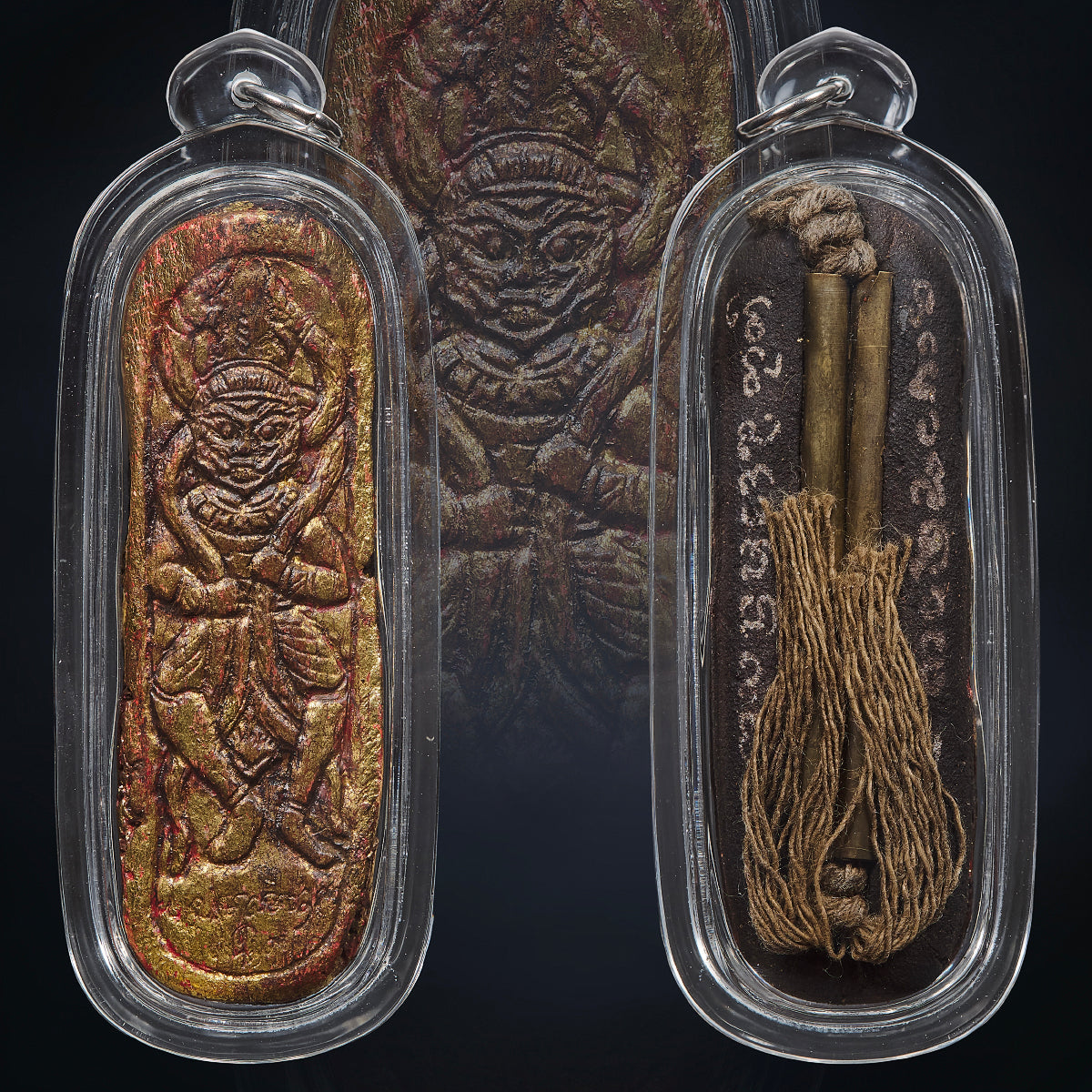
The front depicts Phaya Naga Nak-Rop, carved directly into an old Paneang relic as a powerful warrior or Naga King. The carving was subsequently treated with Burmese red wax and finished with gold, giving the figure an aged ceremonial appearance.
The reverse is packed with cemetery soil and sacred herbs, upon which multiple takruts have been positioned. A substantial length of old corpse rope is bound through the centre, forming one of the dominant ritual components of the piece.
The entire artifact is protected within a clear pendant casing suitable for wearing.
Recommended Pairing
Phaya Naga Nak-Rop may be paired with Phra Rahu when the intention concerns overcoming difficult periods, changing unfavourable circumstances and recognising new opportunities.
It can also be paired with Tao Wessuwan for a stronger emphasis on guardianship, authority and protection, or with Lersi imagery when wisdom, disciplined judgement and guidance are the greater priorities.
As a standalone artifact, however, the Naga warrior already represents a particularly balanced combination of wisdom, courage, protection and prosperity.
-
Free Shipping for Singapore| $15 Worldwide | $60 USA For Items Below $350