
OOBThaiAmulets
Por Sala Tan
Por Sala Tan
Couldn't load pickup availability
PST05
Twin Gaduk Prai
Por Sala Tan
Barang Artifact
Sacred Craftsmanship
Each Twin Gaduk Prai was individually carved and assembled by hand from recovered relics and ritual materials. Differences in the Paneang, fragments, inscriptions, gold application and arrangement of the takruts make every surviving example distinct.
Personal Experiences Shared by Luksits
Among Por Sala Tan's Jinn artifacts, the Twin Gaduk Prai is regarded by his older luksits as an especially difficult piece to encounter.
The reason is simple: very few were created.
Those who obtained unusual Jinn pieces directly from Por Sala Tan often kept them rather than circulating them amongst collectors. His Jinn artifacts have long been spoken of amongst luksits as spiritual companions intended to assist their keeper in constructive matters while gaining merit through that assistance.
The Twin Gaduk Prai is particularly memorable because the presence encountered by Por Sala Tan was not a single Jinn, but two spirits appearing together.
For collectors familiar with Por Sala Tan's older work, this gives the artifact an unusual character. It is not simply a double image made for visual symbolism; according to its origin account, the twin form records the two presences Por Sala Tan encountered during the grave-cleansing rites.
Pieces of this type seldom appear on the secondary market. Older owners who recognise their background tend to hold onto them closely, making intact examples increasingly difficult to encounter.
Summary
The Twin Gaduk Prai originated from Por Sala Tan's work at an abandoned village in a mountainous region close to Burma.
Severe monsoon flooding had submerged villages and rice fields, leaving the area unsafe for habitation. The villagers eventually relocated to safer ground, but remained concerned about old graves that had been damaged by prolonged rainfall and flooding.
Por Sala Tan was asked to conduct the necessary rites at the disturbed burial area.
During this work, he encountered what he understood to be two Jinn spirits watching him from the vicinity of an old damaged hut.
Rather than regarding them as hostile, Por Sala Tan approached and communicated with them. He came to understand that the twins had occupied the area long before the later village settlement existed.
They were not seeking to harm anyone.
They were simply without a home.
This encounter became the origin of the Twin Gaduk Prai.
Historical Background
Twin spiritual figures carry an interesting place within regional folk belief.
Two beings represented together may symbolise companionship, mutual support, balance and combined assistance. Within Por Sala Tan's work, however, the twin imagery has a more specific origin: it represents the two presences he said he personally encountered during the cleansing ceremony.
The term Gaduk Prai reflects the artifact's connection with death-associated sacred materials and the spiritual environment from which they were recovered.
Such objects belong to the Barang side of regional folk practice rather than conventional mainstream Buddhist amulet production.
The purpose, as understood within Por Sala Tan's lineage, is not simply to possess a spirit. The relationship is reciprocal: the spiritual presence is provided with a suitable vessel and opportunities to perform beneficial actions, while the keeper dedicates merit and maintains respectful conduct.
Origins of the Materials
The materials came from an abandoned mountain village near the Burma border.
After severe monsoon flooding devastated the settlement and surrounding rice fields, the villagers moved elsewhere. Years of rainfall and ground movement had also disturbed burial areas, creating concern amongst the former inhabitants.
Por Sala Tan was invited to perform ceremonies at the damaged graves.
Only after communicating with the spiritual presences associated with the area did he collect selected materials for sacred work.
These included Paneang relics, Paneang fragments and cemetery soil.
During the ceremony, Por Sala Tan noticed two figures watching from a distance near a damaged hut.
He calmly approached them.
Through communication, he understood them to be twin Jinn who had remained within the area for decades, predating the village itself.
With the human settlement abandoned, the twins remained behind.
Por Sala Tan therefore proposed another path: that their presence could be invited into suitable artifacts, giving them a spiritual home while allowing them to assist people and accumulate merit through beneficial actions.
Ritual
After collecting the appropriate materials, Por Sala Tan carved the twins directly onto a selected Paneang relic.
The carved surface was treated with red lacquer mixed with Burmese red wax, followed by gold application. Sacred writing was added over and around the twin figures.
The reverse formed the principal ritual chamber.
Por Sala Tan prepared a base of cemetery soil and Nam Man Prai, reconnecting the artifact symbolically with the environment from which its materials originated.
Fragments of the original Paneang were then placed into this base.
Multiple takruts were installed to reinforce the intended qualities of the artifact and stabilise its spiritual composition.
The twin presence was then ritually invited and established within the completed artifact, with the intention that the two Jinn would have a vessel through which they could accompany and assist a respectful keeper.
Blessings and Effects
Within Por Sala Tan's tradition, Jinn artifacts are generally associated with assistance, opportunity, protection, intuition and the movement of circumstances in beneficial directions.
The Twin Gaduk Prai carries an additional idea of two forces working together.
Its traditional purposes may therefore be understood around:
- Metta and favourable human relationships
- Opportunity and movement of fortune
- Assistance in work and business
- Protection and heightened awareness
- Guidance when circumstances are unclear
- Drawing helpful people and circumstances
- Support in overcoming obstacles
- Spiritual companionship
The Burmese red wax reinforces the traditional themes of fortune, influence and personal standing, while the takruts strengthen the individual formulas placed into the artifact by Por Sala Tan.
The twins themselves remain the centre of the piece.
Their role is traditionally understood as helping rather than frightening.
Modern Application
The Twin Gaduk Prai is particularly suited to someone who appreciates Por Sala Tan's Jinn lineage and understands the reciprocal nature of such an artifact.
For business owners, traders and those working with people, its traditional Metta and opportunity aspects may be applied towards better relationships, helpful connections, customer movement and smoother circumstances.
For everyday wear, it may also be approached as an artifact for companionship, awareness and protection.
More importantly, Por Sala Tan's original intention should remain central: assistance should be directed towards good purposes.
The twins were given a vessel so that their continued presence could become connected with beneficial actions and merit.
Physical Details
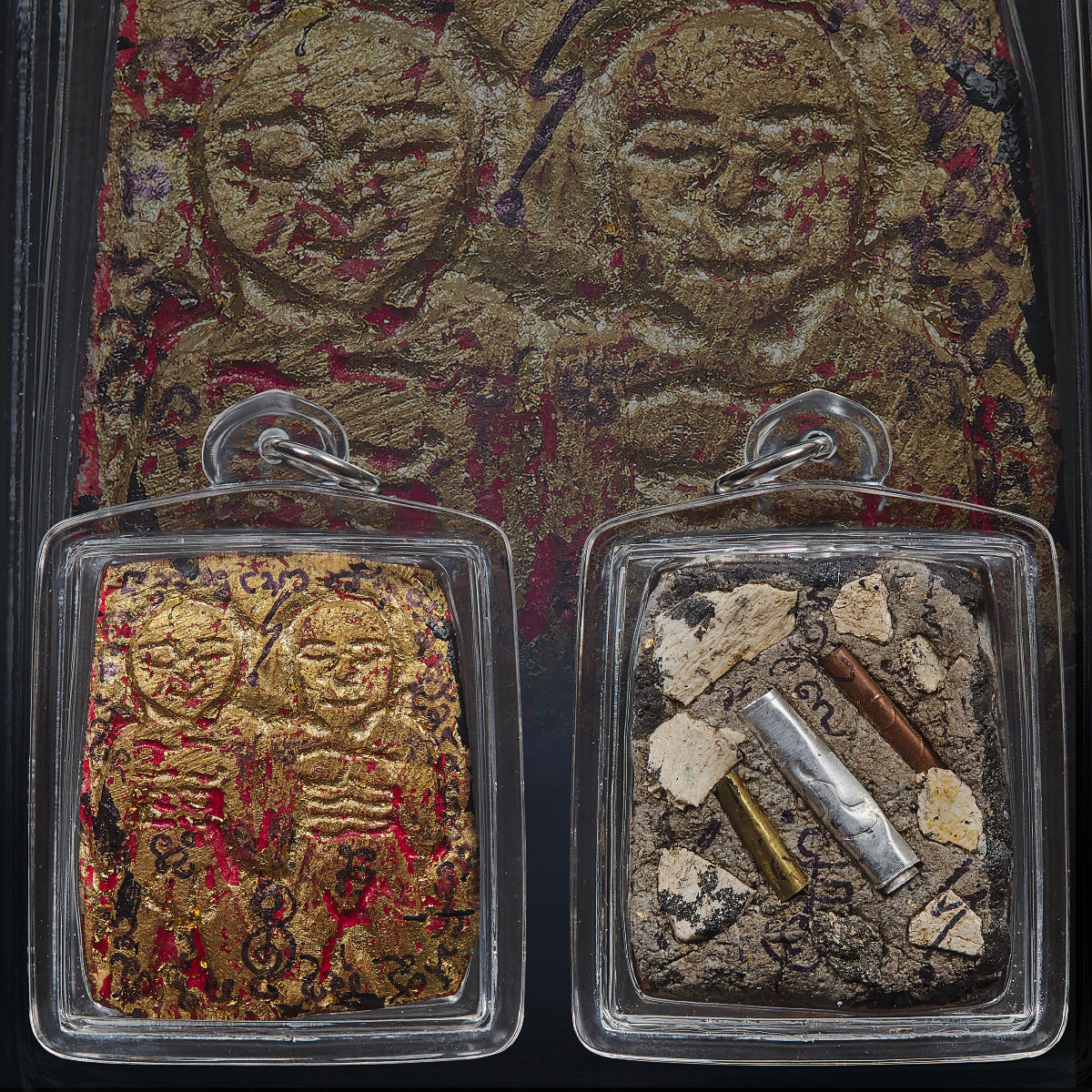
The artifact has a rectangular form with the two spirits carved side by side upon Paneang.
The front is finished with red lacquer mixed with Burmese red wax and gold, producing the characteristic aged red-and-gold appearance associated with a number of Por Sala Tan's Barang works. Handwritten sacred inscriptions remain visible across the figures and surrounding field.
The reverse is densely filled with cemetery soil mixed with Nam Man Prai. Several pale Paneang fragments remain exposed across the surface, together with three visible takruts of different metals and sacred inscriptions beneath the materials.
The contrast between the two sides is particularly striking: the front preserves the identity of the twins, while the reverse preserves the materials and ritual construction supporting them.
Recommended Pairing
Because this is already a spiritually complex Jinn artifact, it can be worn independently.
For business or social purposes, it may be paired with a Metta or wealth artifact to place greater emphasis on customer relations, opportunities and financial movement.
For protection, pairing with Tao Wessuwan, Rahu or a Lersi artifact may provide a more traditional guardian emphasis.
Those who prefer Por Sala Tan's Barang work as originally constructed may simply keep the Twin Gaduk Prai alone.
Personal Notes
What makes this artifact especially interesting is the story behind the twins.
Por Sala Tan did not describe encountering them aggressively guarding the graves or attempting to frighten those performing the ceremony.
He saw them watching quietly from a damaged hut.
When he approached and communicated with them, he understood that they had been connected with the land long before the village was established. Then the people arrived, generations passed, floods destroyed the settlement, and eventually everyone left.
The twins remained.
Their request was remarkably simple in Por Sala Tan's account:
they wanted a home.
Por Sala Tan therefore created a limited number of artifacts through which the twins could continue their existence in another form — accompanying people, assisting with beneficial matters and receiving merit through the good actions performed around them.
This background also explains why older luksits regard the Twin Gaduk Prai differently from an ordinary double-figure carving.
It represents two old presences from an abandoned place, given a new vessel and a new purpose.
Very few were made, and even fewer appear outside established collections today.
-
Free Shipping for Singapore| $15 Worldwide | $60 USA For Items Below $350