
OOBThaiAmulets
Por Sala Tan
Por Sala Tan
Couldn't load pickup availability
PST05
Lersi Ser Ming Pai
Por Sala Tan
Barang Artifact
3 inches
Sacred Craftsmanship
Each artifact was individually carved and assembled from carefully prepared sacred materials. Natural variations in the relic, carving, cloth, gems, takruts and ritual ingredients make every piece unique.
Personal Experiences Shared by Luksits
The most important aspect of this piece is the Lersi presence that Por Sala Tan believed led him to the sacred materials in the first place.
This was shared to me by a luksit of Por Sala Tan who live secluded in the mountains.
While travelling through the North, Por Sala Tan came across a cave carrying what he described as an unusually powerful presence. Rather than immediately entering to search for materials, he sat in meditation and attempted to communicate with whatever remained within the cave.
During this meditation, the presence gradually became clearer.
Por Sala Tan understood it to be connected with a Lersi who had been a strong practitioner of Ser Ming Pai wicha.
What remained particularly vivid in his memory was the Lersi's posture.
He appeared seated with two tigers beside him.
The Lersi presence subsequently guided Por Sala Tan towards a collection of old relics and sacred materials hidden within the cave. Among them, one particular relic felt considerably stronger than the others.
Por Sala Tan reserved that piece for the main image.
When the carving was completed, he reproduced the form as closely as he remembered it: the Lersi seated in command, accompanied by two tigers.
For Por Sala Tan, this was important because the artifact was not designed from imagination. Its form came from the presence that had led him to the materials.
Summary
The Lersi Ser Ming Pai is one of Por Sala Tan's more complex Lersi artifacts, combining Khru lineage, tiger symbolism, cave relics and Barang ritual materials.
Its origin lies in a northern cave where Por Sala Tan encountered a powerful Lersi presence during meditation. According to his account, this Lersi had practised Ser Ming Pai wicha and guided him towards a group of sacred relics and materials.
The strongest relic was selected for the principal carving.
The reverse was then constructed with three additional Lersi images, takruts, blessed red gems, relics, sacred cloth, herbs and ritual inscriptions, with Nam Man Prai and Sai Sin incorporated into the lower section.
The finished piece is centred upon authority, protection, courage, Baramee, command, knowledge and the disciplined strength represented by the tiger lineage.
Historical Background
Lersi Ser Ming Pai belongs to the broader Lersi tradition in which the hermit represents the Khru — the teacher and holder of sacred knowledge.
The tiger adds another dimension.
Within Thai and regional sacred traditions, the tiger represents strength, authority, fearlessness, territorial command and protection. A Lersi accompanied by tigers therefore expresses not uncontrolled aggression, but knowledge combined with the ability to command powerful forces.
The image of the teacher seated calmly between two tigers is particularly meaningful.
The Lersi does not need to fight the animals.
They remain beside him.
Symbolically, this represents power already brought under discipline.
For practitioners, Lersi Ser Ming Pai therefore carries a strong association with mastery: first master oneself, then one becomes capable of directing greater forces.
Origins of the Materials
Por Sala Tan encountered the relics while travelling through the North for meditation and the collection of sacred materials.
Inside the cave, he sensed an unfamiliar but powerful presence and entered meditation to understand it.
Through this communication, he felt guided towards several old relics and sacred components associated with the Lersi practitioner.
Some of the relics were still accompanied by old cloth that had been used to wrap them when they were found. Rather than discarding this material, Por Sala Tan preserved pieces and incorporated them into the finished artifact because of their direct connection with the discovery.
The red gems have a different origin.
Por Sala Tan collected these from a riverbank near Burma during one of his expeditions. He selected such stones only from locations he regarded as prosperous and ritually suitable. The gems were subsequently blessed before being used in his artifacts.
The piece therefore combines materials from two environments important to Por Sala Tan's practice: the secluded northern cave and the river regions near Burma.
Ritual
After completing the main carving, Por Sala Tan did something particularly significant.
He returned with the artifact to the cave where the relic had originally been discovered.
The consecration was performed there on a lunar eclipse day.
Within the ritual understanding followed by Por Sala Tan, eclipses were regarded as unusual periods in which certain rites concerning powerful spiritual forces, guardians and territorial presences could be concentrated.
Returning the carving to its original cave also restored the relic to the environment from which it had emerged.
The Lersi image was consecrated there before being completed with its supporting materials.
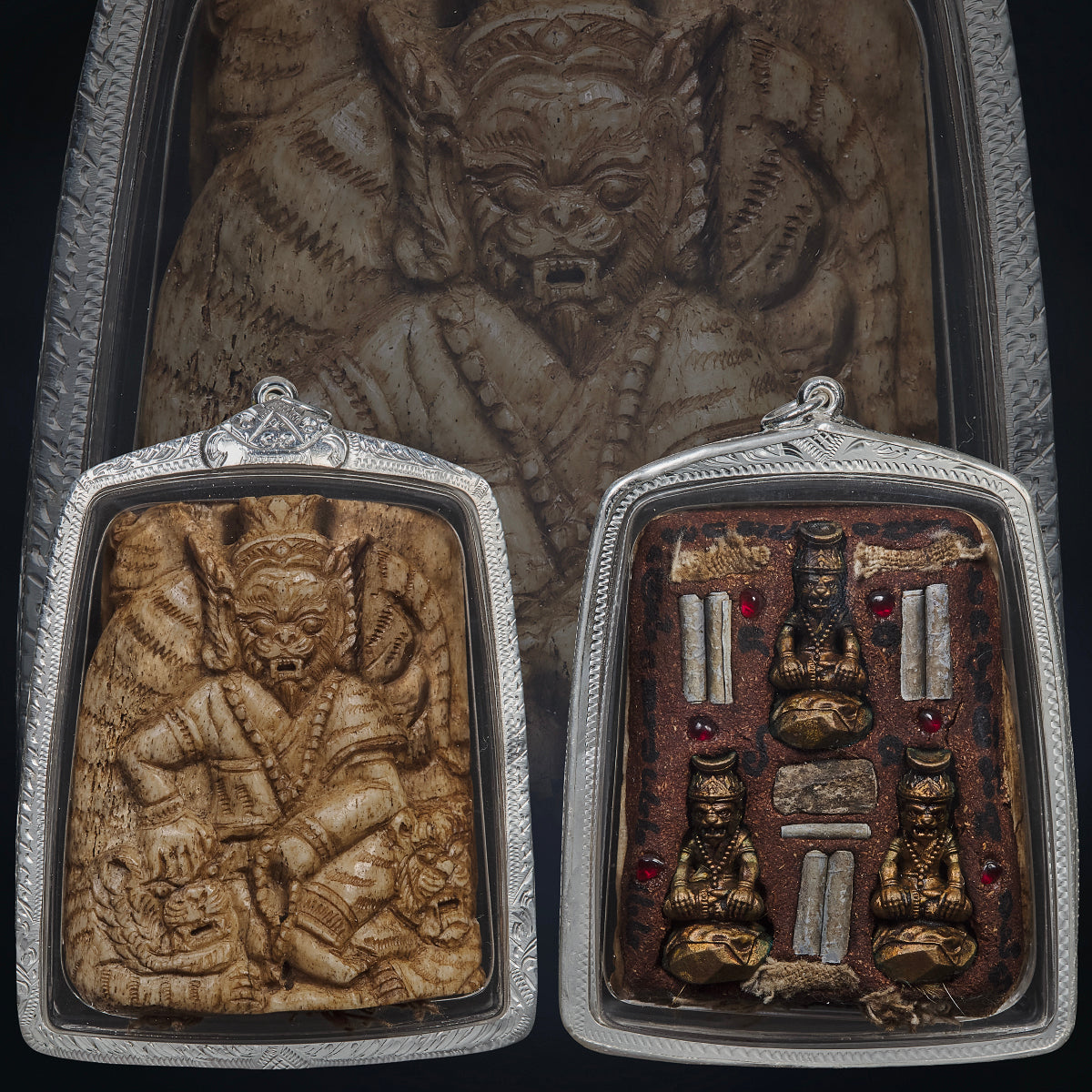
On the reverse, Por Sala Tan installed three smaller Lersi Ser Ming Pai images, surrounded by takruts and blessed red gems. Relic fragments, herbs and sections of the original cloth were incorporated into the ritual base.
The lower portion was further prepared with Nam Man Prai and Sai Sin.
Together, these elements were intended to establish a strong connection between the Lersi, his wicha, the cave relics and the finished artifact.
Blessings and Effects
The principal qualities of Lersi Ser Ming Pai are traditionally associated with authority, protection, courage and mastery through knowledge.
The Lersi element represents wisdom, discipline, guidance and the preservation of wicha.
The tiger element contributes command, confidence, fearlessness and the ability to stand one's ground.
Together, they create an artifact particularly suited to those who must deal with competition, difficult personalities or environments where a strong personal presence is necessary.
Its traditional qualities include Baramee, authority, leadership, protection, stronger judgment, courage, respect and assistance in overcoming obstacles.
The blessed red gems and supporting materials introduce additional associations with prosperity and opportunity, while the Barang components strengthen the artifact's more forceful protective character.
At its centre, however, this remains a Khru artifact.
Its power is represented by the teacher who can sit calmly while two tigers remain under his command.
Modern Application
The Lersi Ser Ming Pai is particularly appropriate for business owners, managers, teachers, practitioners and those in positions where others depend upon their decisions.
It may also suit people entering competitive environments where confidence must be balanced with patience.
The tiger principle encourages courage, but the Lersi principle determines when that courage should be used.
For practitioners of wicha, the piece carries additional significance because its origin is directly connected with a Lersi practitioner and the preservation of his sacred materials.
For everyday wear, its symbolism can be applied simply: remain composed, observe carefully and do not surrender authority through unnecessary fear or anger.
Physical Details
The front is carved from the strongest relic selected by Por Sala Tan from the materials discovered within the northern cave. It depicts Lersi Ser Ming Pai seated with two tigers beside him, following the form Por Sala Tan remembered from his meditation encounter.
The reverse forms a densely constructed ritual chamber. Three small Lersi Ser Ming Pai images are arranged among multiple takruts and blessed red gems, with sacred relic fragments positioned through the centre. Pieces of the old cloth associated with the recovered relics remain visible at the upper and lower portions, while herbs and ritual inscriptions form part of the underlying base.
The bottom was additionally prepared with Nam Man Prai and Sai Sin.
Key points: old Lersi relic, Lersi with two tigers, three supporting Lersi images, takruts, blessed red riverbank gems, relic fragments, sacred cloth, herbs, Nam Man Prai, Sai Sin and cave consecration during a lunar eclipse.
The exposed materials and individual carving give the artifact the unmistakably handmade character of Por Sala Tan's older Barang work.
Recommended Pairing
The Lersi Ser Ming Pai is already a heavily constructed artifact and does not require another piece to complete its traditional purpose.
For stronger professional or business use, it may be paired with a Metta or wealth artifact, combining the Lersi's authority with smoother relationships and financial movement.
For practitioners, pairing it with another Lersi or Khru-lineage artifact can emphasise learning, meditation and preservation of wicha.
Those seeking primarily protective qualities may wear it independently, allowing the Lersi and tiger symbolism to remain the dominant focus.
Personal Notes
Among all the materials used in this piece, the most important is not necessarily the rarest gem, the takruts or even the strongest relic.
It is the image itself.
Por Sala Tan remembered the Lersi presence seated with two tigers beside him.
That same presence led him towards relics that would later be used to create artifacts intended to help others. When Por Sala Tan selected the strongest piece and carved it, he reproduced what he had seen rather than choosing a conventional Lersi design.
He then returned the finished carving to the same cave and consecrated it there during a lunar eclipse.
This completes the circle of the artifact:
the Lersi led him to the relic; the relic became the Lersi; and the finished Lersi returned to the cave from which the material had come.
The two tigers beside him carry the final lesson.
They represent tremendous strength, yet they sit quietly beside the teacher.
For Lersi Ser Ming Pai, that is the nature of true authority:
the greatest power is not the power that constantly needs to show itself, but the power that has already been brought under control.
-
Free Shipping for Singapore| $15 Worldwide | $60 USA For Items Below $350