
OOBThaiAmulets
Por Sala Tan
Por Sala Tan
Couldn't load pickup availability
PST05
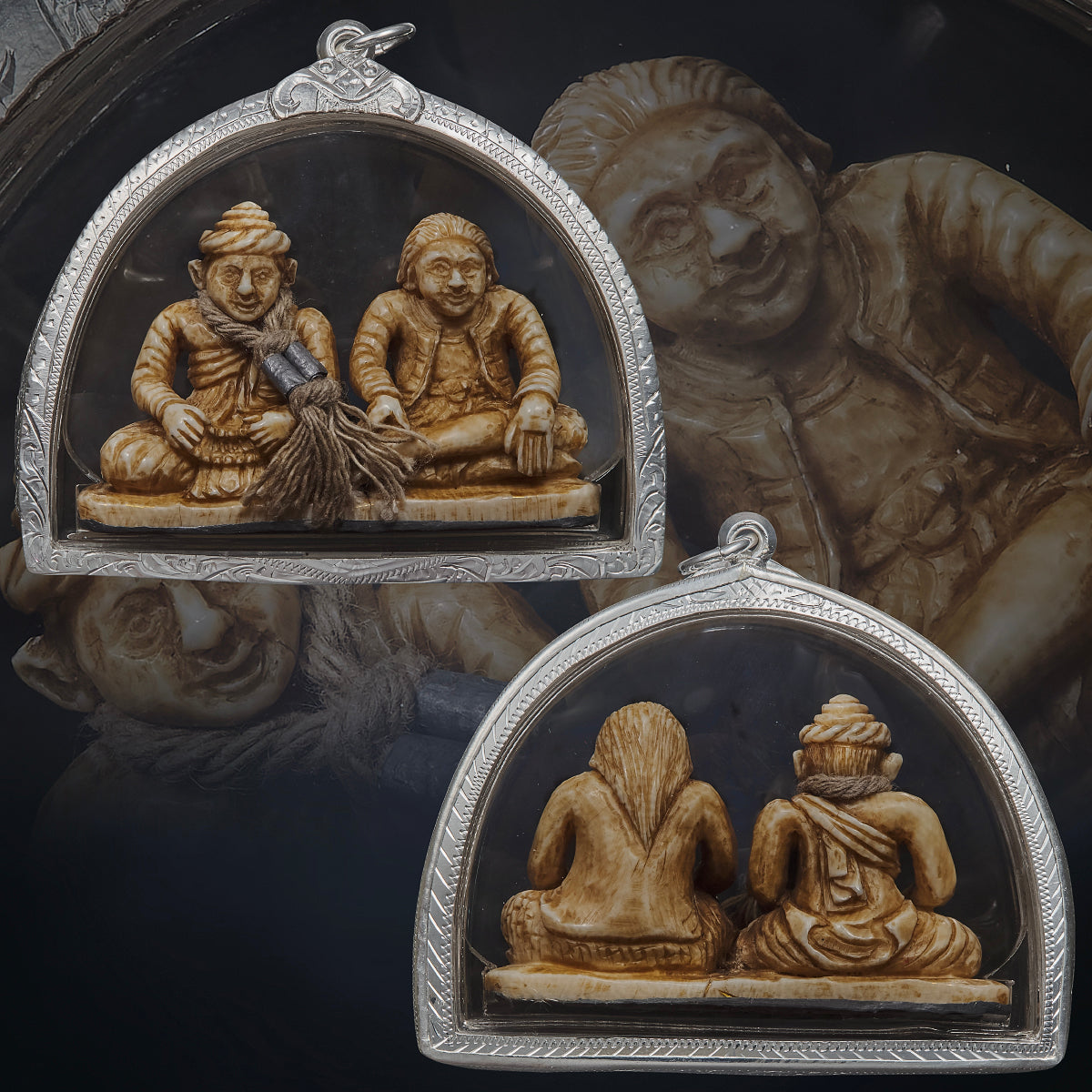
Bobo Aung & Bo Min Gaung
Por Sala Tan
Barang Artifact
2.5 inches width
Sacred Craftsmanship
Each artifact was individually carved and spiritually prepared by hand. Natural variations in the old relic, carving, inscriptions, bindings and surface patina are part of its character and make every piece unique.
Personal Experiences Shared by Luksits
The importance of this piece lies as much in how Por Sala Tan received the material as in the finished carving.
During his time around Mount Popa, he was not simply collecting materials. He was spending time in meditation, searching for sacred herbs and meeting practitioners whose traditions were rooted in the region.
One such encounter was with a Burmese Weizza practitioner.
Although their backgrounds were different, they were able to exchange knowledge and discuss their respective wicha. From this encounter, Por Sala Tan gained further understanding of the Burmese Weizza lineage and the importance attached to its principal teachers.
The old relic material was subsequently entrusted to Por Sala Tan.
When he later created the paired image, he did not rely only upon the carving. The Sai Sin and takrut belonging to the Burmese Weizza were physically tied to Bobo Aung, creating a direct material link back to the practitioner from whom the knowledge had been shared.
For luksits, this gives the artifact a particularly strong Khru and lineage character. It is approached less as a simple wealth charm and more as a piece connected with teachers, knowledge, meditation, protection and the continuation of wicha.
Summary
This paired Bobo Aung and Bo Min Gaung artifact represents Por Sala Tan's encounter with Burmese Weizza tradition during his travels at Mount Popa.
Carved from an old relic received during that journey, the piece brings together two revered figures associated in Burmese devotional tradition with spiritual knowledge, perseverance, protection, meditation and service to the Buddha's teachings.
The construction is especially significant because it incorporates a yantra-inscribed sheet beneath the carving together with Sai Sin and a takrut belonging to the Burmese Weizza practitioner whom Por Sala Tan met.
The piece can therefore be understood as a teacher-and-lineage artifact — one preserving not only sacred imagery, but also the physical connection created through an exchange of knowledge between practitioners.
Historical Background
Mount Popa occupies an important place within Burmese religious and folk tradition. The mountain and surrounding region have long been associated with meditation practitioners, hermits, nat traditions and Burmese esoteric practice.
Within this environment developed strong traditions surrounding the Weizza, accomplished practitioners who pursue disciplined meditation and esoteric knowledge while remaining closely connected with Buddhist devotion.
Two of the best-known names associated with this tradition are Bobo Aung and Bo Min Gaung.
Bobo Aung occupies an especially legendary position in Burmese belief. Traditional accounts remember him as a great master of meditation and alchemical knowledge, associated with control of the Four Elements — Earth, Water, Wind and Fire, sometimes expressed through the elemental formula Na Ma Pa Ta.
Stories surrounding him also connect his lineage with old Burmese alchemical practices, sacred medicines and the transmission of esoteric knowledge.
Bo Min Gaung, by contrast, belongs to a much later period and is closely associated with Mount Popa. He became one of the most widely revered Weizza figures of modern Myanmar and remains strongly represented in Burmese devotional culture.
Their images appearing together therefore represent a continuity of teacher, lineage and spiritual practice across generations.
Origins of the Materials
The principal relic used for this artifact was given to Por Sala Tan during his journey to Mount Popa.
The trip itself had several purposes. He spent time meditating in the region while also searching for sacred herbs and other natural materials suitable for future spiritual work.
During this period he encountered the Burmese Weizza practitioner with whom he exchanged knowledge.
The old relic was subsequently carved according to what had been shared with him, taking the form of the two important Weizza figures.
Additional lineage materials were then incorporated.
A yantra-inscribed sheet was wrapped beneath the carving, creating a hidden ritual foundation. More importantly, old Sai Sin and a takrut that had belonged to the Burmese Weizza practitioner were tied around the Bobo Aung figure.
These components distinguish the piece from a purely representational carving. They preserve a physical connection with the practitioner and the Mount Popa encounter from which the artifact originated.
Ritual
The ritual character of this artifact is centred upon Khru — the teacher.
Por Sala Tan first received knowledge from the Burmese Weizza practitioner and later translated that encounter into physical form through the carving.
The paired image represents Bobo Aung and Bo Min Gaung as lineage figures, while the inscribed sheet beneath provides the yantra foundation of the piece.
The Weizza practitioner's personal Sai Sin and takrut were then bound directly to Bobo Aung.
Within traditional sacred-object construction, such personal materials can represent continuity between teacher, teaching and artifact. Their importance lies not simply in being old, but in having belonged to the practitioner connected with the transmission of knowledge.
The finished piece was therefore intended to carry the qualities of lineage, meditation, wisdom, protection, Metta and disciplined spiritual practice.
Blessings and Effects
The paired Bobo Aung and Bo Min Gaung image is traditionally approached foremost for wisdom, guidance and protection through knowledge.
As Weizza figures, they represent disciplined learning and the gradual development of spiritual capability rather than uncontrolled power.
The artifact may traditionally be associated with Baramee, Metta Maha Niyom, clearer judgment, perseverance, protection during travel, success through knowledge and assistance when facing difficult circumstances.
Bobo Aung's connection with alchemical and elemental traditions adds an emphasis upon mastery, balance and transformation.
Bo Min Gaung contributes the character of a later Mount Popa practitioner remembered for perseverance, protection and devotion to the continuation of the Buddhist teachings.
Together, they create a strong Khru-ba Achan principle: respect the teacher, preserve the lineage and apply knowledge responsibly.
Modern Application
This artifact is particularly suitable for practitioners, teachers, business owners, craftsmen and those whose progress depends upon developing genuine knowledge over time.
It can also be approached by people entering a new profession or period of study, where patience and willingness to learn from experienced teachers are essential.
Its Mount Popa association makes it especially meaningful for meditation and spiritual practice.
For businesspeople, its traditional Metta and Baramee qualities may be interpreted through better relationships, increased personal standing, clearer decisions and gaining the confidence of others.
For travellers and those working in unfamiliar environments, the protective qualities traditionally associated with the Weizza lineage provide another natural application.
Physical Details
The artifact consists of a paired three-dimensional carving of Bobo Aung and Bo Min Gaung, seated together upon a single old relic base. The two figures are individually detailed, with different clothing, facial features and hairstyles reflecting their separate identities.
The construction remains visible rather than being completely concealed. A yantra-inscribed sheet is wrapped beneath the carving, while old Sai Sin and a takrut belonging to the Burmese Weizza practitioner are bound around the Bobo Aung figure, forming the most important lineage components of the piece.
Key points: old Mount Popa-associated relic, paired Bobo Aung and Bo Min Gaung carving, yantra-inscribed sheet, Burmese Weizza Sai Sin and personal takrut, with the artifact originating from Por Sala Tan's direct encounter and exchange of knowledge in Myanmar.
The natural grain, age marks and hand-carved details of the relic remain visible throughout.
Recommended Pairing
The paired image is already a substantial Khru and lineage artifact and can comfortably be worn or kept independently.
For practitioners, it may be paired with a Lersi artifact, creating a strong combination centred upon teachers, wisdom, meditation and preservation of wicha.
For business or professional purposes, a Metta or wealth artifact can complement its Baramee and guidance qualities.
However, the importance of this piece lies primarily in its lineage rather than in building a complicated combination around it. For many devotees, it is best appreciated on its own as a representation of the Weizza teachers.
Personal Notes
There is an important difference between collecting an old sacred material and receiving one through an encounter with another practitioner.
This piece belongs to the latter.
Por Sala Tan travelled to Mount Popa to meditate and search for sacred materials. There he encountered a Burmese Weizza practitioner, and instead of merely passing one another, the two shared knowledge.
The old relic became the physical beginning of the artifact.
The knowledge Por Sala Tan received determined what he carved.
The yantra sheet established its ritual foundation.
And the Burmese practitioner's own Sai Sin and takrut, tied directly to Bobo Aung, preserved the connection to the person who had shared that knowledge with him.
This is why the paired image should be understood foremost as a lineage piece.
Bobo Aung represents the legendary old master. Bo Min Gaung represents a later continuation of Burmese Weizza devotion closely associated with Mount Popa. Por Sala Tan's carving brings the two together, while the personal materials of the Burmese practitioner connect that older tradition with a living exchange of wicha.
The meaning of the artifact can therefore be expressed simply:
knowledge is received from a teacher, strengthened through practice, and preserved so that the lineage does not disappear.
-
Free Shipping for Singapore| $15 Worldwide | $60 USA For Items Below $350