
OOBThaiAmulets
Por Sala Tan
Por Sala Tan
Couldn't load pickup availability
PST05
Phra Rahu Kwan Thung
Por Sala Tan
Barang Artifact
1.5 inches
Sacred Craftsmanship
Each artifact was individually carved and assembled from carefully prepared sacred materials. Natural variations in the relic, carving, soil, herbs and placement of the coin and takruts make every piece unique.
Personal Experiences Shared by Luksits
One story associated with this type of Rahu concerned a young fruit seller whose business had been struggling for several weeks.
Each morning she worried about the same problems — rent was approaching, customers were few, unsold fruit was spoiling and there was increasingly little left in her money pouch.
She wore a small Phra Rahu Kwan Thung, with the old Garuda coin set into its reverse.
Remembering the teaching represented by Rahu, she continued praying faithfully but did not simply wait for money to appear.
She began looking carefully at what was going wrong.
She reduced unnecessary waste, prepared smaller and more affordable fruit bundles, spoke politely to every person who stopped at her stall and concentrated on encouraging existing customers to return.
The improvement was gradual.
People began coming back. Smaller bundles sold more easily, less fruit was discarded at the end of the day, and the money remaining after expenses slowly became more consistent.
For her, the blessing of Rahu was not a sudden windfall. It was a difficult business cycle beginning to turn, while Kwan Thung represented something equally important — not simply receiving money, but learning how to keep it from continually flowing away.
Summary
The Phra Rahu Kwan Thung combines two complementary principles within one Por Sala Tan artifact.
Rahu represents the passing and transformation of difficult fortune.
Kwan Thung represents money, livelihood and the wish for wealth to remain within one's purse rather than continually disappearing through losses and expenses.
Por Sala Tan strengthened this combination with prosperous soil from good-harvest land, wealth and flourishing herbs, takruts and an old Garuda one-baht coin.
The resulting artifact is traditionally directed towards fortune reversal, wealth retention, good harvest, stable income, business improvement and gradual prosperity.
Historical Background
Phra Rahu is one of the most recognisable figures associated with changing fortune in Thai sacred tradition.
Rahu consumes the celestial body during an eclipse, temporarily covering its light. Yet the darkness does not remain permanently.
This made Rahu an important symbol for those experiencing periods when their normal fortune appears to have disappeared — poor business, financial pressure, repeated setbacks, difficult competition or circumstances that refuse to move forward.
The important principle is that the eclipse eventually passes.
Kwan Thung introduces a more specifically financial dimension.
The expression evokes the idea of money remaining in the purse. Within Thai folk and amulet culture, objects carrying this name are consequently associated with preserving wealth, maintaining livelihood and preventing one's earnings from disappearing as quickly as they arrive.
Together, Rahu and Kwan Thung form a natural combination: change the bad cycle, restore prosperity, and retain what has been gained.
Origins of the Materials
The old relic used for the carving belonged to a collection of materials gradually gathered by Por Sala Tan's luksits over many years.
Por Sala Tan blessed these accumulated materials before selecting individual pieces for particular artifacts.
For the Kwan Thung Rahu, the reverse was prepared with soil taken from prosperous ground associated with good harvests. In agricultural symbolism, fertile land represents more than crops — it represents the ability of effort to produce a worthwhile return.
Por Sala Tan combined this soil with his own mixture of sacred herbs associated with prosperity, good luck, wealth and flourishing livelihood.
Takruts were then added to reinforce the wealth intention.
The most immediately recognisable component is the old Thai one-baht coin, carrying the Garuda emblem associated with the reign of King Rama IX. Coins of this type have also become familiar within Thai amulet culture as Kwan Thung wealth pieces, making its inclusion particularly appropriate to the purpose of this Rahu.
Ritual
The accumulated relics and materials were first blessed by Por Sala Tan before the individual artifacts were created.
He subsequently selected the old relic and carved its surface into Phra Rahu consuming the celestial orb, establishing the fortune-reversal character of the piece.
The reverse was constructed around a different but complementary intention.
Prosperous soil and wealth herbs formed the foundation, while the Garuda coin became the central Kwan Thung element. Additional takruts were positioned around the composition to reinforce luck, wealth and continued prosperity.
The ritual logic is therefore straightforward:
Rahu changes the difficult cycle. Prosperous earth encourages growth. Kwan Thung helps preserve the resulting wealth.
Blessings and Effects
The Phra Rahu Kwan Thung is traditionally associated with wealth, good harvest, financial stability and changing unfavourable fortune towards better conditions.
For businesspeople and traders, its emphasis is upon improving financial movement while reducing the pattern of money continually disappearing through setbacks, waste or unexpected expenses.
For those connected with agriculture, the prosperous soil gives the artifact an additional association with fertility, productive land, stronger harvests and receiving a fair return for one's produce.
The Garuda coin contributes traditional symbolism of authority, standing and protection, while its Kwan Thung association strengthens the intention of retaining wealth.
Its principal qualities may therefore be understood as fortune reversal, prosperity, wealth retention, flourishing livelihood, business stability and protection from prolonged financial decline.
Modern Application
The Phra Rahu Kwan Thung is particularly suited to business owners, traders, farmers, salespeople and those whose income fluctuates from month to month.
It may also appeal to people who earn reasonably well but repeatedly find that unexpected expenses prevent them from building financial stability.
The lesson of Kwan Thung is especially relevant here.
Prosperity is not determined solely by how much enters the purse. What remains after expenses is equally important.
The fruit seller's story illustrates this well. Her situation improved not only because more customers eventually returned, but because she reduced waste, adjusted her products and made better use of what she already had.
In this sense, the artifact represents both attracting prosperity and preserving it.
Physical Details
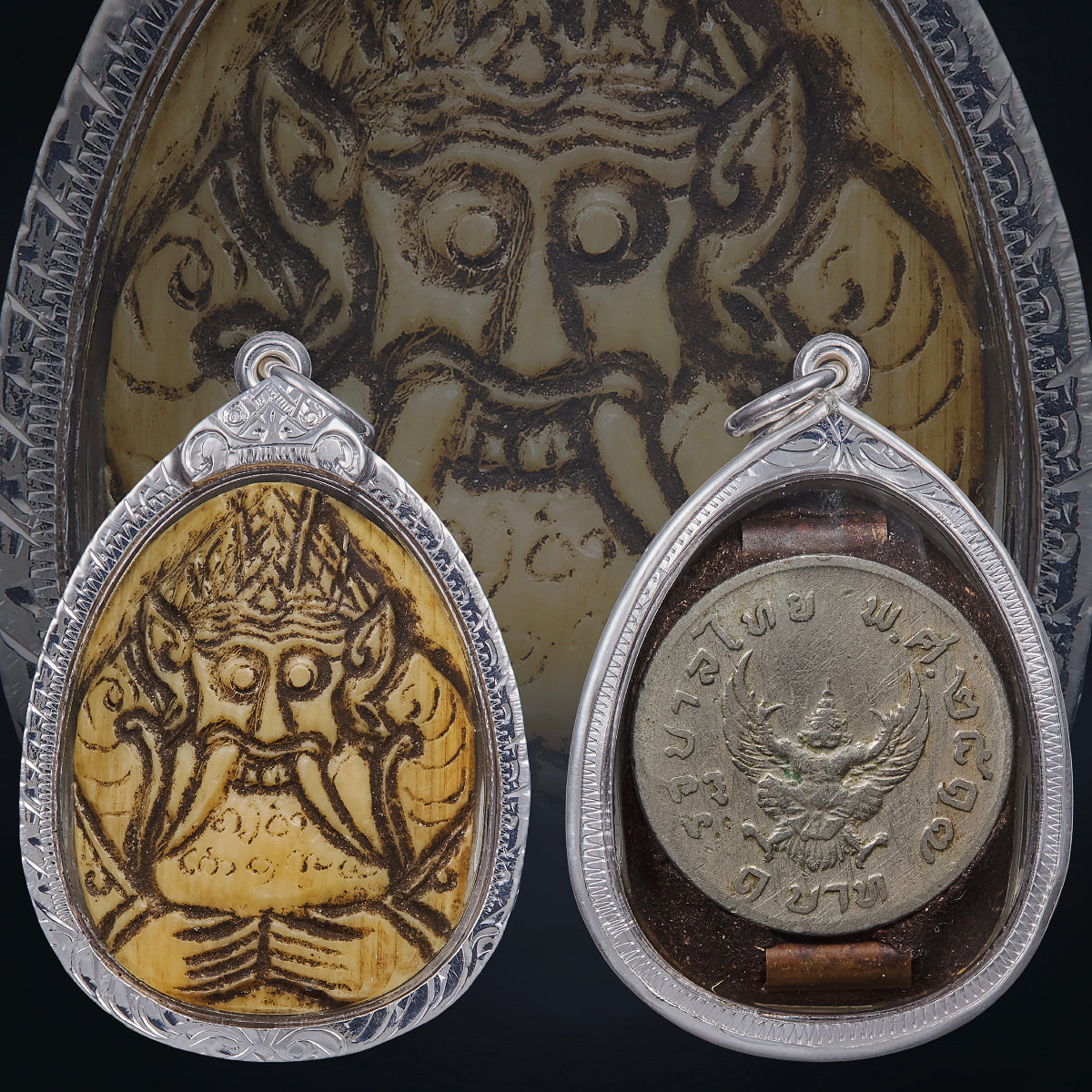
The Phra Rahu Kwan Thung is individually hand-carved by Por Sala Tan from old sacred relic material. The front depicts the characteristic face of Rahu consuming the celestial orb, with sacred markings incorporated into the carving.
The reverse is built upon prosperous soil mixed with Por Sala Tan's wealth and flourishing herbs. An original Thai one-baht Garuda coin occupies the centre, accompanied by additional takruts positioned above and below to strengthen the wealth intention.
Key points: old hand-carved relic, Phra Rahu, prosperous good-harvest soil, wealth herbs, Garuda Kwan Thung coin and additional wealth takruts.
Its exposed materials and naturally irregular carving reflect the individually prepared character of Por Sala Tan's work.
Recommended Pairing
The Phra Rahu Kwan Thung is already strongly oriented towards wealth and financial stability, making it suitable for independent wear.
For merchants and salespeople, it may be paired with a Metta or Salika artifact to strengthen communication and customer relationships alongside its existing wealth qualities.
For those experiencing strong competition or external obstacles, Tao Wessuwan may provide a complementary protective emphasis.
For everyday business use, however, Rahu and Kwan Thung already provide a particularly balanced combination: clear the obstacle, encourage prosperity and retain the resulting wealth.
Personal Notes
The meaning of this artifact can be understood through the young fruit seller.
When business became difficult, she could easily have asked Rahu for an immediate miracle.
Instead, she prayed and continued working.
She looked at what could be changed. She reduced waste. She adjusted her prices and portions. She treated customers well and gave them reasons to return.
Slowly, the empty space in her money pouch became smaller.
That is where Rahu and Kwan Thung meet.
Rahu teaches that an eclipse is temporary. A difficult period does not mean that prosperity has disappeared forever.
Kwan Thung adds the second lesson: when prosperity returns, learn how to keep what you have earned.
The blessing of this piece is therefore not simply about becoming rich.
It represents something more sustainable:
turn bad fortune towards good, allow honest effort to flourish, and keep enough of the harvest to build a better tomorrow.
-
Free Shipping for Singapore| $15 Worldwide | $60 USA For Items Below $350