
OOBThaiAmulets
Por Sala Tan
Por Sala Tan
Couldn't load pickup availability
PST05
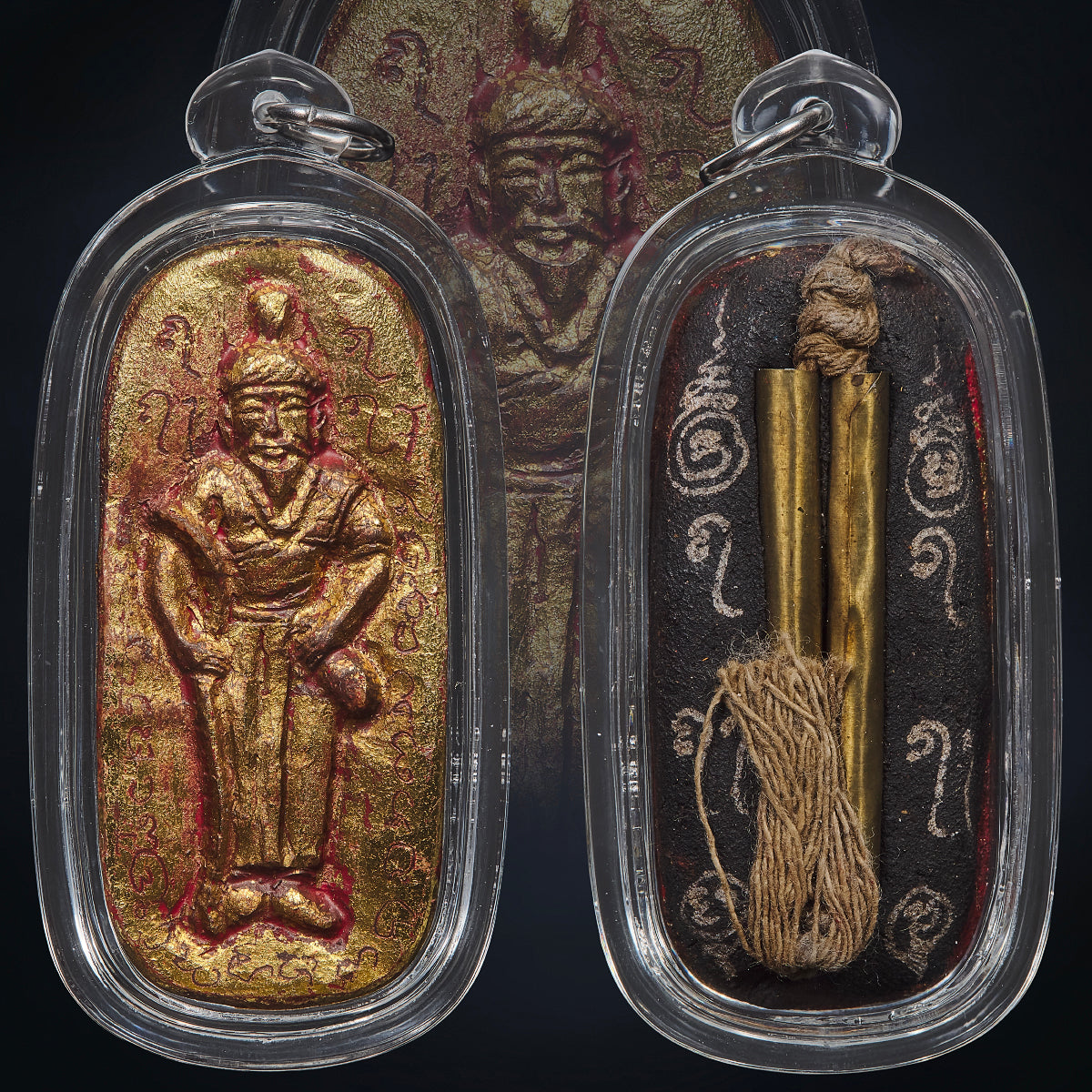
Phra Lersi Narod Gaduk Prai
Por Sala Tan
Barang Artifact
2.5 inches
Sacred Craftsmanship
Each artifact was individually carved and assembled by hand. Natural differences in the relic, lacquer, gold finish, takrut placement and sacred materials make every piece unique.
Personal Experiences Shared by Luksits
Among the relic materials collected from the abandoned village, Por Sala Tan felt that one particular piece carried an unusually strong presence connected with knowledge, wisdom and spiritual authority.
A local story about Lersi Narod captures the meaning of this artifact particularly well.
A young man once went into the forest looking for the great Lersi. He wanted a charm that would make him wealthy and respected without studying, working or listening to anyone.
After many days, he found Lersi Narod sitting beneath a tree repairing a cracked water jar.
The young man asked for a sacred object that would bring him quick success.
Lersi Narod pointed to the damaged jar and asked:
“If I cover this jar with gold, will it hold water?”
The young man answered that it would not. The crack had to be repaired first.
The Lersi explained that life was the same.
Wisdom repairs the crack. Discipline binds it. Kindness is the water carried for others.
He then gave the young man three teachings:
Rian Hai Jing
Learn sincerely.
Phut Hai Di
Speak well.
Tham Hai To Nueang
Keep doing what is right, consistently.
The young man returned home, learned his trade properly, treated people fairly and kept his promises. In time, people trusted him, his work grew and he became respected.
The lesson is central to the meaning of Lersi Narod.
The strongest blessing is not necessarily a shortcut.
It is the wisdom to become a good student, a dependable worker and eventually someone capable of guiding others.
It is knowledge directing power.
Luksits who favour Lersi artifacts often approach them for steadier judgment, clearer thinking and the ability to remain composed when difficult decisions must be made. In business or professional life, this can be interpreted as knowing when to speak, when to wait, whom to trust and how to proceed without unnecessary conflict.
The Phra Lersi Narod Gaduk Prai is particularly suited to people who value progress through skill, discipline, good communication and accumulated experience, rather than depending only upon luck.
Summary
The Phra Lersi Narod Gaduk Prai combines two distinct traditions within a single artifact.
The first is Lersi Narod, the sacred teacher associated with wisdom, learning, ritual knowledge and guidance.
The second is Por Sala Tan’s cemetery-based Barang practice, represented by Paneang relic material, cemetery soil, Nam Man Prai, takruts and death-associated ritual components.
Por Sala Tan created this piece after sensing a particular quality of knowledge and wisdom within one of the relics recovered during the cleansing of damaged graves.
He therefore chose to carve Lersi Narod, believing that the form of the great teacher would best direct and maximise the character already present within the material.
The result is an unusual artifact centred upon wisdom, guidance, protection, disciplined progress, Metta and the ability to overcome difficult circumstances through better judgment.
Historical Background
The materials came from an abandoned village situated in a mountainous area towards the Thai–Burma border.
Severe monsoon flooding had submerged villages and rice fields, eventually making the area unsuitable for continued habitation. The villagers relocated to safer ground, but they remained concerned about graves that had been damaged by prolonged rainfall and erosion.
Por Sala Tan was invited to assist with the necessary ceremonies.
He travelled to the burial area, performed cleansing and settlement rites, communicated with the spiritual presences associated with the graves and collected selected materials for future sacred work.
From these spiritually infused materials he later produced several different artifacts, each shaped according to the character he perceived within the individual relic or spiritual presence.
The Phra Lersi Narod Gaduk Prai emerged from one such piece.
Origins of the Materials
The main body of the front was carved from Paneang relic material recovered in connection with the cemetery work.
Paneang is highly regarded within certain folk and Barang traditions because it is treated as a strongly death-associated relic carrying accumulated Prai qualities.
For this piece, however, Por Sala Tan did not leave the material in an abstract form. He carved it into Lersi Narod, transforming the raw relic into the image of the Khru, or sacred teacher.
The reverse incorporates cemetery soil mixed with Nam Man Prai, together with takruts and bound ritual components.
The rope and cord visible within such constructions also carry symbolic importance. In folk practice, rope represents binding, holding and connecting. When associated with funeral or cemetery materials, it may be understood as helping anchor spiritual intention to the artifact.
This symbolism can extend to holding opportunities, keeping beneficial relationships close, restraining hostile influences and strengthening the connection between the wearer and the spiritual helper represented by the piece.
Ritual
The ritual background of this artifact begins with the cemetery cleansing itself.
Por Sala Tan did not simply enter the abandoned burial ground to collect relics. His original purpose was to help settle an area disturbed by natural disaster and damaged graves.
Only after performing the necessary rites and communicating with the spiritual presences did he collect selected sacred materials.
When preparing this particular relic, Por Sala Tan felt a distinct quality associated with knowledge, wisdom and power.
He therefore chose the form of Lersi Narod rather than another deity or guardian.
The finished carving was coated with red lacquer mixed with Burmese wax and gold paint, while the reverse was built from cemetery soil, Nam Man Prai, takruts and the additional ritual bindings.
The intent was to place strong cemetery material under the direction of the Khru principle — power governed by wisdom, discipline and proper judgment.
Blessings and Effects
The traditional emphasis of the Phra Lersi Narod Gaduk Prai centres upon wisdom, learning, guidance and steady advancement.
Lersi Narod represents the teacher. For this reason, the artifact is particularly relevant for those who need to develop mastery within a profession, business or spiritual discipline.
It may traditionally be approached for better judgment, clearer thinking, respectful speech, protection through awareness, stronger authority and the ability to learn from experience.
The cemetery and Prai materials add another dimension, associated with overcoming difficult circumstances, protection and spiritual assistance.
Together, these qualities create a piece that is less about reckless force and more about using knowledge to control circumstances.
Its traditional application can therefore be summarised as: learn properly, speak carefully, act consistently and allow Baramee to develop through dependable conduct.
Modern Application
The Phra Lersi Narod Gaduk Prai is particularly suitable for teachers, business owners, managers, craftsmen, practitioners and anyone whose success depends upon knowledge and decision-making.
It may also appeal to people entering a new trade or profession, where progress depends upon learning from seniors and developing genuine competence.
For businesspeople, its qualities can be interpreted through practical situations: choosing the right partner, speaking appropriately during negotiation, recognising danger early and maintaining steady progress rather than chasing shortcuts.
Its symbolism is equally relevant to spiritual practice.
Lersi Narod reminds the wearer that sacred knowledge is traditionally connected with discipline, responsibility and respect for the teacher, not merely with obtaining power.
Physical Details
The Phra Lersi Narod Gaduk Prai is an individually made Por Sala Tan artifact with a carved Lersi Narod image on Paneang relic material. The front is finished in red lacquer blended with Burmese wax and gold paint, giving the seated teacher a richly aged ceremonial appearance.
The reverse remains visibly functional. Cemetery soil mixed with Nam Man Prai forms the dark base, with multiple takruts positioned vertically and ritual cord bound through the centre. Additional sacred material is incorporated towards the lower portion.
Key points: Paneang relic, hand-carved Lersi Narod, red lacquer, Burmese wax, gold finish, cemetery soil, Nam Man Prai, ritual bindings and takruts.
Its exposed construction and natural irregularities are characteristic of Por Sala Tan’s handmade Barang work.
Recommended Pairing
The Phra Lersi Narod Gaduk Prai may be worn independently when the main intention is wisdom, guidance, discipline and protection.
For stronger protection, it may also be paired with Tao Wessuwan or Rahu, particularly where the wearer is dealing with conflict, rivalry or unstable surroundings.
Because this artifact already combines Khru and Prai elements, additional pairing is not essential.
Personal Notes
A local story about Lersi Narod captures the meaning of this artifact particularly well.
A young man once went into the forest looking for the great Lersi. He wanted a charm that would make him wealthy and respected without studying, working or listening to anyone.
After many days, he found Lersi Narod sitting beneath a tree repairing a cracked water jar.
The young man asked for a sacred object that would bring him quick success.
Lersi Narod pointed to the damaged jar and asked:
“If I cover this jar with gold, will it hold water?”
The young man answered that it would not. The crack had to be repaired first.
The Lersi explained that life was the same.
Wisdom repairs the crack. Discipline binds it. Kindness is the water carried for others.
He then gave the young man three teachings:
Rian Hai Jing
Learn sincerely.
Phut Hai Di
Speak well.
Tham Hai To Nueang
Keep doing what is right, consistently.
The young man returned home, learned his trade properly, treated people fairly and kept his promises. In time, people trusted him, his work grew and he became respected.
The lesson is central to the meaning of Lersi Narod.
The strongest blessing is not necessarily a shortcut.
It is the wisdom to become a good student, a dependable worker and eventually someone capable of guiding others.
That same principle explains why Por Sala Tan chose Lersi Narod for this particular relic. He sensed knowledge and power within the material, but instead of leaving that power without direction, he placed it under the image of the Khru.
Power may open a door. Wisdom teaches you which door is worth entering.
-
Free Shipping for Singapore| $15 Worldwide | $60 USA For Items Below $350