
OOBThaiAmulets
Por Sala Tan
Por Sala Tan
Couldn't load pickup availability
PST05
Phra Rahu Chana Mar Jinn
Por Sala Tan
Barang Artifact
2.5 inches
Sacred Craftsmanship
Each artifact was individually assembled and prepared from old sacred materials. Differences in the Paneang, carving, soil, herbs and Sai Sin naturally give each piece its own character.
Personal Experiences Shared by Luksits
Accounts surrounding this Jinn describe a presence particularly associated with turning difficult circumstances around.
According to the history related to Por Sala Tan, the Jinn had previously assisted the retired border soldier who later became village chief. Villagers also regarded the presence as having helped the wider community during difficult periods.
Rather than being remembered primarily for Saneh or wealth attraction, its reputation centred upon situations where circumstances appeared to be moving in the wrong direction — bad luck becoming manageable, problems finding unexpected solutions, and unfavourable situations eventually producing a better outcome.
Luksits carrying works of this nature have similarly described periods when an apparently closed situation unexpectedly reopened. A rejected opportunity might return through another person, a difficult negotiation might suddenly become more favourable, or an obstacle that had persisted for months might begin to resolve after an unexpected change of circumstances.
Some also describe narrowly avoiding problems through fortunate timing — arriving late and thereby missing an unpleasant incident, changing a decision shortly before discovering an unseen problem, or receiving assistance precisely when a situation appeared to be deteriorating.
Such experiences are traditionally interpreted through the combined character of the artifact: the Jinn assists, Rahu changes the direction of misfortune, and the Yod Thong represents victory after difficulty.
Summary
The Phra Rahu Chana Mar Jinn was constructed around the history and perceived nature of a particular guardian Jinn.
Por Sala Tan encountered the presence while conducting rites among damaged graves at an abandoned village. Through ritual communication, he understood that the Jinn had once been connected with the village chief, a retired border soldier, and had developed a reputation for helping both its keeper and the surrounding community.
Por Sala Tan therefore created an artifact reflecting this character.
Phra Rahu represents reversal — consuming misfortune and changing difficult circumstances.
The Yod Thong Victory Buddha represents victory, resilience and the Jinn's historical connection with its former soldier keeper.
The cemetery soil, sacred herbs and corpse Sai Sin preserve the Prai and burial-ground foundation from which the work emerged.
Together, the piece is directed towards changing bad circumstances into better ones and overcoming situations that initially appear unfavourable.
Historical Background
Phra Rahu holds an important position in Thai astrological and occult traditions.
Associated with eclipses, Rahu is traditionally approached during difficult cycles of Chata, periods of repeated setbacks, hidden opposition and circumstances that seem continually to move against the individual.
The symbolism comes from the eclipse itself.
Rahu consumes the celestial body, bringing temporary darkness — but the darkness does not remain permanently. The sun or moon eventually emerges again.
For this reason, Rahu became strongly associated with reversal, transformation and the ending of difficult cycles.
The title Chana Mar adds another layer. In sacred terminology, Chana concerns victory or overcoming, while Marrefers broadly to obstructive forces or conditions that stand in the way of progress.
Within this particular artifact, the meaning is therefore not simply protection from adversity.
It is victory through adversity.
Origins of the Materials
The materials originated from a remote mountainous village close to the Burmese border.
Severe monsoon flooding had submerged homes, agricultural land and rice fields. Conditions deteriorated until the settlement became unsuitable for habitation, forcing the villagers to relocate to safer ground.
Their burial grounds remained.
Rainfall and erosion subsequently damaged some of the graves, causing concern among the former inhabitants. Por Sala Tan was asked to visit the abandoned area and perform the necessary ceremonies.
He conducted cleansing rites around the graves and meditated to communicate with the spiritual presences associated with the location.
Only after this ritual process were selected materials collected for sacred work.
Among the materials retained were Paneang fragments, cemetery soil and Sai Sin associated with the burial grounds, which later became components in several different artifacts.
It was during these rites that Por Sala Tan encountered the Jinn connected with this particular piece.
Ritual
While performing the cemetery cleansing, Por Sala Tan sensed the presence of a Jinn around the burial grounds.
Through his subsequent communication, he understood that this was not simply a wandering entity from one of the disturbed graves.
According to the lineage account, the Jinn had previously been associated with the village chief, himself a retired border soldier. It had assisted its keeper and was also remembered as a beneficial presence within the village.
Most importantly, Por Sala Tan understood its particular nature to concern reversal — helping circumstances move from bad towards good and turning periods of poor fortune towards better outcomes.
This characteristic determined the entire construction.
Por Sala Tan selected Phra Rahu for the principal Paneang carving because Rahu's traditional wicha closely reflected the Jinn's own nature: changing difficult Chata and consuming misfortune.
Above Rahu he placed the Yod Thong Victory Buddha, representing victory and preserving the symbolic connection with the Jinn's former keeper as a soldier.
The reverse was then prepared with sacred herbs and cemetery soil, with corpse Sai Sin incorporated into the ritual foundation.
The resulting work was therefore not an arbitrary combination of sacred objects. Each component was selected to express a different part of the Jinn's history and function.
Blessings and Effects
The central quality of this artifact is Plik Duang — reversal or turning of fortune.
It may traditionally be approached during periods when problems seem to repeat themselves: financial setbacks, stalled careers, unsuccessful negotiations, difficult competition or circumstances where every attempted solution appears to create another obstacle.
Rahu represents the consumption of those unfavourable conditions.
The Jinn adds the element of spiritual assistance and fortunate intervention, particularly because its traditional reputation already concerned helping its former keeper and village through difficulties.
The Yod Thong Victory Buddha introduces Chana — victory and perseverance. The intention is not merely to escape difficulty, but to emerge from it in a stronger position.
The artifact may therefore be understood through three connected movements:
Rahu changes the cycle. The Jinn assists the passage. Yod Thong brings the intention towards victory.
Modern Application
The Phra Rahu Chana Mar Jinn is particularly suited to periods of transition, competition or prolonged difficulty.
Someone facing repeated setbacks in business may approach it with the intention of changing the pattern surrounding their work. A person seeking promotion may pray for obstacles to lessen and for an opportunity to prove themselves. Those entering negotiations, dealing with difficult competitors or rebuilding after financial problems may similarly relate to its symbolism.
It may also be carried during travel or periods involving uncertain decisions, especially where the keeper wishes for both protection and favourable timing.
Its deeper purpose is therefore not simply "luck".
It concerns changing direction when the present direction is no longer favourable.
Physical Details
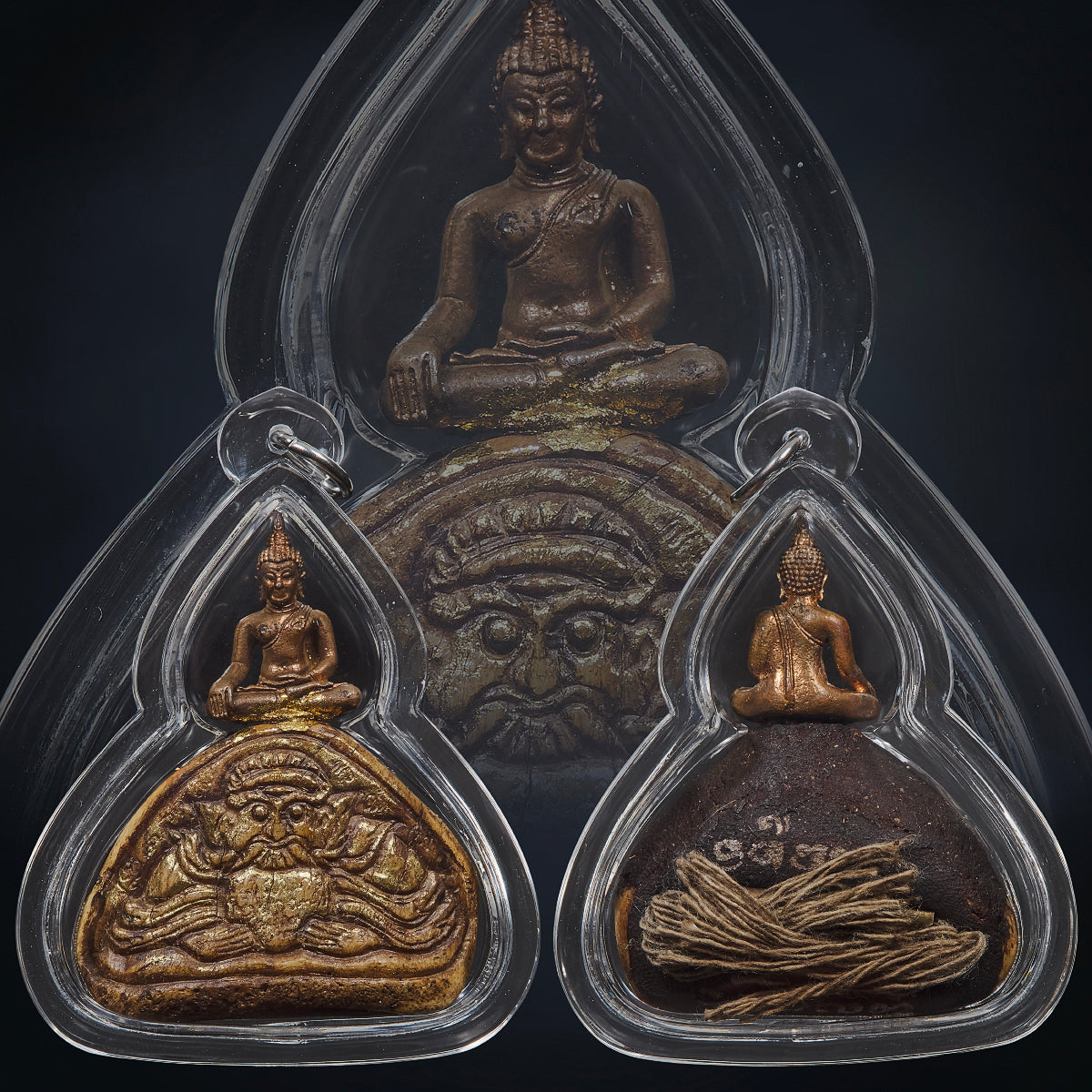
The artifact has a distinctive two-part composition. The lower section is carved from Paneang into Phra Rahu, presented in a broad, powerful form with large eyes, pronounced facial features and arms extending around the central celestial form. The naturally aged surface retains warm brown and gold tones that emphasise the depth of the carving.
Directly above Rahu sits a separate Yod Thong Victory Buddha, cast in metal and seated in the traditional meditation posture. Its elevated placement creates a clear visual hierarchy: Rahu occupies the worldly field of changing adversity below, while the Buddha represents victory, composure and spiritual direction above.
The reverse exposes the ritual foundation. A dark prepared mass of sacred herbs and cemetery soil fills the lower body, with sacred markings visible across its surface. A substantial length of old corpse Sai Sin is folded and preserved against the backing.
Viewed together, the front explains the purpose while the reverse preserves its origin: Rahu for reversal, Yod Thong for victory, and the cemetery materials for the Jinn and Prai foundation behind the work.
The entire construction is protected within a fitted clear casing shaped around the Buddha and Rahu composition.
Recommended Pairing
Because this artifact already contains a strong combination of Rahu, Jinn and cemetery-derived materials, Phra Somdej provides an excellent stabilising companion through Buddhist Baramee and composure.
Tao Wessuwan may be paired for stronger guardianship and command over hostile spiritual influences, while Phra Sivali complements the piece where the keeper's principal intention concerns livelihood, opportunity and financial recovery.
Personal Notes
What makes this piece particularly interesting is that Por Sala Tan appears to have allowed the history of the Jinn to determine the design.
The Jinn was not simply encountered and placed into a generic form.
According to the lineage account, it had once accompanied a man who had served as a border soldier before becoming the chief of his village. It had helped its keeper, and villagers remembered its assistance during difficult circumstances.
Its defining character was turning bad towards good.
Por Sala Tan therefore chose Rahu — the celestial figure whose symbolism concerns darkness, disruption and eventual reversal.
Above Rahu he placed the Yod Thong Victory Buddha — a reminder of the Jinn's former soldier keeper and the principle of victory after struggle.
Behind both remain the cemetery earth, sacred herbs and Sai Sin from the abandoned village.
Even the origin of the artifact reflects its purpose. The village itself had suffered an overwhelming reversal of fortune: floodwater destroyed the land and forced its people away. Yet from that abandoned place came materials that Por Sala Tan redirected towards a work concerned with surviving adversity and finding a road forward.
That gives the Phra Rahu Chana Mar Jinn a particularly coherent meaning:
When circumstances turn against you, endure.
When the road closes, find another opening.
When fortune falls, turn it again.
Rahu transforms.
The Jinn assists.
Yod Thong represents victory.
-
Free Shipping for Singapore| $15 Worldwide | $60 USA For Items Below $350