
OOBThaiAmulets
Por Sala Tan
Por Sala Tan
Couldn't load pickup availability
PST05
Jinn Prai Mai Long
Por Sala Tan
Barang Artifact
1.5 inches
Sacred Craftsmanship
Each piece was individually carved and ritually prepared from old coffin material. Variations in the grain, carving, lacquer, gilding and ritual stuffing naturally make every example unique.
Personal Experiences Shared by Luksits
The most distinctive experiences associated with this Jinn have concerned warning rather than attraction or wealth.
Several devotees have described developing an unusual feeling shortly before an unpleasant situation occurred. Sometimes it appeared as sudden hesitation — a strong feeling not to travel by a particular route, not to proceed with a meeting, or simply to delay leaving home.
Only afterwards would they learn that something had happened which made the delay fortunate.
Others described the warning more subtly. They might suddenly think about checking a locked door, electrical appliance, vehicle or something belonging to a family member without having an obvious reason to do so. These moments were later interpreted by the devotees as the Jinn drawing their attention towards something requiring caution.
Accounts from villagers have also associated the piece with protection of the household, family members and personal property. Some attributed fortunate escapes from accidents or unexpected danger to its guardianship.
One recurring description is that the Jinn does not necessarily prevent the dangerous situation from existing. Instead, devotees feel that it gives them just enough awareness to recognise that something is wrong before circumstances develop further.
For this reason, some luksits describe its strongest quality as a kind of sixth sense for approaching danger or unpleasant surprises.
These accounts remain personal testimonies within the lineage and should not be understood as guaranteed outcomes.
Summary
The Jinn Prai Mai Long is fundamentally a guardian artifact.
Its construction brings together several materials carrying different symbolic functions.
The coffin wood represents transition and the boundary between life and death. Cemetery soil connects the work to the burial ground from which the materials originated. Sacred relic material introduces an element of merit and blessing, while the takrut provides the written ritual formula supporting the construction.
At the centre of these elements stands the guardian Jinn — a presence Por Sala Tan encountered while conducting rites at the abandoned village and subsequently invited into the carving.
Its traditional emphasis is therefore protection, heightened awareness, timely warning and assistance when confronting uncertain circumstances.
Historical Background
Jinn occupy a complex place within the spiritual traditions encountered across parts of Southeast Asia.
Depending upon region and lineage, they may be understood as unseen beings connected with particular territories, forests, mountains, old settlements or individuals. Some are approached cautiously, while others may be regarded as guardians when a proper relationship has been established through ritual practice.
In this particular lineage account, the Jinn was understood as a guardian associated with the village, rather than simply a wandering presence encountered among the graves.
This distinction is important.
The natural disaster had forced the human inhabitants to abandon their settlement, but according to Por Sala Tan's experience during the rites, its unseen guardian remained.
The carving therefore represents a continuation of that protective function in another form.
Origins of the Materials
The story begins with a remote village in the mountainous region near the Burmese border.
Severe monsoon flooding submerged homes, rice fields and surrounding land. Conditions eventually became unsuitable for habitation, and the villagers relocated to a safer area.
The burial grounds remained behind.
Continued rain and erosion damaged some of the graves, leaving former residents concerned about the condition of those buried there. Por Sala Tan was subsequently asked to enter the abandoned area and perform the necessary cleansing and spiritual rites.
During this work, he meditated and communicated with the spiritual presences surrounding the burial ground.
Selected materials were collected only after these rites had been completed and permission had been sought according to his practice.
Among them was coffin wood, together with cemetery earth and other sacred materials later used across several different works.
It was during these ceremonies that Por Sala Tan sensed the presence he came to understand as the village's guardian Jinn.
Ritual
Por Sala Tan's encounter with the Jinn became the foundation for the artifact.
During meditation and ritual communication, he perceived a particular form associated with the presence. The coffin wood was subsequently carved according to this vision, producing the unusual crouching guardian figure seen on the finished piece.
The wood was prepared with red lacquer before being finished with gold, allowing the red foundation to remain visible through the deeper carved details.
The lower portion was then ritually stuffed with cemetery soil from the burial area, sacred relic material and a takrut.
Por Sala Tan finally performed the invocation through which the Jinn was invited to become spiritually associated with the carving.
Within the lineage understanding, this did not create a new guardian. Rather, it provided an established guardian presence with a physical sacred object through which it could continue helping those who carried it.
Blessings and Effects
The principal quality associated with this Jinn is guardianship.
Protection may traditionally extend towards the wearer, family members, the home and personal property. For those who travel frequently or work in unfamiliar environments, the piece may be carried with prayers for safe passage and avoidance of unnecessary danger.
A second important quality is intuition and advance warning.
Devotees have described sudden hesitation, unexplained caution, changes of mind or an unusually strong feeling concerning a person, journey or situation. When later circumstances appear to justify that instinct, they may regard it as guidance from the Jinn.
The artifact is also traditionally approached for assistance in passing through obstacles and uncertain periods, particularly when the correct path is not immediately clear.
Rather than representing aggressive force, its character is closer to a watchman:
observe first, warn when necessary, and protect what has been placed under its care.
Modern Application
The Jinn Prai Mai Long may particularly appeal to people whose daily lives involve travel, responsibility for others, valuable property or unpredictable environments.
Someone travelling frequently may carry it for protection and timely intuition. A business owner may keep it near the workplace with the intention of guarding property and becoming more alert to questionable situations. Parents may dedicate prayers towards the wellbeing of family members, while those working late or travelling through unfamiliar areas may seek a stronger sense of protection.
Its warning aspect can also be understood practically.
The purpose is not to encourage fear or suspicion. Rather, it represents awareness — noticing unusual circumstances, trusting reasonable caution and avoiding unnecessary risks.
Physical Details
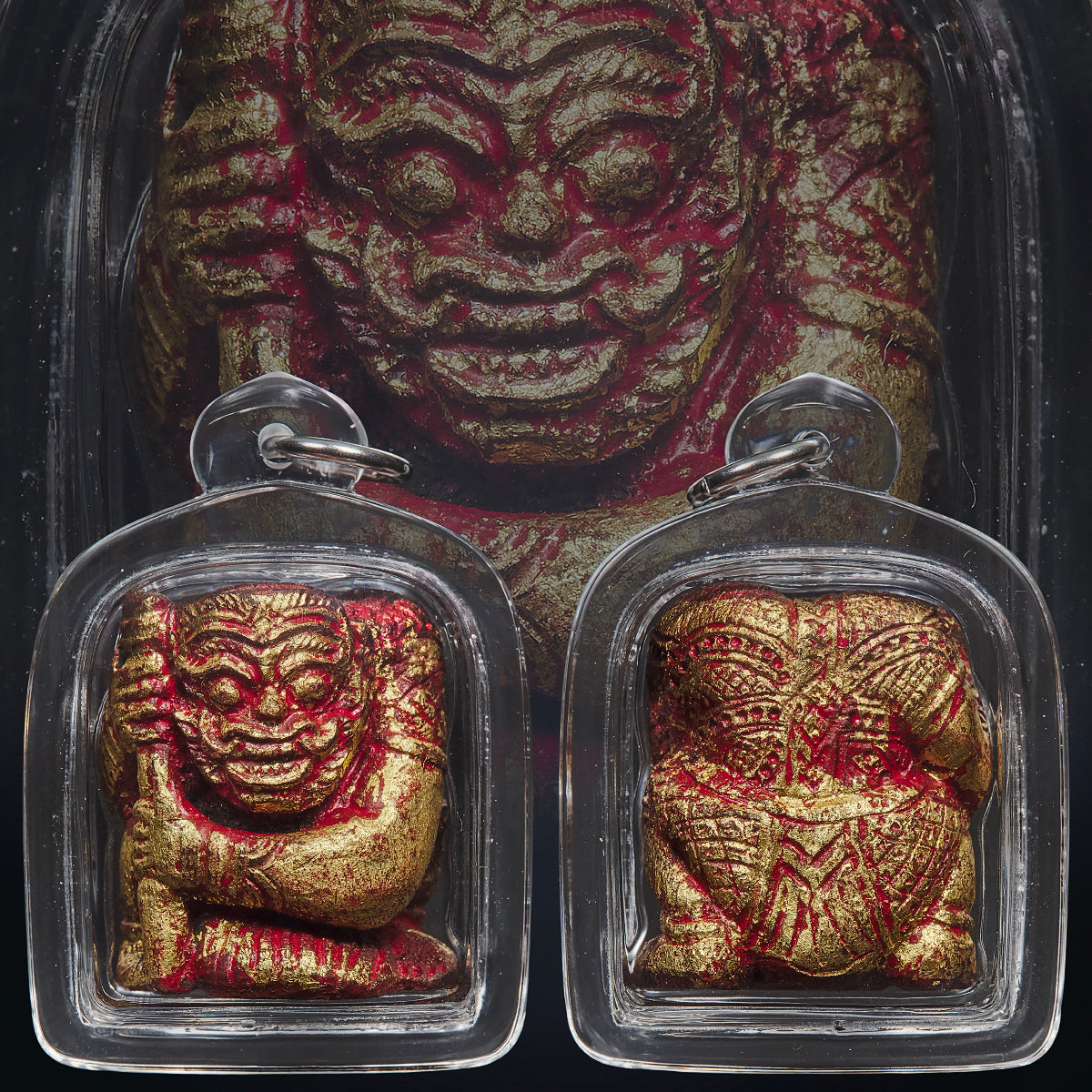
The Jinn is carved from a compact section of old coffin wood, producing a broad, crouching figure with an intentionally formidable appearance. The face has large rounded eyes, pronounced brows and an exposed-tooth expression, while the arms are held prominently across the front of the body. The posture gives the carving a distinctly watchful, guardian-like character.
The surface was prepared with red lacquer and gold finishing. Considerable red remains visible throughout the deeper lines of the face, limbs and clothing, while worn areas of gold reveal the underlying preparation and natural texture of the old wood.
The reverse continues the carving rather than presenting a flat backing. Deeply worked lines define the rear of the head, hair or headdress, shoulders, clothing and crouched legs. The strong red-and-gold treatment continues across this side.
At the bottom is the concealed ritual stuffing containing cemetery soil, sacred relic material and a takrut. These components connect the carved guardian directly with the burial-ground materials from which the work originated.
The complete Jinn is housed within a fitted clear protective casing.
Recommended Pairing
For a balanced Buddhist foundation, Phra Somdej may be worn alongside the Jinn for Baramee, calmness and spiritual stability.
Tao Wessuwan is particularly complementary where stronger guardianship and protection against hostile spiritual influences are desired, while Phra Rahu may accompany it during periods of major uncertainty or difficult changes in fortune.
Personal Notes
There is a particular symbolism surrounding this Jinn because its story begins with a place that had already lost its human inhabitants.
Floodwater came through the village. Homes and rice fields were abandoned. Families relocated. Even the burial grounds were damaged by the continuing rain.
Yet according to Por Sala Tan's account, the guardian had remained.
The coffin wood remembers the end of life. The cemetery soil represents the ground of impermanence and the courage to face what is feared. The sacred relic material represents merit, blessing and the possibility of rising above hardship.
The Jinn stands between these elements as the guardian.
Por Sala Tan did not simply carve an imagined figure onto old coffin wood. According to the lineage account, he first encountered the presence, communicated with it, perceived its form, and only then had that form carved into the material recovered from the place it had once guarded.
Perhaps this also explains why devotees speak so frequently about warnings.
A guardian does not need to fight every danger.
Sometimes protection means noticing the danger before reaching it.
The village was abandoned.
The guardian remained.
Its duty was given a new place to continue.
-
Free Shipping for Singapore| $15 Worldwide | $60 USA For Items Below $350