
OOBThaiAmulets
Por Sala Tan
Por Sala Tan
Couldn't load pickup availability
PST05
Mae Per Mai Long Prai
Por Sala Tan
Barang Artifact
2 inches
Sacred Craftsmanship
Each Mae Per was individually carved and ritually prepared from the available coffin material. Natural differences in the old wood, carving, lacquer, gilding and ritual preparation give every piece its own character.
Personal Experiences Shared by Luksits
Among luksits, this Mae Per became associated not only with Saneh, but with something more practical: circumstances changing after a long period of hardship.
One particularly remembered account came from an ordinary office worker who had spent years working long hours simply to support her household. She was dependable and diligent, yet much of her effort went unnoticed. She was frequently given additional responsibilities without any meaningful improvement in her position.
After beginning to wear the Mae Per, she did not report an immediate or dramatic change. Instead, she noticed that people began paying greater attention to the work she was already doing.
Her efforts were acknowledged more openly. Senior colleagues became more receptive towards her, and the quality and consistency of her work were eventually recognised by management.
She was subsequently promoted.
The promotion improved her income and working circumstances, making everyday life considerably easier for her and her family. She regarded the experience as one of the clearest manifestations of Mae Per's Metta: not creating ability that was absent, but allowing existing effort and good qualities to finally be seen by the right people.
Other devotees have described similar, smaller changes — strangers becoming warmer towards them, colleagues becoming more cooperative, conversations developing more easily and assistance appearing during periods when they felt overwhelmed.
For some, the strongest quality was therefore not romantic attraction at all. It was the feeling of becoming more favourably received, remembered and supported.
Summary
Mae Per Mai Long Prai combines three important elements of Por Sala Tan's Barang practice.
The first is Mae Per, a traditional feminine figure associated with attraction, kindness, generative force, support and prosperity.
The second is Mai Long Sop — coffin wood. Within folk-occult practice, material associated with a coffin occupies a liminal position because it has accompanied the final boundary between life and death.
The third is the Prai presence Por Sala Tan believed to be associated with the material. According to the lineage account, this presence was invited to remain within the sacred work and assist devotees as a means of accumulating merit.
The Metta Maha Niyom takrut then gives the piece a clear worldly direction: being favourably received, gaining recognition, attracting assistance and improving one's circumstances through better relationships with others.
Historical Background
The Coffin-Wood Tradition
Mai Long Sop literally refers to coffin wood.
Within certain Thai folk-occult traditions, coffin material is regarded as a boundary material — something physically associated with the passage from life into death, mourning and remembrance.
Its significance is therefore not simply that it is old wood.
The coffin represents the body's final shelter. At the same time, it reminds the living of impermanence: circumstances, status, hardship and even life itself do not remain unchanged forever.
When used by a ritual practitioner, such material may be ritually redirected towards protection, endurance, transformation or Prai-oriented assistance.
In this sense, the material is not valued merely because of its association with death. Its deeper symbolism concerns transition.
Something has ended.
Something else can begin.
Origins of the Materials
The coffin wood used for this Mae Per came from the same remote mountainous region near the Burmese border where Por Sala Tan had been asked to attend damaged graves.
Severe monsoon flooding had submerged sections of the village and surrounding rice fields. The area eventually became unsuitable for habitation, forcing the villagers to move to safer ground.
Their graves could not move with them.
Heavy rainfall and erosion continued damaging the burial area, and the former villagers became concerned about the condition of the graves and funeral materials left behind.
Por Sala Tan was asked to assist.
He travelled into the abandoned settlement and performed the necessary ceremonies around the affected burial grounds. According to the account surrounding these pieces, he also meditated and communicated with the spiritual presences associated with the area before collecting anything.
Only after the rites were completed were selected materials retained for sacred work.
Among them were pieces of coffin wood and other materials associated with the damaged graves.
Ritual
While examining and preparing the recovered materials, Por Sala Tan sensed an unusually concentrated Prai presence associated with the coffin wood selected for this piece.
According to the lineage account, he communicated with the presence rather than immediately working the material.
The intention established was one of assistance and merit: the Prai would help devotees facing difficulties, while the good arising from such assistance would in turn be dedicated as merit.
Por Sala Tan subsequently carved the coffin wood into Mae Per.
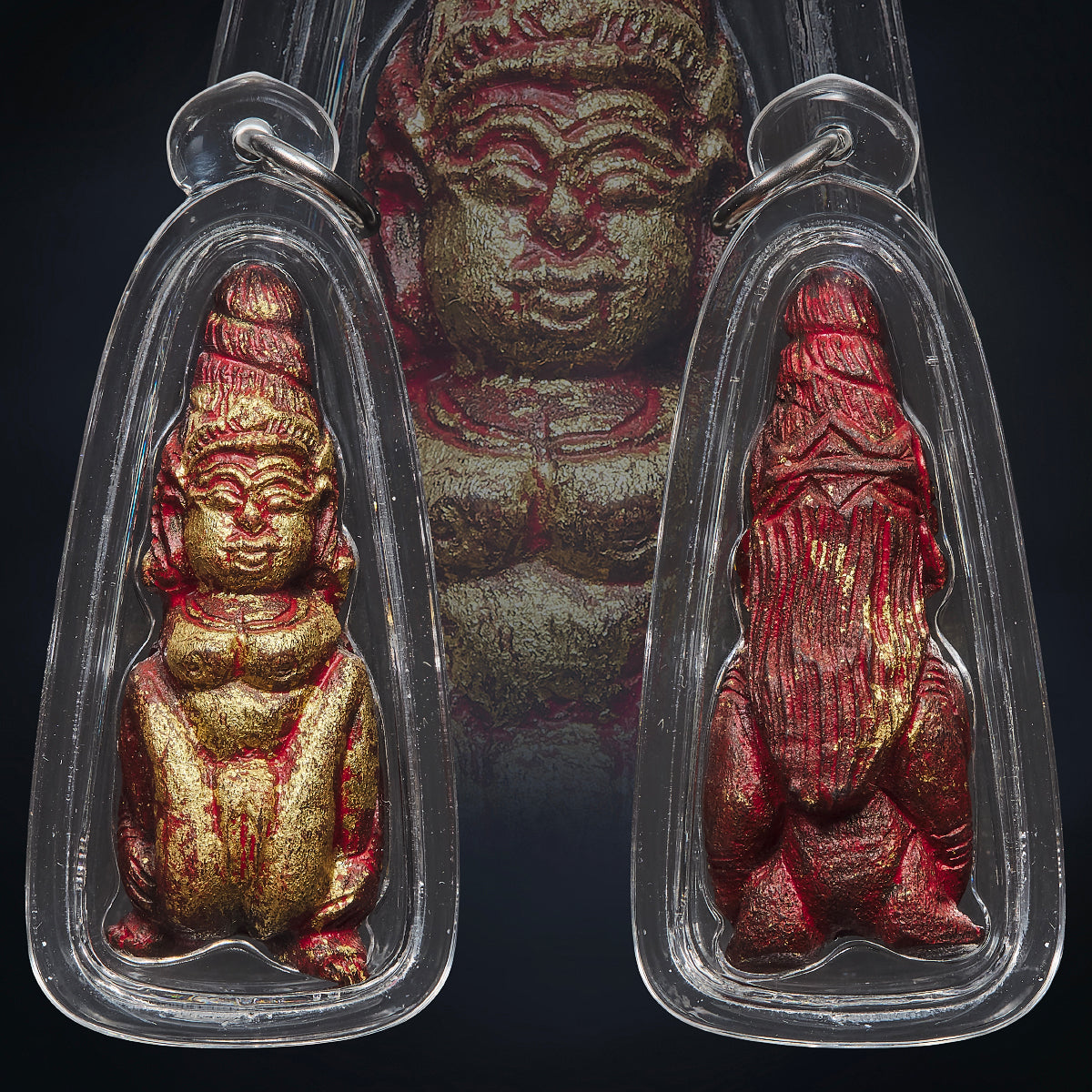
The particular form is unusual. Mae Per is portrayed with an elevated, almost courtly appearance, which Por Sala Tan associated with a princess or woman of noble standing rather than an ordinary female figure.
The completed carving was coated in red lacquer blended with Burmese wax before being gilded.
Finally, a Metta Maha Niyom takrut was installed at the bottom, reinforcing the qualities of goodwill, popularity, favourable treatment and recognition.
Blessings and Effects
The principal quality of this Mae Per is Metta Maha Niyom — being favourably regarded and warmly received by others.
This can be important in ordinary life. A person may possess ability and work diligently, yet advancement often depends partly upon whether those qualities are recognised by employers, customers, colleagues or people in positions of influence.
Mae Per's Metta is therefore traditionally sought for recognition, cooperation, helpful relationships and attracting support.
Saneh forms another aspect of the work. Within Mae Per traditions, this may be understood as personal magnetism — becoming easier to notice, remember and approach. Depending upon the keeper's intention, this can apply to relationships, social interaction, customers or professional networking.
The artifact is also associated with transformation of hardship. This interpretation is particularly appropriate given the origin of its material: coffin wood from a place itself transformed by disaster.
The Prai component adds the traditional concept of spiritual assistance, while the Metta Maha Niyom takrut directs that assistance towards favourable human response.
The overall intention is therefore gentle but practical:
Be noticed. Be received kindly. Find support. Allow difficult circumstances to change.
Modern Application
Although Mae Per is sometimes discussed primarily in relation to opposite-sex attraction, this particular piece has a much broader application.
It is especially relevant to people whose progress depends upon recognition and interpersonal response.
An employee may seek recognition from management. A salesperson may focus upon customers becoming more receptive. A business owner may seek goodwill and returning clients. Someone entering a new workplace may use the piece with the intention of establishing harmonious relationships and receiving assistance from senior people.
Its symbolism can also resonate with someone rebuilding life after a difficult period.
The personal experience of the office worker illustrates this particularly well. She was already working hard. The change she associated with Mae Per was that her effort stopped being invisible.
For this piece, that distinction is important.
Physical Details
The artifact is carved from an elongated section of old coffin wood, giving the figure a narrow upright form. The front depicts Mae Per as a composed female figure with a high, elaborate headdress, prominent facial features and a formal seated posture. Her appearance is noticeably more dignified than the exaggerated sensual imagery sometimes encountered in folk Mae Per carvings, supporting the tradition surrounding this example as a representation of a woman of elevated or noble status.
Por Sala Tan prepared the wood with red lacquer mixed with Burmese wax before applying gold. The gold remains strongest across the face and front of the body, while the red foundation shows clearly through the recesses and worn areas.
The reverse retains the sculptural form of the figure rather than being filled with additional materials. Long carved hair extends down the back beneath the headdress, with the red lacquer particularly prominent across the deeper lines. Remnants of gold remain scattered across the surface, creating a naturally aged red-and-gold finish.
A Metta Maha Niyom takrut is inserted at the bottom of the carving, forming the concealed ritual component supporting the outward image of Mae Per.
The simplicity is deliberate: the coffin wood itself is the principal sacred material.
Recommended Pairing
Phra Somdej provides a balanced Buddhist foundation of Baramee and stability alongside the Prai character of Mae Per.
For livelihood and prosperity, Phra Sivali complements the piece particularly well. For merchants and customer-facing professions, Nang Kwak can reinforce the qualities of Metta, customer attraction and continuing trade.
Personal Notes
The deeper character of this Mae Per lies in the transformation of its material.
A coffin is the body's final shelter. Within traditional practice, however, the wood does not need to represent fear or misfortune. It can instead become a reminder that nothing remains fixed.
The village changed.
The families who once lived there moved away.
The graves were damaged.
And material once associated with death was eventually placed in the hands of Por Sala Tan.
According to the lineage account, he sensed a particularly strong Prai presence within this material and did not attempt simply to suppress or discard it. Instead, the presence was invited towards another purpose — helping those still living and receiving merit through that assistance.
Por Sala Tan then chose the form of Mae Per, unusually portrayed as a woman of elevated standing, and reinforced her with a Metta Maha Niyom takrut.
This gives the piece a meaning extending beyond attraction.
The office worker who later received her promotion provides a fitting example. Her hardship did not disappear because she stopped working. She continued doing what she had always done.
What changed was that someone finally saw her value.
That perhaps expresses this Mae Per most clearly:
From hardship towards opportunity.
From being overlooked towards being recognised.
From carrying everything alone towards receiving support.
The coffin wood represents what has passed. Mae Per represents what may still change.
-
Free Shipping for Singapore| $15 Worldwide | $60 USA For Items Below $350