
OOBThaiAmulets
Por Sala Tan
Por Sala Tan
Couldn't load pickup availability
PST05
Phra Rahu Gaduk Prai
Por Sala Tan
Barang Artifact
2 inches
Sacred Craftsmanship
Each artifact was individually carved and assembled from the available sacred materials. Differences in Paneang, lacquer, gilding, cemetery earth, Nam Man Prai, corpse rope and takruts naturally make every example unique.
Personal Experiences Shared by Luksits
Among luksits, Rahu pieces are often carried during periods when life seems trapped in a repeating pattern — money enters and disappears, opportunities almost succeed before collapsing, or one difficulty seems to follow another.
One wearer involved in business described several months of unusually poor timing. Customers showed interest but repeatedly delayed payment, while unexpected expenses consumed whatever income came in. After carrying Rahu, he felt the important change was not an immediate windfall, but that money began to remain with him for longer. Payments arrived more consistently and fewer unexpected problems appeared to consume his earnings.
He associated this particularly with the corpse-rope symbolism of the piece — not simply calling wealth, but holding what had already been obtained.
Another luksit working on commission reported a more direct Choke Lap experience. An old contact unexpectedly introduced him to a customer whom he had never approached before. The resulting transaction produced a substantial commission during an otherwise quiet period. He regarded it as an expression of the windfall-luck takrut.
Others carrying Rahu works describe situations involving troublesome people gradually losing their influence. Gossip stops spreading, a difficult colleague moves elsewhere, or circumstances change so that an old conflict no longer controls the wearer's decisions.
The recurring theme is therefore less about instant wealth and more about a difficult cycle breaking, an opening appearing, and favourable circumstances becoming easier to retain once they arrive.
Summary
This Phra Rahu Gaduk Prai combines three closely connected ritual ideas: transformation, spirit-associated power and binding.
Rahu represents the consumption and reversal of difficult fortune.
The cemetery soil and Nam Man Prai establish the Prai foundation of the work.
The Chueak Sop, or corpse rope, introduces the symbolism of binding and retaining — traditionally interpreted as holding fortune, keeping opportunities from slipping away, strengthening attraction and restricting hostile influences.
Finally, the two takruts establish two clear directions: one for Choke Lap and unexpected fortune, the other for turning bad luck towards good.
The final lunar-eclipse consecration completes the relationship between these materials and Rahu's traditional eclipse symbolism.
Historical Background
Phra Rahu occupies a distinctive position within Thai astrological and occult traditions.
Rahu is traditionally associated with the eclipse — the celestial force that temporarily consumes the sun or moon before releasing it again. This image became an important metaphor for difficult cycles in human life.
Rahu is therefore commonly approached during periods of unfavourable Chata, repeated setbacks, hidden opposition, financial instability or sudden reversals of circumstances.
The desired effect is not simply protection from difficulty. It is transformation: Rahu consumes the negative condition so that circumstances may eventually emerge differently.
This makes the lunar eclipse particularly significant within Rahu practice. In certain occult traditions, an actual eclipse is regarded as a powerful period for Rahu-oriented rites because the celestial event mirrors the mythology and symbolism of the deity.
For this reason, Por Sala Tan deliberately waited for a lunar eclipse before completing the consecration of the artefact.
Origins of the Materials
The cemetery materials originated from a remote mountainous settlement near the Burmese border.
Severe monsoon flooding had submerged parts of the village and surrounding rice fields. Continued damage eventually made the area unsuitable for habitation, forcing the villagers to relocate to safer ground.
Their concern did not end after leaving.
The burial grounds had suffered heavily from rainfall and erosion, with graves damaged by the continuing weather. The former villagers therefore asked Por Sala Tan to assist with the cemetery.
Por Sala Tan travelled into the abandoned area and performed the necessary ceremonies at the affected graves. According to the lineage account, he also meditated and communicated with the spiritual presences associated with the site.
Only after these rites were completed did he collect selected materials for sacred use.
Among them were cemetery soil and Chueak Sop — rope associated with the graves and funerary setting. Together with Paneang fragments and other materials, these became the foundation for several Gaduk Prai works subsequently created by Por Sala Tan.
Ritual
For this particular piece, Por Sala Tan selected a suitable Paneang fragment and carved Phra Rahu directly into the material.
He then applied red lacquer mixed with Burmese wax, followed by gold, producing the characteristic gilded surface with red emerging through the deeper lines.
The reverse required a different preparation.
Por Sala Tan blended cemetery soil from the burial ground with Nam Man Prai, creating the dark ritual base. Into this he installed two separate takruts.
One was prepared specifically for Choke Lap and windfall fortune.
The other was prepared for Plik Duang — changing an unfavourable cycle and turning bad luck towards good fortune.
Around the completed arrangement he incorporated the corpse rope recovered from the graves, physically encircling the reverse components.
Once constructed, the artefact was kept until the arrival of a lunar eclipse. Por Sala Tan then performed the final Rahu consecration, completing the piece under the celestial condition traditionally associated with Rahu himself.
Blessings and Effects
The principal purpose of this Phra Rahu is fate turning.
Someone experiencing a prolonged period of setbacks may traditionally approach Rahu to consume the conditions surrounding those difficulties — particularly bad Chata, hidden hostility and recurring obstacles.
The dedicated Plik Duang takrut reinforces this direction.
The second takrut concentrates upon Choke Lap, traditionally associated with unexpected gains, fortunate transactions, sudden opportunities, commissions and money arriving from an unforeseen direction.
The corpse rope adds another symbolic dimension.
In certain Barang traditions, Chueak Sop is treated as a liminal material connected with the boundary between life and death. Because rope itself ties and holds, practitioners may symbolically employ it for Saneh, attraction, retaining customers, holding wealth, binding protective formulas or restricting hostile influences.
In the context of this Rahu piece, its most appropriate interpretation is retention: once fortune has been opened, do not allow it to disappear easily.
This creates a distinctive sequence within the artefact:
Rahu consumes adversity.
One takrut turns the cycle.
One takrut opens Choke Lap.
The corpse rope binds and holds.
Modern Application
The Phra Rahu Gaduk Prai is particularly relevant to people experiencing unstable cycles rather than simply a lack of income.
A business owner may be earning but constantly losing money to unexpected problems. A salesperson may repeatedly bring prospects close to completion only for them to disappear. Someone may encounter good opportunities but find that they never remain long enough to develop.
In these circumstances, the corpse-rope symbolism becomes especially relevant: calling opportunity is one matter; holding it is another.
The piece may therefore appeal to business owners, traders, salespeople and commission-based professionals seeking a combination of Choke Lap, improved circumstances and greater continuity once opportunities arrive.
Its protective dimension may also be applied to workplace rivalry, hidden opposition and periods when external interference repeatedly disrupts progress.
Physical Details
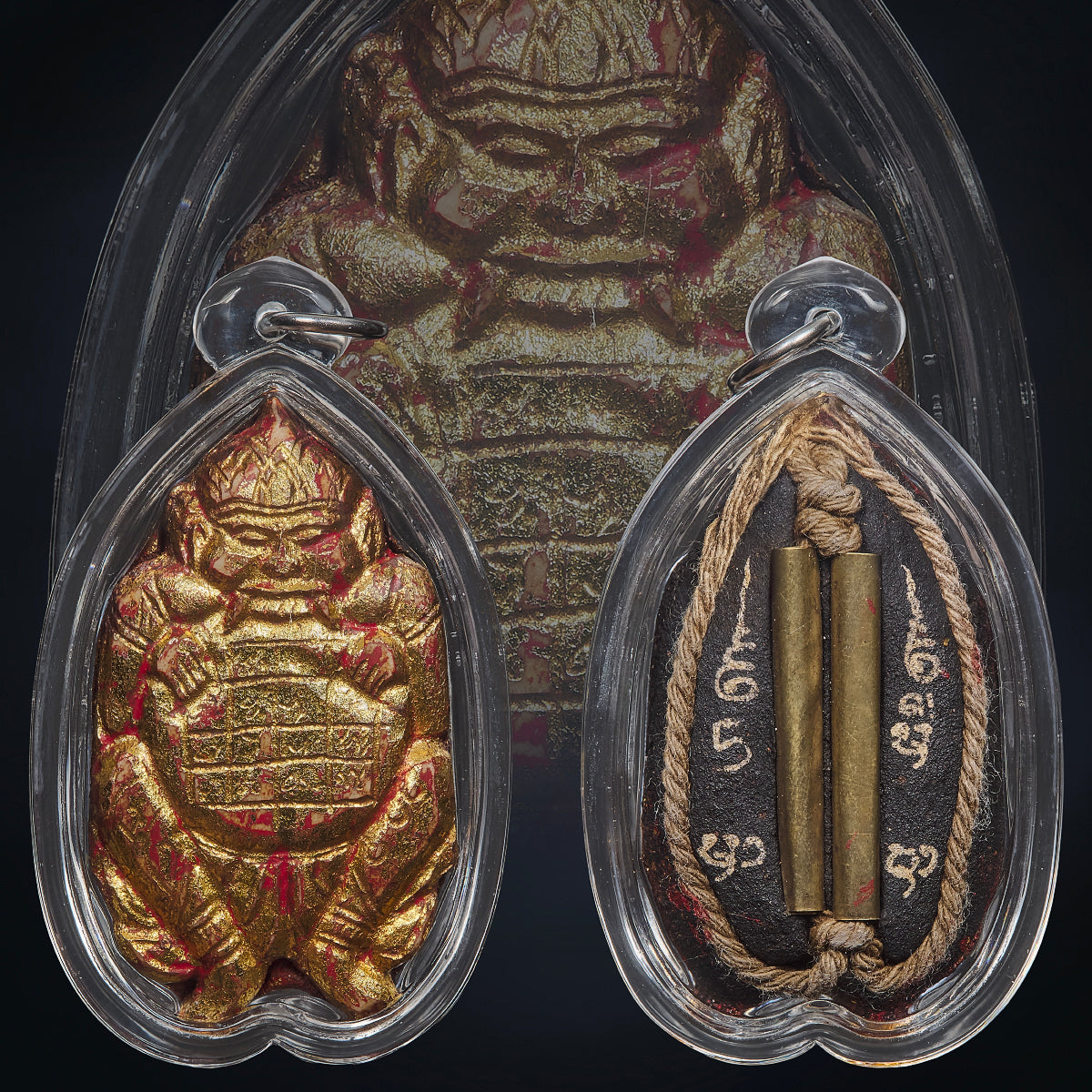
The front consists of a strongly modelled Phra Rahu carved from Paneang, with the figure gripping the central celestial form in the familiar eclipse symbolism. Por Sala Tan coated the carving with red lacquer mixed with Burmese wax before applying gold. Natural wear allows the red foundation to emerge through the gilding, particularly around Rahu's face, arms, body and the deeper carved details.
The reverse reveals the ritual construction particularly clearly. A dark foundation of cemetery soil mixed with Nam Man Prai covers the rear surface. Two brass takruts are mounted vertically through the centre, representing the separate intentions of windfall fortune and reversal of bad luck.
Most distinctive is the aged Chueak Sop, or corpse rope, which runs around the perimeter of the reverse before being tied above and below the takruts. Rather than being concealed within the material, the rope remains deliberately visible as one of the principal components of the artefact.
Sacred markings appear upon the dark foundation around the takruts, while remnants of the red ritual preparation can still be seen around the edges.
The physical arrangement expresses the wicha almost literally: Rahu transforms on the front, while the reverse binds together cemetery earth, Prai preparation and the two separate directions of fortune.
Recommended Pairing
Because the Phra Rahu Gaduk Prai already contains a strong Barang and Prai foundation, a calmer Buddhist piece provides the most balanced pairing.
Phra Somdej complements it with Baramee and stability. Phra Sivali may be worn alongside it where livelihood, abundance and continuing support are important, while Tao Wessuwan is suitable where the keeper wishes to emphasise guardianship and protection.
Personal Notes
What distinguishes this example from other Rahu pieces made from the same cemetery materials is the corpse rope.
The village itself had already experienced a dramatic reversal. Floodwaters overwhelmed homes and rice fields. Families were forced to relocate. Graves were damaged, leaving the living concerned about those who remained behind.
Por Sala Tan entered the abandoned area first to perform rites for those graves. Only afterwards, and according to the lineage account after communication with the associated spirits, were selected materials collected.
From those materials he carved Rahu.
He mixed the cemetery soil with Nam Man Prai.
He installed one takrut for unexpected fortune and another for turning bad luck towards good.
Then he incorporated the old corpse rope — a material whose physical purpose is to tie and hold — around the ritual components.
Yet even then the work was not finished.
Por Sala Tan waited until a lunar eclipse before completing the consecration.
The construction therefore follows one continuous idea: consume what is harmful, turn what has become unfavourable, open the way for fortune, and hold onto what finally arrives.
For this particular Phra Rahu, that final idea of holding is important. Fortune is not only something to attract. It must also be given the opportunity to remain.
-
Free Shipping for Singapore| $15 Worldwide | $60 USA For Items Below $350