
OOBThaiAmulets
Por Sala Tan
Por Sala Tan
Couldn't load pickup availability
PST05
Phra Rahu Gaduk Prai
Por Sala Tan
Barang Artifact
2 inches
Sacred Craftsmanship
Each artefact was individually carved, prepared and consecrated by hand. Natural variations in the Paneang, Burmese wax, gilding, graveyard soil, coffin material and takruts make every example unique.
Personal Experiences Shared by Luksits
Luksits who keep Rahu pieces often describe their experiences as a change in the direction of circumstances, particularly after enduring a prolonged period in which problems seem to arrive one after another.
One wearer had experienced several difficult months in business. Payments were repeatedly delayed, potential customers withdrew at the final stage and unexpected expenses continued appearing. After carrying Rahu and praying for the difficult cycle to pass, an overdue payment was finally recovered. Shortly afterwards, an old customer returned with a new order and another stalled transaction unexpectedly reopened.
He did not describe the experience simply as receiving money. What impressed him was that a sequence of bad circumstances appeared to have stopped repeating itself.
Another luksit working on commission experienced something closer to Choke Lap. During a quiet period, a former customer unexpectedly contacted him and introduced a new client. The resulting transaction produced a substantial commission despite there having been no active prospect beforehand. He associated the event with the windfall-luck takrut installed within his Rahu piece.
Others have spoken about difficult people gradually losing their influence. Workplace rivalry may settle, gossip may stop spreading, or someone who had repeatedly obstructed the wearer may simply cease becoming relevant to the situation.
For this particular construction, such experiences correspond closely with its two dedicated takruts: one opens towards unexpected fortune; the other seeks to reverse an unfavourable cycle.
Summary
The Phra Rahu Gaduk Prai is fundamentally an artefact concerned with turning difficult circumstances.
Its principal image is Rahu, traditionally associated with eclipses and with consuming misfortune, unfavourable Chata, hidden hostility and periods when progress appears continually obstructed.
Its materials carry an equally important history.
They originated from the burial grounds of a mountain settlement abandoned after severe monsoon flooding. Por Sala Tan was asked to enter the area because the former villagers remained concerned about graves that had been damaged by rain, flooding and erosion.
After performing the necessary ceremonies and, according to the lineage account, communicating with the spiritual presences associated with the graves, Por Sala Tan collected selected materials for sacred work.
For this example he combined Rahu, Paneang, graveyard earth, a coffin nail and two purpose-specific takruts, before waiting for a lunar eclipse to complete the consecration.
The resulting piece has a clear progression:
Rahu consumes adversity. One takrut reverses bad fortune. The second opens towards Choke Lap. The lunar eclipse completes the work.
Historical Background
Phra Rahu occupies a distinctive position within Thai astrological and occult traditions.
Rahu is inseparable from the eclipse. In traditional cosmology, he temporarily consumes the sun or moon, bringing darkness before eventually releasing it again.
From this developed the symbolic idea of Rahu consuming negative conditions.
Devotees therefore commonly turn towards Rahu during periods associated with difficult Chata, repeated setbacks, hidden enemies, sudden reversals or circumstances in which progress continually appears to collapse.
Yet the most important part of the eclipse is that it eventually ends.
The celestial body emerges again.
Rahu can therefore represent not only darkness or adversity, but the transition through adversity into another phase. This makes Rahu particularly appropriate for rites concerned with reversing fortune.
The lunar eclipse used for the final consecration was consequently more than an auspicious date. Within traditional occult belief, the eclipse is considered a period when Rahu's symbolism is most directly manifested, making it especially significant for Rahu-oriented ritual work.
Origins of the Materials
The materials used in this artefact came from a remote mountainous settlement near the Burmese border.
Severe monsoon flooding had submerged areas of the village together with surrounding rice fields. Continued damage eventually made the location unsuitable for habitation, forcing the villagers to relocate to safer ground.
Although the living could move, the graves remained behind.
Heavy rainfall and erosion had damaged portions of the burial area, and the former villagers became increasingly concerned about the condition of those buried there. Por Sala Tan was eventually asked to enter the abandoned settlement and perform the necessary ceremonies.
He conducted rites at the affected graves to restore spiritual order and pay respect to the deceased.
According to the account surrounding these pieces, Por Sala Tan also communicated with the spiritual presences connected with the burial grounds. Only after completing this process did he collect selected sacred materials for future ritual use.
These materials subsequently became the foundation for several different Gaduk Prai artefacts, each directed towards a different form of wicha.
Ritual
For this example, Por Sala Tan selected a suitable Paneang fragment and carved Phra Rahu directly into it.
The carving was coated with red lacquer blended with Burmese wax. Gold was subsequently applied across the prepared surface, leaving portions of the red foundation visible through the aged gilding.
At the reverse, Por Sala Tan used graveyard soil taken from the graves he had ritually attended. Into this foundation he installed an old coffin nail recovered from the burial site.
Two separate takruts were then prepared.
The first was dedicated to Choke Lap — unexpected and windfall fortune.
The second was dedicated specifically to Plik Duang — turning an unfavourable cycle and changing bad luck towards good fortune.
Por Sala Tan then waited.
Rather than completing the consecration immediately, he held the prepared artefact until the arrival of a lunar eclipse. During that eclipse, the final Rahu rites were performed and the work was completed.
Within the traditional logic of the artefact, this final stage is particularly important. The physical image of Rahu, the fate-turning takrut and the actual celestial eclipse were brought together within the same ritual process.
Blessings and Effects
The central quality of this Phra Rahu is Plik Duang — reversal or turning of fortune.
Someone experiencing repeated setbacks may traditionally approach Rahu not simply to request more luck, but to break the existing pattern of misfortune first.
This may concern financial difficulty, stalled business, repeated failures, workplace opposition, hidden enemies or an extended period in which opportunities continually disappear at the final moment.
The dedicated fate-turning takrut reinforces this purpose.
The second takrut introduces Choke Lap and windfall fortune. This may traditionally manifest through unexpected income, commissions, fortunate transactions, returned money, useful introductions or opportunities arriving from directions the keeper had not anticipated.
Protection is equally important. Rahu is traditionally approached against hidden hostility, harmful spiritual influences, malicious intentions and circumstances operating beyond the keeper's immediate awareness.
The coffin nail and graveyard earth give the work its deeper Gaduk Prai character and physically connect it with the cemetery rites from which the materials originated.
The purpose is therefore sequential:
Remove the obstruction. Turn the cycle. Protect the new direction. Allow fortune to enter.
Modern Application
The Phra Rahu Gaduk Prai is particularly relevant during periods when someone feels caught within a repeating pattern of setbacks.
A business owner may experience declining trade, unpaid invoices and negotiations repeatedly collapsing. An employee may encounter workplace politics or advancement that remains continually blocked. A salesperson may experience an extended period in which promising enquiries never convert.
In such circumstances, the symbolism of Rahu is not merely about attracting more wealth. It is about changing the conditions that prevent progress from occurring.
The Choke Lap takrut then provides the second direction: once circumstances begin to move again, favourable opportunities are traditionally encouraged to enter.
This also makes the piece symbolically appropriate when rebuilding after a difficult period — changing employment, recovering from financial setbacks, restarting a business or entering a new phase after prolonged instability.
Physical Details
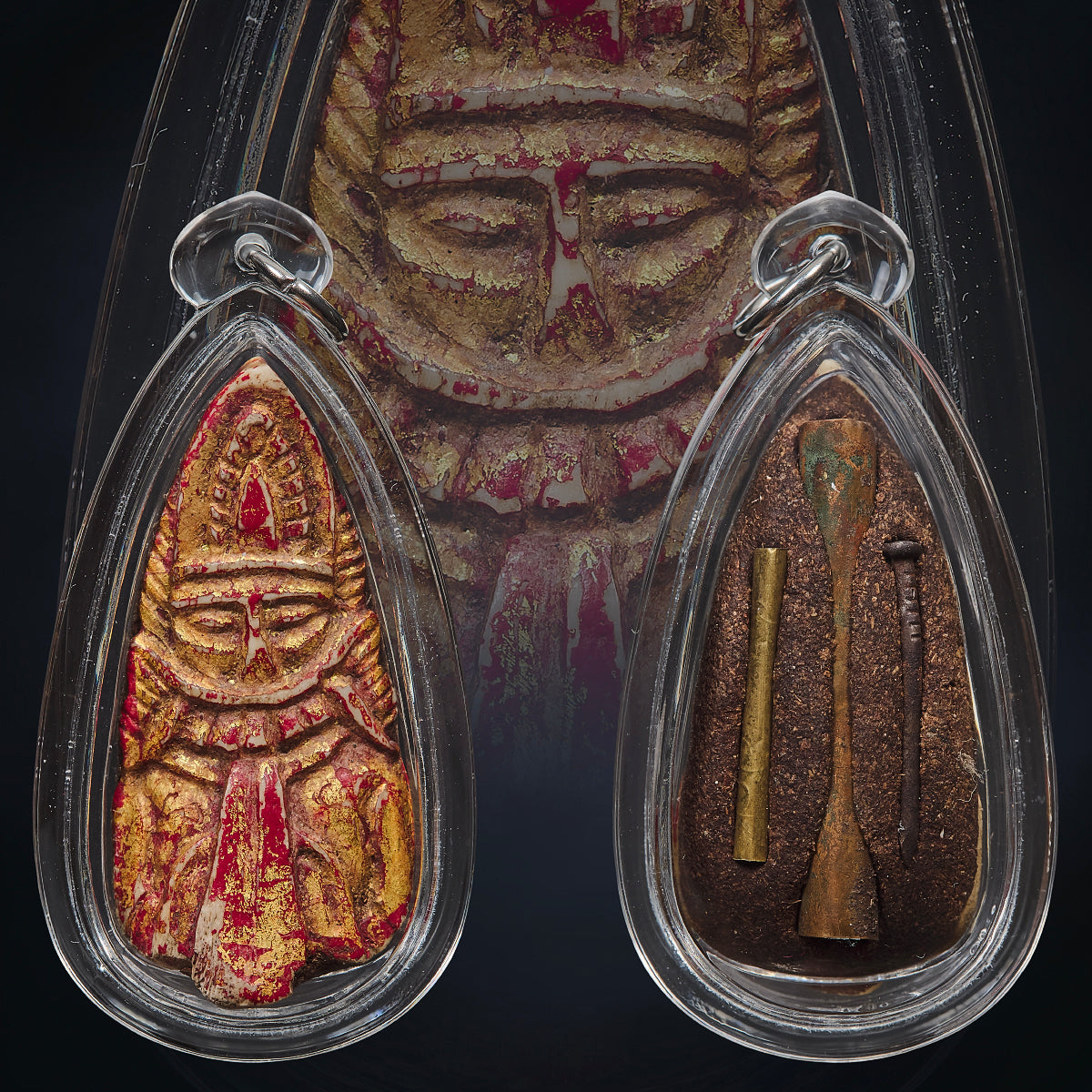
The front is carved from a naturally elongated piece of Paneang, depicting Phra Rahu in a distinctive upright guardian-like form. The facial features are strongly defined, with closed or lowered eyes and an elaborate upper headdress. Por Sala Tan prepared the carving with red lacquer mixed with Burmese wax before applying gold, and the remaining red can still be seen strongly through the worn gilding, particularly around the facial lines, headdress and lower body.
The reverse exposes the material construction of the artefact. A dark reddish-brown foundation of graveyard soil collected from the damaged burial grounds fills the rear surface.
Three principal ritual components are mounted vertically upon it. One is the coffin nail recovered from the grave, its naturally aged metal surface left clearly visible. Alongside it are the two individually prepared takruts — one for Choke Lap and windfall fortune, and the other for turning bad luck towards good fortune.
The simplicity of the reverse is significant. Rather than being heavily decorated, the actual cemetery-derived materials and dedicated takruts remain visible as the principal elements of the wicha.
The two sides therefore reveal the complete structure of the work: Rahu establishes transformation on the front; graveyard earth and the coffin nail provide the Gaduk Prai foundation; the twin takruts establish windfall fortune and reversal of bad luck.
The complete artefact is housed within a fitted clear casing.
Recommended Pairing
This is already a concentrated Rahu and Gaduk Prai piece, so additional strong spirit-oriented artefacts are unnecessary.
Phra Somdej provides a balanced Buddhist foundation of Baramee and stability. Phra Sivali complements the Choke Lap element with a steadier emphasis upon livelihood and abundance, while Tao Wessuwan may be paired where stronger guardianship and spiritual protection are desired.
Personal Notes
The most meaningful element of this Phra Rahu is the relationship between its origin and its final consecration.
The materials began in a place where circumstances had already changed violently.
Floodwaters overwhelmed the village and rice fields. Families were forced to leave their homes. The graves remained behind and were gradually damaged by rain and erosion.
Por Sala Tan entered that abandoned place because the former villagers were concerned for their dead.
He performed the necessary ceremonies first.
Only after communicating with the associated spiritual presences were selected materials taken for sacred work.
From those materials, Por Sala Tan chose to carve Rahu — the celestial figure whose very symbolism concerns darkness, disruption and eventual emergence from an eclipse.
He then added a coffin nail from the grave and two carefully separated intentions: one takrut to turn bad luck towards good, another to invite Choke Lap once the cycle had changed.
Yet he still waited.
The artefact was only completed when a lunar eclipse finally arrived.
That timing gives the piece its clearest symbolic continuity: material from a place transformed by disaster was made into Rahu, prepared for the transformation of difficult fortune, and finally consecrated during the celestial event that embodies Rahu's own mythology.
The message of the piece is therefore not simply “bring me luck.”
It is more deliberate:
Let Rahu consume what has become harmful. Let the difficult cycle reach its end. Then allow fortune to return when the darkness passes.
-
Free Shipping for Singapore| $15 Worldwide | $60 USA For Items Below $350