
OOBThaiAmulets
Por Sala Tan
Por Sala Tan
Couldn't load pickup availability
PST05
Yant Saneh Rang
Por Sala Tan
2.5 inches
Barang Artifact
Sacred Craftsmanship
Each example was individually inscribed and assembled by hand. Differences in the old relic, yantra, Nam Man Prai, takruts and placement of the ritual components naturally make every piece unique.
Personal Experiences Shared by Luksits
Artefacts produced from this particular group of relics developed a reputation among Por Sala Tan's luksits for having a noticeably strong presence.
Some users described feeling the character of the pieces almost immediately when carrying or keeping them nearby. Compared with ordinary metta works, the attraction was described as more direct and pronounced.
Feedback particularly concerned attention from the opposite sex and unexpected approaches from strangers. Users spoke of people initiating conversation more readily, showing unusual interest or remaining engaged longer than they normally expected.
Others described becoming more noticeable in social environments without deliberately seeking attention.
Because this Yant Saneh Rang combines the original relic lineage with a concentrated Saneh yantra and Nam Man Prai, it became associated with the stronger end of Por Sala Tan's Maha Saneh works.
These accounts remain personal experiences rather than guaranteed effects.
Summary
The Yant Saneh Rang is a specialised Por Sala Tan artefact devoted primarily to strong attraction, personal magnetism and favourable interpersonal response.
Its construction is deliberately concentrated.
The front is completely covered with Saneh yantra, creating the principal ritual field. The reverse combines Nam Man Prai, takruts and male-female attraction symbolism, reinforcing the same purpose through physical sacred materials.
The relic itself carries the history of an elderly couple who, according to the account received through Por Sala Tan's meditation, had lived together in a secluded mountain hut during their final years.
Por Sala Tan ritually sought permission to use their remaining relic material for metta and saneh work and subsequently invited the associated spiritual presence to assist the future keeper.
Historical Background
Saneh Rang belongs to the stronger attraction-oriented side of traditional Thai occult practice.
Where ordinary Metta Maha Niyom generally seeks goodwill, kindness and favourable treatment from a broad range of people, Saneh places greater emphasis upon personal fascination, attraction and the ability to become strongly noticed by another person.
Maha Saneh works may therefore incorporate materials and yantras different from general-purpose metta amulets.
Nam Man Prai has a particularly established place within this tradition. In traditional Barang practice, properly prepared Prai oil serves as a ritual medium connected with attraction, spirit work and the transmission of specific wicha.
Por Sala Tan's construction brings these elements together within one compact artefact: the yantra provides the written wicha, Nam Man Prai provides the ritual medium, and the original relic provides the spiritual foundation.
Origins of the Materials
The relic material originated from a remote mountainous area explored by one of Por Sala Tan's luksits while researching traditional wicha.
An old, apparently abandoned hut was found there, together with the relics. At the time, there was little information explaining who had once occupied the dwelling.
The materials were eventually brought to Por Sala Tan.
Rather than immediately using them, he meditated with the relics and attempted to establish their history — who they belonged to, why they remained in the hut and whether they could appropriately be incorporated into his work.
Through this process, Por Sala Tan understood them to be associated with an elderly couple who had chosen to live secluded in the mountains during the final period of their lives.
He subsequently sought permission to use portions of the relic material for the creation of metta and saneh artefacts.
The same origin forms the spiritual foundation of this Yant Saneh Rang.
Ritual
The front was personally and extensively worked by Por Sala Tan.
Rather than applying only a few sacred characters, he covered the surface with a complete grid of Saneh yantras, filling the available area with attraction-oriented inscriptions. The intention was to create a continuous ritual field across the entire face of the artefact.
The reverse was then assembled around the bottle of Nam Man Prai installed at its centre.
Handwritten takruts were positioned alongside it, accompanied by figures representing the male-female and attraction aspects of the wicha. These components were set into a prepared ritual base before the completed piece received further consecration.
Por Sala Tan then performed the appropriate rites and invited the associated spiritual presence to remain with the artefact and assist its keeper, following the same underlying lineage as the other works produced from these relics.
The finished piece is therefore both yantra-charged and spirit-assisted, with Nam Man Prai forming the central ritual medium on the reverse.
Blessings and Effects
The principal purpose of the Yant Saneh Rang is Maha Saneh.
Traditionally, it is intended to increase personal magnetism, make the user more noticeable and encourage stronger interpersonal response. Its emphasis is particularly associated with opposite-sex attraction, romantic attention and situations where the wearer wishes to become more approachable or memorable.
The metta aspect supports smoother interaction once contact has been established. In this sense, attraction and metta perform different roles: one draws attention, while the other encourages that attention to develop into a favourable interaction.
The piece is also associated with popularity and social presence. This can extend beyond romance into occupations where personal appeal and rapport matter, including sales, entertainment, hospitality and customer-facing work.
Because Nam Man Prai and an invited spiritual presence form part of its construction, this is traditionally regarded as a more specialised Barang Saneh piece, rather than a general-purpose Buddhist metta amulet.
Modern Application
In contemporary use, the Yant Saneh Rang remains primarily an attraction artefact.
Its traditional symbolism is particularly relevant to dating, meeting new people and situations where personal presence and first impressions are important.
The same qualities can extend naturally into social and professional settings. Someone working in sales or hospitality, for example, may value being approachable and remembered favourably. Performers and public-facing professionals may similarly relate to its emphasis upon visibility and audience response.
The central idea remains straightforward: to strengthen the user's presence so that others notice, approach and respond more readily.
As with Por Sala Tan's spirit-assisted works, traditional practice places importance upon respectful conduct and appropriate intentions when keeping the artefact.
Physical Details
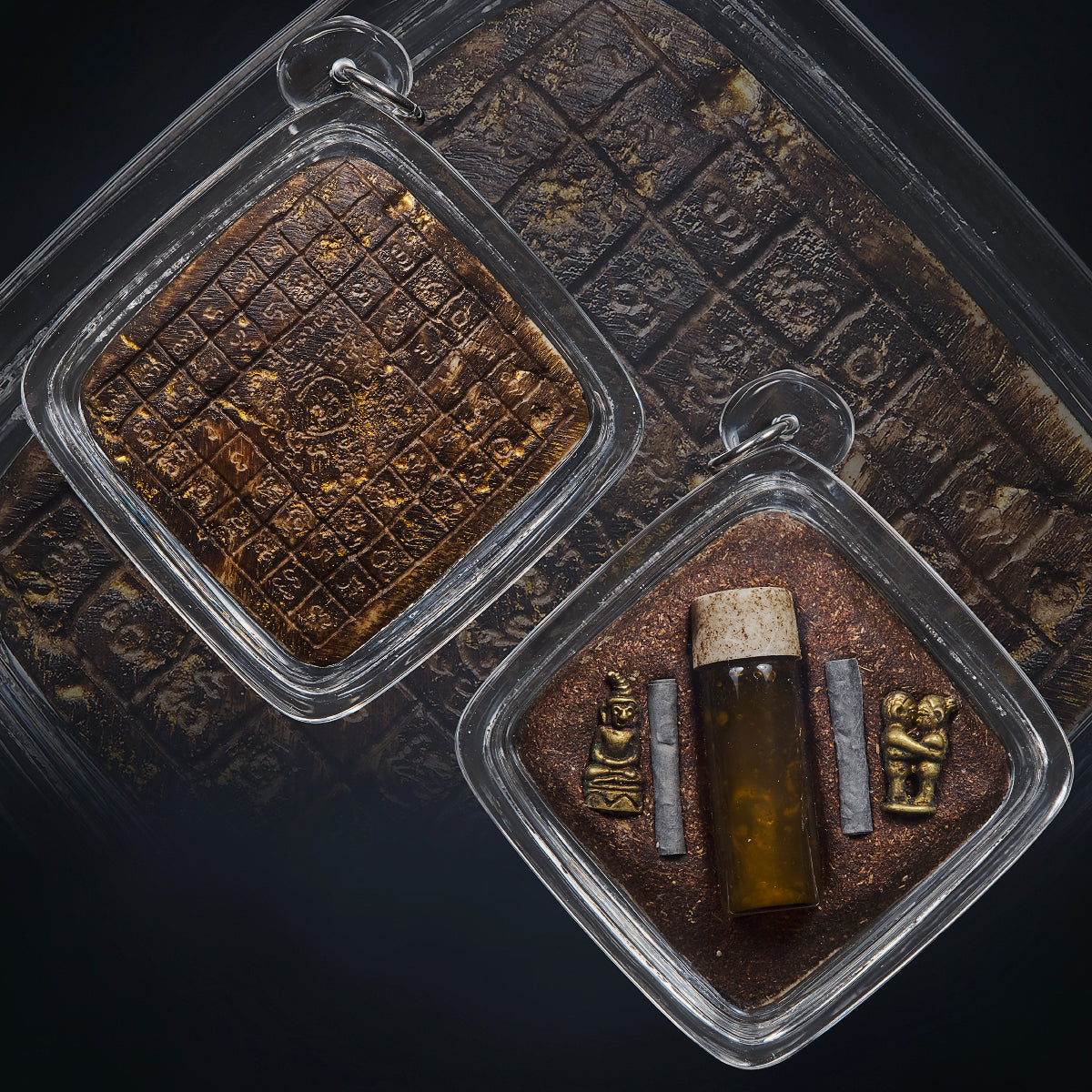
The Yant Saneh Rang is a diamond-shaped, double-sided artefact whose front is dominated by Por Sala Tan's fully hand-inscribed Saneh yantra. The surface is divided into numerous individual compartments containing sacred characters, with further ritual imagery worked into the centre. Traces of gold remain across the aged brown surface, highlighting portions of the densely engraved design.
The reverse reveals the material construction of the wicha. At the centre is a small sealed bottle containing Nam Man Prai, capped with a pale relic or sacred-material fitting. Two handwritten takruts stand vertically on either side of the bottle.
Small ritual figures flank the composition, including Ngan and Yin Tong imagery, reinforcing the male-female and attraction character of the piece. All of these elements are embedded upon a dark reddish-brown prepared sacred base.
The arrangement is highly deliberate. The front provides the complete written field of Saneh wicha, while the reverse physically contains the Nam Man Prai and supporting ritual components through which the same intention was reinforced.
The complete artefact is now housed within a clear fitted casing, preserving both the densely hand-yanted front and the original rear composition.
Recommended Pairing
The Yant Saneh Rang is already a highly concentrated attraction piece and does not require another strong Saneh artefact beside it.
For a more balanced combination, Phra Somdej may provide a calmer Buddhist foundation and Baramee. Those using the piece in commercial environments may pair it with Nang Kwak for customer attraction or Phra Sivali where livelihood and opportunity are equally important.
Personal Notes
This Yant Saneh Rang shows a different application of the same unusual mountain relics used in Por Sala Tan's other attraction works.
In the Salika form, greater emphasis was placed upon communication and attraction through speech.
Here, Por Sala Tan concentrated the work much more directly upon Saneh itself.
The entire front became a field of attraction yantra. The reverse was centred upon Nam Man Prai, supported by takruts and male-female imagery. Behind these physical components remained the history of the elderly couple whose relics had been discovered within the abandoned mountain hut.
Por Sala Tan first sought to understand that history before using the material. Only after meditation and ritually requesting permission did he transform portions of the relics into these specialised works.
The result is one of the more concentrated expressions of his Saneh practice: relic as the foundation, yantra as the written wicha, Nam Man Prai as the ritual medium, and the invited presence as the assisting force.
-
Free Shipping for Singapore| $15 Worldwide | $60 USA For Items Below $350