
OOBThaiAmulets
Por Sala Tan
Por Sala Tan
Couldn't load pickup availability
PST05
Phaya Burisat
Por Sala Tan
Barang Artifact
2.5 inches
Sacred Craftsmanship
The relic was subsequently carved according to this instruction. Each example was individually prepared by hand, with natural differences in the old material, carving, herbs, cave soil, takruts and ritual composition making every completed piece unique.
Personal Experiences Shared by Luksits
Experiences surrounding Por Sala Tan's Phaya Burisat have tended to centre upon authority, advancement, recognition and opportunity.
Earlier luksits reported becoming more noticeable within their professional environments. Some felt that colleagues and superiors began taking their opinions more seriously, while others described being entrusted with responsibilities that placed them closer to decision-makers and people of greater influence.
There were also reports concerning wealth and opportunity. These were not always described as sudden financial gains. More commonly, users spoke of recognising openings earlier, meeting useful contacts, gaining access to influential people or being presented with opportunities that could improve their professional position.
One particularly vivid account concerned a user whose career advanced considerably within a relatively short period and who eventually became a provincial governor. Among luksits familiar with the piece, this became one of the memorable experiences associated with the Phaya Burisat's qualities of authority and advancement.
Such experiences remain personal testimonies rather than guarantees, but they closely reflect the traditional qualities attributed to this form of wicha.
Summary
Phaya Burisat is traditionally regarded as one of the powerful attendants within the retinue of Tao Wessuwan, the great guardian associated with command over yaksha and spirit beings.
His traditional character centres upon authority and the maintenance of order. Phaya Burisat is described as capable of suppressing unruly spiritual forces and commanding beings that refuse proper control. This formidable reputation gradually gave rise to his association with protection, leadership, prestige and personal authority.
Por Sala Tan's version combines this guardian tradition with the Lersi Ser Ming Pai lineage of the original relic. The reverse then broadens its purpose through wealth- and popularity-oriented herbs together with soil from the cave itself.
The resulting artifact therefore brings together several complementary qualities: command, protection, Baramee, popularity, wealth and advancement.
Historical Background
Within Thai traditional belief, Tao Wessuwan stands as a great guardian and ruler over numerous classes of yaksha and spirit beings. Phaya Burisat is traditionally counted among the powerful attendants entrusted with maintaining order within this domain.
Folklore portrays him as particularly formidable towards dangerous or disobedient spirits. Some traditions describe him as capable of consuming unruly entities, an image intended to convey the extent to which lesser harmful forces are believed to fear his authority.
The deeper principle is control through superior Baramee and power.
Phaya Burisat is also connected in traditional accounts with guardianship of sacred places, relics and chedis. Guardian imagery of this wider tradition can be encountered particularly across northern Thailand and neighbouring regions of Myanmar.
For practitioners, these characteristics extend naturally into worldly matters. The same force that commands disorder symbolically becomes leadership, reputation, confidence and the ability to hold one's position when surrounded by competition or opposition.
Origins of the Materials
The principal relic was discovered during Por Sala Tan's travels in northern Thailand.
After sensing the unusual presence within the cave, he entered meditation rather than immediately disturbing the site. During this meditation, he believed he established contact with a powerful Lersi associated with the location.
The presence guided him towards relic material understood to be connected with a practitioner of Lersi Ser Ming Pai wicha. Por Sala Tan was then directed to use the material specifically for the carving of Phaya Burisat.
Importantly, Por Sala Tan also retained soil from the cave. This was later incorporated into the reverse of the finished artifact, maintaining a physical connection between the completed piece and the location where its principal material had originated.
The reverse was further prepared with sacred herbs traditionally used for increasing wealth and popularity. These ingredients expanded the character of the artifact beyond protection and command, directing part of its wicha towards favourable social response, recognition and material opportunity.
Ritual
Once the Phaya Burisat carving had been completed, Por Sala Tan did something particularly important: he returned the artifact to the original cave.
The principal consecration was deliberately arranged to coincide with a lunar eclipse.
Within traditional occult practice, eclipses are regarded by some lineages as powerful transitional periods suitable for particular forms of ritual work. Por Sala Tan selected this moment for a rite involving authority, guardian forces and the strong presence he had originally encountered within the cave.
During the eclipse, he meditated and performed the appropriate incantations. The essence of Phaya Burisat was ritually invited and stabilised into the carving, while the Lersi Ser Ming Pai connection of the original relic was retained through the materials installed at the reverse.
The cave soil further anchored the finished artifact to the place of discovery, completed with yant.
In this way, the consecration brought together the original cave, Lersi relic, Phaya Burisat, eclipse and Por Sala Tan's own wicha within a single ritual process.
Blessings and Effects
The central quality of this Phaya Burisat is Amnaj — authority and command. It is traditionally suited to those who need to lead, make decisions, manage others or maintain their standing when faced with strong personalities and competition.
Closely related is Baramee, the personal weight and presence through which others naturally recognise someone's position. This aspect makes the piece particularly relevant to professional advancement, leadership and those aspiring towards greater responsibility.
Its guardian nature provides the protective dimension. Phaya Burisat is traditionally associated with suppressing unruly spiritual influences and is therefore sought for protection against harmful forces, hostile intentions, black magic and spiritually unsettled environments.
The herbs installed at the reverse introduce another important direction: wealth and popularity. Popularity here should not be understood simply as fame. Within traditional metta-oriented practice, it refers to being favourably received, remembered, supported and accepted by those one encounters.
Combined with authority, this creates an interesting balance. The intention is not merely for others to fear or obey the wearer, but for authority to coexist with favourable recognition and support.
Wealth then follows the same practical principle: greater recognition can lead to stronger networks; stronger networks create opportunities; and suitable opportunities can lead to advancement and improved financial circumstances.
Modern Application
The Phaya Burisat is especially relevant to people working in environments where position, reputation and relationships are closely connected.
For someone seeking promotion, its traditional symbolism concerns both attaining greater responsibility and developing the presence required to carry that responsibility successfully.
For business owners and senior professionals, the combination of authority and popularity can be equally meaningful. Leadership alone may command attention, but favourable interpersonal response helps turn that attention into cooperation.
Those in government, administration, management, sales or organisational leadership may therefore find particular meaning in the combination of Amnaj, Baramee, Metta and wealth-oriented wicha within the same artifact.
The experience of the luksit who later rose to become a provincial governor is remembered precisely because it reflects this combination — visibility, recognition, authority and advancement occurring together.
Physical Details
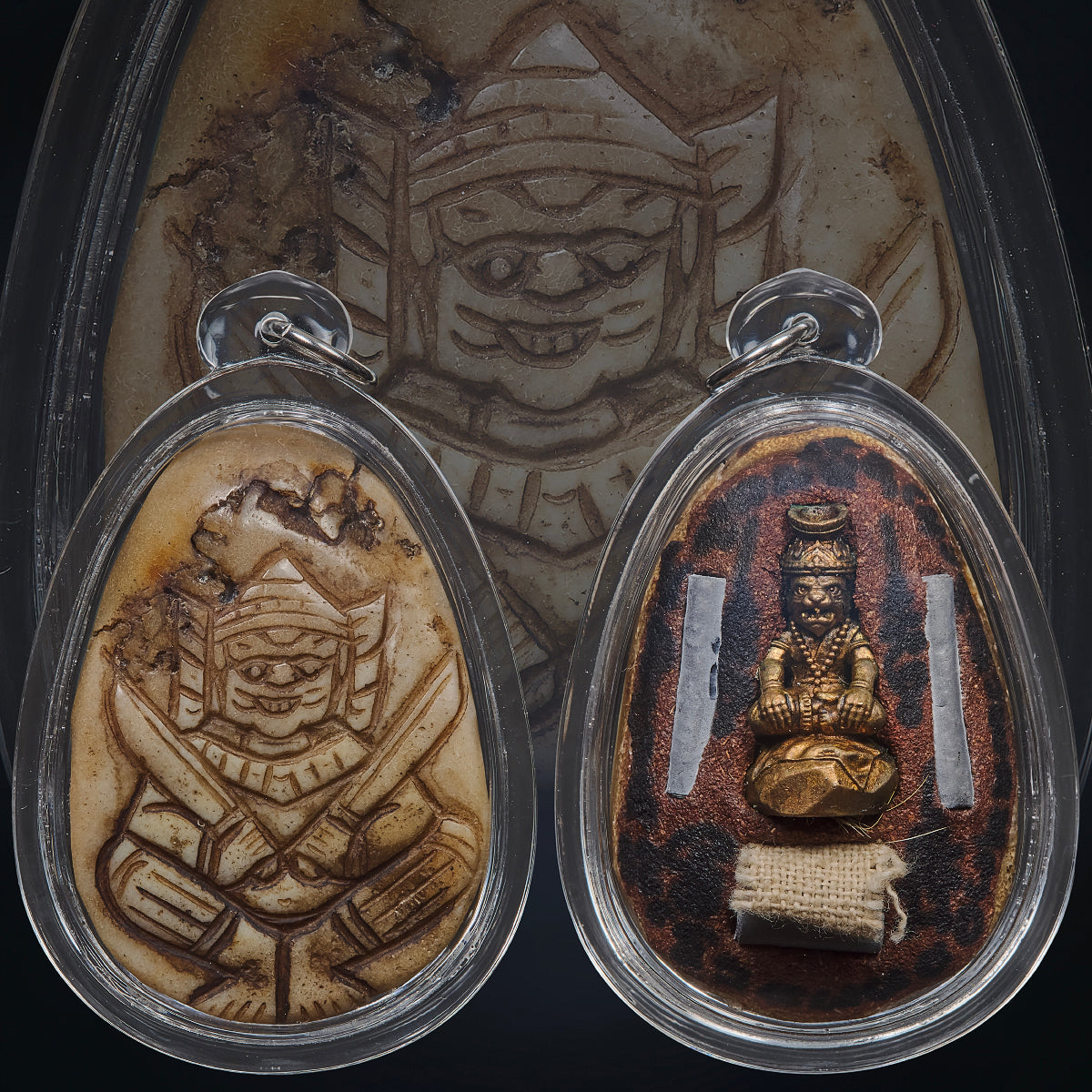
The artifact is carved from an old sacred relic associated with a practitioner of Lersi Ser Ming Pai wicha. On the front, Phaya Burisat appears as a formidable guardian with crossed arms, his strong facial expression and compact seated posture emphasising command and restraint. The natural ageing, colour variation and irregularities of the original relic remain visible around the carving.
The reverse contains the more complex ritual composition. A small metallic Lersi Ser Ming Pai figure occupies the centre, with handwritten takruts positioned alongside it. Around and beneath these elements are the prepared sacred materials used by Por Sala Tan, including herbs for increasing wealth and popularity together with soil brought back from the original northern cave.
The dark red, brown and black tones visible across the rear reflect this layered preparation of herbs, soil and ritual substances. Additional material is bound beneath the Lersi figure, completing the compact arrangement.
The two sides consequently perform different roles within the same object. Phaya Burisat forms the visible face of authority and guardianship, while the reverse preserves the Lersi lineage, cave connection, wealth and popularity wicha that support the carving.
The completed artifact is housed within a fitted clear protective casing, allowing both the carved relic and the original ritual composition at the rear to remain visible.
Recommended Pairing
The Phaya Burisat is sufficiently complete to function as a principal piece because it already combines authority, protection, popularity, opportunity and wealth-oriented wicha.
For professional advancement, it may be paired with Phra Somdej to provide a calmer foundation of Buddhist Baramee and stability. Phra Sivali complements its wealth and opportunity aspects, while Tao Wessuwan forms a natural pairing for those wishing to place greater emphasis upon guardianship, authority and command.
Personal Notes
The most important feature of this Phaya Burisat is the continuity between the relic, the cave and the final consecration.
Por Sala Tan first entered the cave because he sensed an unfamiliar but powerful presence. Through meditation, he believed that a Lersi guided him towards the relic and instructed him to create Phaya Burisat from it.
After the carving was completed, Por Sala Tan did not simply consecrate it elsewhere and consider the work finished. He returned to the same cave during a lunar eclipse, bringing the completed carving back to the place where its story had begun.
Even the cave itself remained physically represented in the finished artifact through the soil incorporated into its reverse.
The Lersi relic provides the lineage. The cave soil preserves the connection to place. The herbs direct the wicha towards wealth and popularity. Phaya Burisat provides authority and protection.
Together, they explain why this particular piece became associated not merely with defence, but with a broader form of worldly Baramee — to be recognised, to gain support, to encounter opportunity and to rise when the path towards greater responsibility opens.
-
Free Shipping for Singapore| $15 Worldwide | $60 USA For Items Below $350