
OOBThaiAmulets
Por Sala Tan
Por Sala Tan
Couldn't load pickup availability
PST05
Salika Ling Tong Relic
Por Sala Tan
Mainstream Artifact
1.5 inches
Sacred Craftsmanship
Only a limited quantity could be produced from the materials supplied by the monks. The pieces received blessing together with the Burmese forest practitioners before Por Sala Tan brought them back to Thailand for further ritual preparation and consecration.
Each example was assembled and inscribed individually by hand. Variations in the relic, Kao Kwai carvings, herbal mixture, wax, takruts and yantra therefore make every surviving piece naturally unique.
Personal Experiences Shared by Luksits
Feedback surrounding Por Sala Tan's Salika works has consistently centred upon speech, confidence and interpersonal response.
Several users reported that they became noticeably more confident when speaking with customers or presenting products. Rather than describing an abrupt change in personality, they spoke of being able to explain themselves more naturally, approach customers with less hesitation and maintain conversation more comfortably.
This has made Por Sala Tan's Salika artefacts particularly sought after among salespeople and those whose income depends upon communication.
Users have also reported positive experiences when promoting products, dealing with customers and attempting to gain another person's attention long enough to explain an offer or proposal.
Summary
The Salika Ling Tong belongs to an old family of Southeast Asian metta and speech-related wicha.
Salika imagery is traditionally associated with pleasant speech, persuasive communication, popularity and the ability to make others receptive to one's words. The paired form, often understood through the idea of two birds communicating harmoniously, further strengthens its association with conversation and interpersonal attraction.
This particular piece combines several traditions within one artefact: handwritten Salika yantra, sacred relic material, Kao Kwai, takruts, metta-saneh herbs, Yoni herbs and Burmese red wax.
Its close material and ritual connection with Burmese forest monks gives it an especially interesting place among Por Sala Tan's limited handmade Salika works.
Historical Background
Salika wicha takes its symbolism from the small bird traditionally admired for its attractive voice and lively communication.
Within Thai occult traditions, Salika consequently became associated with Waja Saksit and metta through speech — words that attract attention, create goodwill and encourage others to listen.
The wicha became particularly relevant to occupations where personal communication determines opportunity: merchants, travelling traders, negotiators, performers and those who regularly deal with strangers.
Por Sala Tan's version carries an additional Burmese influence. Through his contact with forest practitioners, he incorporated materials and methods outside the more familiar central Thai Salika tradition, particularly the preparation of the herbal components found at the rear.
Origins of the Materials
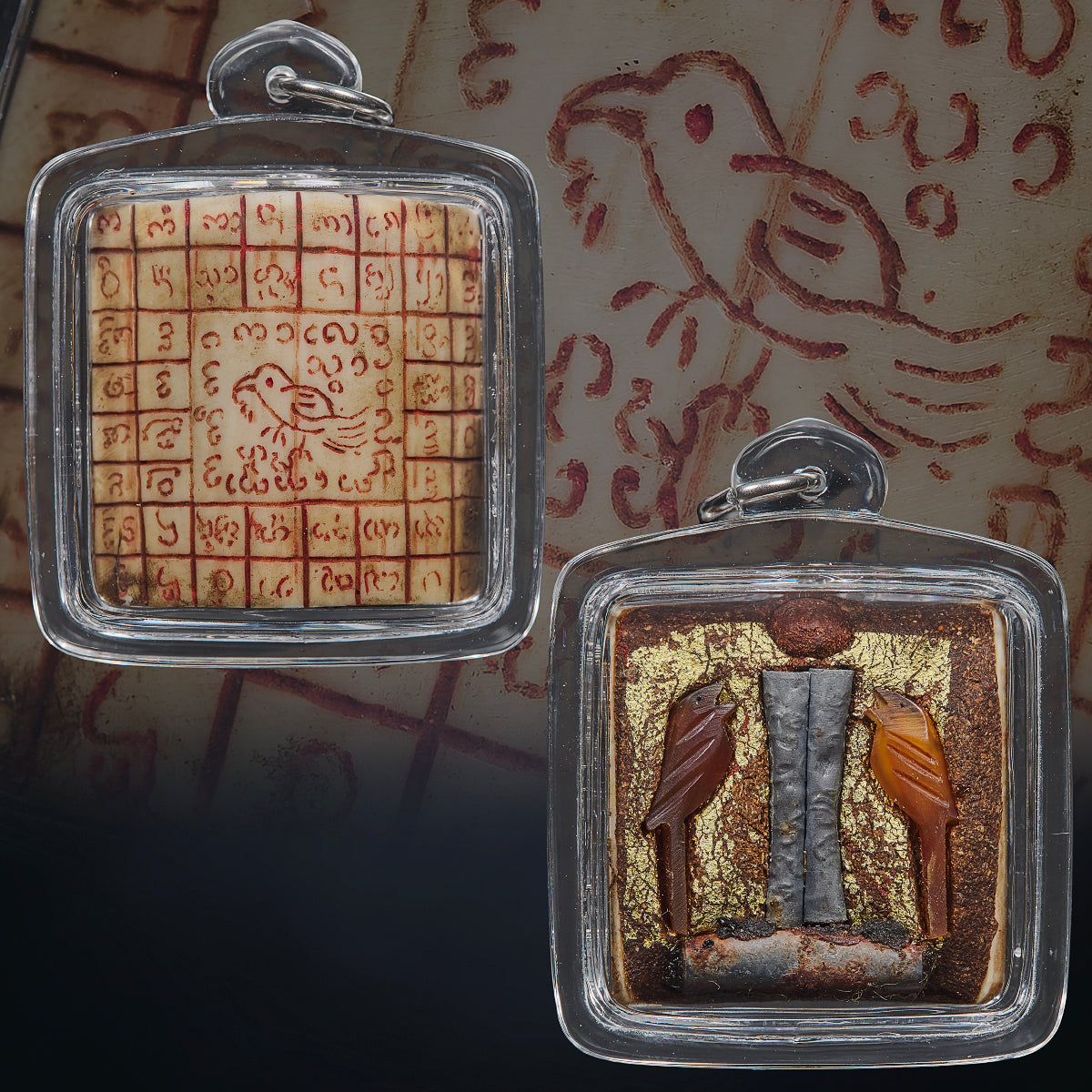
The front relic originated from Burmese forest monks and later became the physical foundation upon which Por Sala Tan inscribed the Salika Ling Tong yant.
On the reverse are two Salika birds carved from Kao Kwai, creating a physical representation of the paired Salika wicha rather than relying solely upon written yantra.
Handwritten takruts provide another layer of ritual inscription.
Sacred metta and saneh herbs were placed within the rear cavity and combined with traditional Burmese red wax.
Of particular importance is the small Yoni herbal preparation. Por Sala Tan learned the method from the Burmese forest monks and prepared it as a concentrated component within the artefact. Within this context, Yoni symbolism belongs to attraction and receptive energy, complementing the communicative qualities represented by the paired Salika.
Ritual
The construction followed more than a single blessing ceremony.
The original materials were obtained through the Burmese forest-monk lineage, and the limited pieces received ritual blessing in association with those practitioners.
After returning to Thailand, Por Sala Tan continued the work himself. He inscribed the Salika yantra, assembled the Kao Kwai birds, takruts and herbal components, and subjected the completed artefacts to additional blessing according to his own wicha.
This combination is significant: the piece preserves the Burmese source lineage of its materials and herbal knowledge while carrying Por Sala Tan's own ritual handwriting and consecration.
Blessings and Effects
The traditional emphasis of this Salika Ling Tong is Metta Maha Niyom and persuasive communication.
It is associated with smoother speech, confidence when approaching others, gaining attention during conversation and creating a more receptive atmosphere during discussions.
The saneh components extend this towards personal attraction and favourable interpersonal response, while the paired Salika imagery emphasises communication between two parties.
For commercial use, its traditional purpose is particularly relevant to sales, negotiation, customer relations, presentations and product promotion.
The intention is not simply to speak more, but to have one's words heard, received and remembered favourably.
Modern Application
The traditional Salika concept translates particularly naturally into modern commercial life.
A salesperson may use it as a focus before approaching an important customer. A business owner may pray before negotiations. Those working online may associate the same wicha with livestream selling, presentations, client calls, marketing and product demonstrations.
It can equally apply outside commerce: interviews, networking, teaching, public speaking or any situation where confidence and clear communication affect the outcome.
The practical principle remains much the same as it was for earlier traders: opportunity often begins when another person is willing to listen.
Physical Details
Type: Salika Ling Tong sacred artefact
Master: Por Sala Tan
Tradition: Thai–Burmese wicha
Production: Limited quantity
Front: Sacred relic received from Burmese forest monks, personally hand-yanted by Por Sala Tan with the Salika Ling Tong yantra and surrounding sacred script.
Reverse: Pair of Salika Ling Tong individually carved from Kao Kwai, handwritten takruts, sacred metta-saneh herbs, Burmese red wax and the distinctive ball-like Yoni herbal preparation taught through the Burmese forest-monk lineage.
The piece is presently protected within a clear pendant casing while retaining visibility of both its hand-inscribed front and densely constructed reverse.
Recommended Pairing
This piece is already strongly focused upon speech, metta and interpersonal attraction, so it works particularly well as a specialised communication artefact.
For commercial purposes it may be paired with Nang Kwak for customer attraction or Phra Sivali for opportunity and abundance. For those wanting greater authority alongside the softer Salika qualities, a tiger or Lersi-based piece can provide a complementary emphasis upon confidence and command.
Personal Notes
What makes this Salika particularly interesting is not simply the pair of Kao Kwai birds visible at the back, but the continuity of knowledge behind its construction.
The relic and certain materials came from Burmese forest monks. The preparation of the Yoni herbs was learned from them. The initial spiritual connection was established within that lineage, while Por Sala Tan subsequently completed the yantra, construction and additional blessing in Thailand.
It is therefore a small but highly detailed example of how Por Sala Tan incorporated knowledge received through cross-border forest traditions into his own wicha.
Among his Salika works, its traditional purpose remains very clear: good speech opens conversation; conversation opens opportunity.
-
Free Shipping for Singapore| $15 Worldwide | $60 USA For Items Below $350