
OOBThaiAmulets
Por Sala Tan
Por Sala Tan
Couldn't load pickup availability
PST05
Wa Tanoo
Por Sala Tan
Mainstream artifact
1 inch
Sacred Craftsmanship
Each Wa Tanoo was individually formed from prepared herbal material, so differences in shape, surface, texture and ageing are natural characteristics of these handmade pieces.
Personal Experiences Shared by Luksits
These small Wa Tanoo were remembered primarily as protective pieces for children rather than elaborate collector's objects.
In the villages around the northern countryside, children commonly played outdoors and sometimes wandered towards nearby fields, woodland and forest edges. Encounters with snakes, insects and other animals were a genuine concern, alongside the ordinary risks of falls, sickness and becoming lost.
Parents therefore tied these small Wa Tanoo around a child's wrist or neck with Sai Sin and regarded the bull as a travelling guardian.
Older villagers also associated them with protection during periods when children were frequently unwell. The Nur Wahn itself consisted of herbs regarded within traditional practice as protective and disease-resisting in character.
For many families, the attraction of the piece was its simplicity: small enough for a child to carry continuously, yet made specifically with protection in mind.
Summary
This is one of Por Sala Tan's more practical expressions of Wa Tanoo wiccha.
The bull is deliberately compact and uncomplicated. Its purpose was not decorative grandeur but continuous protection, particularly for younger members of rural families.
Within traditional belief, Wa Tanoo is regarded as a guardian force capable of standing between its keeper and harmful influences. Por Sala Tan combined this established guardian symbolism with Nur Wahn, creating a piece intended for protection on both the spiritual and everyday levels.
Its traditional purposes include Klaew Klaad, protection against harmful spiritual influences and black magic, defence from animals, strengthening against illness and general safeguarding while travelling or moving through unfamiliar places.
Historical Background
Wa Tanoo, or Wua Tanu, belongs to an old family of Thai protective wiccha in which the bull becomes more than an agricultural animal.
The bull traditionally represents strength, endurance, territorial protection and the ability to confront danger directly. In occult practice, an empowered Wa Tanoo may therefore be treated as a spiritual guardian rather than merely an image representing a bull.
Certain traditions are closely connected with bulls struck by lightning, whose remains are regarded as carrying an unusually forceful natural current. Other lineages construct Wa Tanoo from metals, powders, woods or sacred herbal preparations according to the purpose of the master.
Por Sala Tan worked with several forms of Wa Tanoo during different periods. This particular type is significant because it was made from Nur Wahn and reduced to a size suitable for everyday village use, including by children.
Origins of the Materials
The body is composed primarily of Nur Wahn, a prepared mixture of herbs selected according to traditional protective properties.
Within older Northern practice, Wahn may be collected and combined for different purposes. Some are associated with warding harmful influences; others with strengthening, protection, recovery or maintaining physical well-being.
For this Wa Tanoo, Por Sala Tan's emphasis was protective.
The herbal body therefore complemented the guardian character of the bull: one element representing a force capable of confronting danger, the other providing the traditional protective qualities of sacred plants.
The pierced body also allowed Sai Sin to become part of its practical construction when worn.
Ritual
Por Sala Tan prepared and consecrated these pieces principally as guardian amulets.
The Wa Tanoo form was empowered towards standing guard against harmful influences, while the Nur Wahn provided the herbal foundation of the piece.
Particular attention was given to the realities of rural life. Children could wander beyond the immediate household, play around agricultural land or enter the edges of nearby forest. Protection against animal encounters, accidents, harmful spiritual influences and illness was therefore part of the original intention behind the series.
Once completed, Sai Sin could be passed through the central opening and the Wa Tanoo tied securely to the wearer.
Blessings and Effects
Traditional qualities associated with this Wa Tanoo include:
- Klaew Klaad — passing safely through danger
- Protection against harmful spiritual influences
- Defence against black magic and hostile intentions
- Protection against animal attacks and dangerous encounters
- Traditional herbal protection against illness and disease
- Strength and resilience during difficult periods
- Greater personal confidence and stability
- Guardian protection while travelling or entering unfamiliar surroundings
- Stability in livelihood, business and finances
Its central character remains protection first. Wealth and stability are secondary qualities arising from the broader Wa Tanoo tradition.
Modern Application
Although originally particularly practical for village children, the same concept translates easily into modern life.
Its unusually small dimensions make it suitable for people who prefer an unobtrusive protective piece. It may be worn around the neck, carried discreetly, or retained as a small household guardian.
For travellers, outdoor workers and people regularly moving through unfamiliar environments, the traditional symbolism of Klaew Klaad and guardian protection is especially appropriate.
It is also an interesting piece for collectors studying Por Sala Tan's work because it demonstrates how his wiccha was sometimes adapted around ordinary community needs rather than created solely as elaborate ritual artefacts.
Physical Details
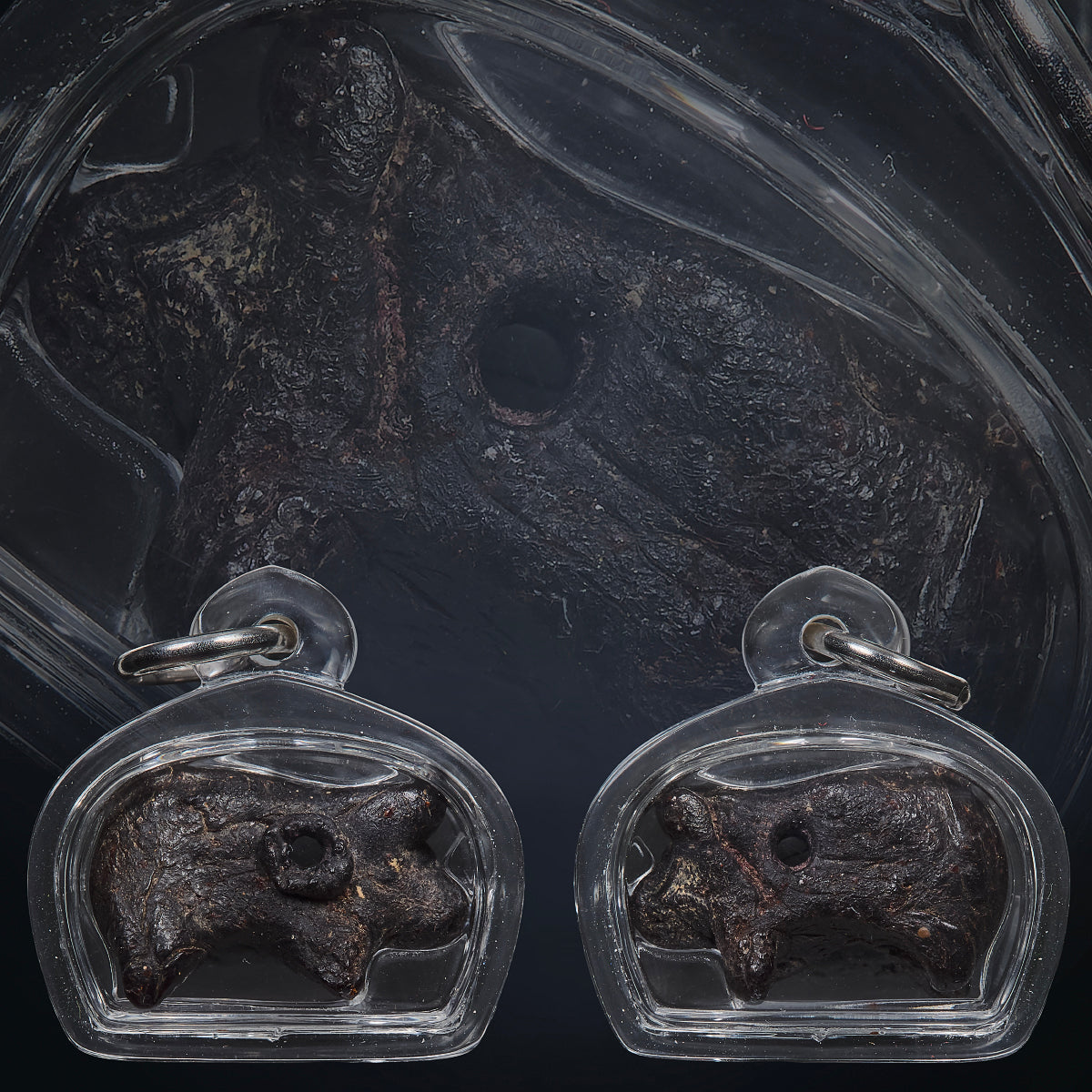
The piece takes the natural form of a small standing bull, with the head lowered slightly forward and the body kept deliberately compact.
It is made from dark Nur Wahn herbal material, now showing considerable natural ageing, surface irregularity and patination.
Most distinctive is the round opening passing through the body. This functional feature allowed Sai Sin to be threaded through the Wa Tanoo so it could be worn around the wrist or neck.
Its small size was intentional, making the guardian comfortable enough for everyday wear and particularly suitable for children.
Recommended Pairing
This Wa Tanoo already functions as a dedicated protective piece and does not require another amulet to complete its traditional purpose.
For adults, it may be paired with a Baramee-oriented Buddhist amulet when greater emphasis upon confidence, authority and career stability is desired.
For those keeping stronger spirit-based or Yin objects, the Wa Tanoo can instead occupy the protective side of a collection, providing a traditional guardian element alongside those more specialised pieces.
Personal Notes
What makes this Wa Tanoo particularly meaningful is its original purpose.
It was not made primarily as a rare display object. Por Sala Tan made these small enough to be threaded with Sai Sin and placed directly around the wrists or necks of village children.
That detail gives the piece considerable context.
In a rural environment where children could wander into fields and nearby forest, the concerns of parents were immediate: animals, accidents, sickness, unseen dangers and simply wanting their children to return home safely.
Por Sala Tan answered those concerns through a very simple construction — a small guardian bull made from protective Nur Wahn, pierced so that it could remain continuously with the child.
Today, surviving examples provide an interesting glimpse into the practical side of older Northern wiccha, where sacred objects were not always created for collectors. Sometimes they were made for something much more straightforward: to guard the people who wore them in everyday life.
-
Free Shipping for Singapore| $15 Worldwide | $60 USA For Items Below $350