
OOBThaiAmulets
Por Sala Tan
Por Sala Tan
Couldn't load pickup availability
PST05
Mae Ba Nang Lueng
Por Sala Tan
B.E. 253x
Barang Artifact
1.5 inches
Sacred Craftsmanship
Each piece was individually prepared from hand-mixed sacred materials, with the relics and takruts positioned separately. Natural differences in texture, colour, facial formation and material placement therefore make every surviving example unique.
Personal Experiences Shared by Luksits
Early keepers of Mae Ba Nang Lueng frequently spoke about Saneh and favourable human interaction as the most immediately noticeable characteristics.
Business owners and people working in sales described customers becoming easier to approach, conversations lasting longer and negotiations progressing with less resistance. Some associated periods of improved business and repeated customer activity with keeping the Mae.
Others approached her for personal relationships. Accounts commonly centred upon renewed communication, reconciliation after disagreements, greater attention from the opposite sex and an increased ability to attract people's interest.
The experiences were not always described as dramatic events. Some keepers simply felt that people became more receptive towards them, making it easier to build relationships, ask for assistance or create opportunities through conversation.
These remain personal accounts from devotees rather than independently verifiable effects, but they explain why Mae Ba Nang Lueng developed a particularly strong reputation among Por Sala Tan's early Barang collectors.
Summary
Mae Ba Nang Lueng is one of Por Sala Tan's older Prai-based female spirit artifacts, with this main batch dating to approximately B.E. 253x.
According to the lineage account, Mae Ba Nang Lueng had been a Cambodian woman deeply involved with old Khmer wicha. She became particularly remembered for strong Maha Saneh, together with more forceful occult practices.
Following her death, local villagers associated a series of disturbances with her lingering presence. Por Sala Tan eventually travelled to the area and spent approximately two weeks performing rites intended to settle and regulate the spirit.
Recognising what he regarded as an unusually powerful current, he subsequently incorporated relic materials associated with her into a small number of sacred objects.
Historical Background
The oral history surrounding Mae Ba Nang Lueng describes her as a Cambodian practitioner of Khmer wicha who eventually settled within the wider Isan-border region.
She was remembered particularly for Saneh. Stories surrounding her describe an unusually compelling personal presence, with people approaching her for assistance in matters of attraction, reconciliation and material opportunity.
Her reputation also had a considerably darker side. Villagers believed she possessed knowledge of aggressive occult practices and could direct her wicha against enemies or assist people involved in dangerous activities.
According to the traditional account, she had maintained a vow of celibacy connected with her practice. This changed after meeting a traveller described as possessing unusually strong Baramee and Yang energy. She became involved with him and later became pregnant.
Her subsequent loss of spiritual confidence and personal circumstances were said to have led to her death by suicide.
Afterwards, villagers attributed unusual disturbances to her lingering spirit. Agricultural tools reportedly disappeared, crops were disturbed, couples experienced inexplicable quarrels followed by equally unusual reconciliation, and travellers told stories of seeing a female figure drawing them towards the forest.
These accounts belong to the oral tradition surrounding the artifact and are best understood as part of its provenance rather than documented historical fact.
Origins of the Materials
The principal material is a mixture containing bone ash and small relic chips associated with Mae Ba Nang Lueng.
Within Por Sala Tan's Barang practice, physical material connected with a particular spirit could function as a medium or anchor, preserving a direct relationship between the artifact and the spiritual identity invoked during its creation.
A Paneang fragment associated with Mae Ba Nang Lueng was also incorporated into the construction. Such material was considered especially important where the practitioner intended to maintain a specific spiritual connection rather than create a general Prai amulet.
The remaining body was prepared from Por Sala Tan's ritual material mixture before the individual pieces were formed.
Ritual
Por Sala Tan's involvement reportedly began after villagers sought assistance with the disturbances attributed to Mae Ba Nang Lueng.
The journey to the village itself required approximately five hours by van, after which Por Sala Tan remained in the area for around two weeks. During this period he performed repeated ceremonies, recited katha and made offerings while attempting to communicate with and settle the spirit.
Rather than simply suppressing what was regarded as a powerful presence, Por Sala Tan's approach was to regulate and redirect it towards assistance.
This principle continued into the construction of the amulet.
Each piece required eight takruts, reflecting the amount of ritual control Por Sala Tan considered necessary. The takruts acted as the governing structure around the Prai material, directing its traditional qualities towards Metta, Saneh, prosperity and protection.
Blessings and Effects
The strongest traditional association of Mae Ba Nang Lueng is Maha Saneh — attraction, personal magnetism and the ability to draw attention.
Closely related is Metta Mahaniyom, particularly where favourable treatment, persuasion and social acceptance are important. This makes the Mae traditionally relevant to salespeople, business owners, entertainers and occupations that depend heavily upon personal interaction.
Wealth is approached indirectly through these qualities. The emphasis is upon drawing people, opportunities and favourable circumstances, allowing business and livelihood to develop through human connections.
Protection forms another aspect of the practice, particularly against hostile intentions and spiritual disturbances.
Because this is a Prai-based artifact, its traditional character is considerably different from mainstream Buddhist amulets and should be understood within the folk-occult tradition from which it originated.
Modern Application
Mae Ba Nang Lueng is particularly associated with professions where charisma and human relationships directly influence results.
For business owners, the traditional intention is to encourage customer attraction and repeated opportunities. Sales and finance professionals may approach the Mae for smoother communication, persuasion and stronger rapport with clients.
Within personal relationships, the emphasis is traditionally upon attraction, reconciliation and restoring communication where affection has weakened.
Collectors who keep Barang artifacts may also value this batch historically. It represents an older period of Por Sala Tan's practice when individual spirit-related materials were prepared in relatively small quantities and required substantial manual ritual work.
Physical Details
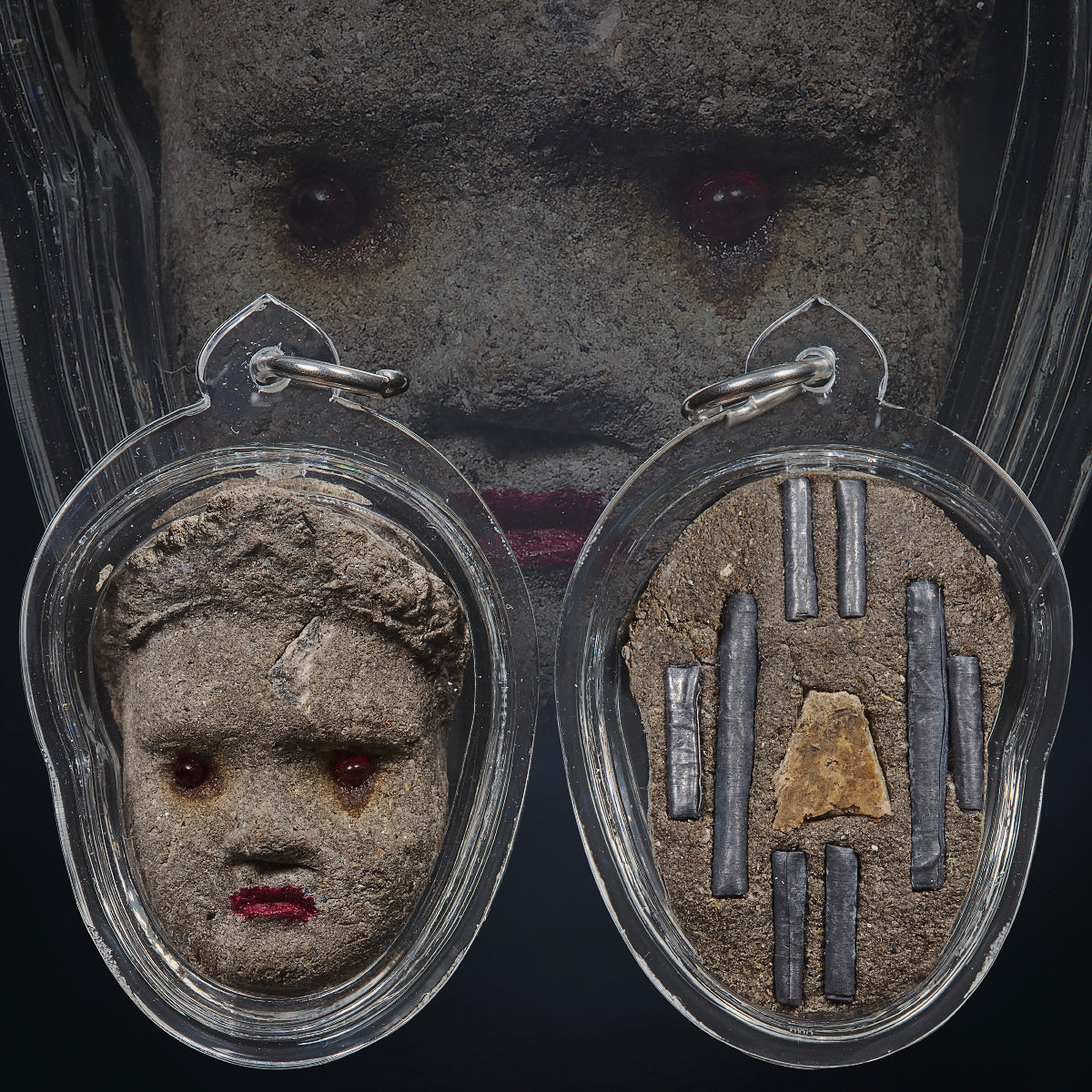
This is a compact oval amulet measuring approximately 1.5 inch, formed primarily from an aged grey-brown sacred powder and bone-ash mixture.
The front presents a simple female face in low relief. The features are deliberately primitive and direct: pronounced brows, recessed eyes fitted with dark reddish inserts, a broad nose and lips marked with deep red pigment. The surface remains coarse and granular, with natural irregularities arising from the hand-prepared material.
The reverse exposes much of the amulet's ritual construction. Eight lead-coloured takruts of varying lengths are arranged around the surface rather than concealed inside the body. At the centre sits a small irregular relic fragment associated with the Mae, while the surrounding base retains the same coarse sacred mixture used for the front.
The uneven surface, differences between the takruts and visible hand-forming are characteristic of the batch. The amulet is now housed in a clear protective plastic casing, allowing the full construction of both sides to remain visible.
Recommended Pairing
Mae Ba Nang Lueng can be kept independently, particularly when the intended focus is Saneh, Metta or relationship-based opportunity.
For commercial use, pairing it with a mainstream wealth or Phra Sivali amulet can balance attraction with the broader intention of stable livelihood and prosperity.
Those keeping several Prai or strongly Yin-oriented artifacts may prefer pairing it with a Baramee or protective Buddhist amulet, creating a more balanced arrangement between spirit-based assistance and mainstream protective practice.
Personal Notes
This particular Mae Ba Nang Lueng has remained in my collection for more than a decade.
What has always interested me about the piece is that its small size hides a surprisingly involved construction. From the front it appears to be a relatively simple hand-formed female image. The reverse tells a very different story: eight separate takruts surrounding a central relic, all contained within an amulet.
The eight takruts are particularly significant to me because they show the emphasis Por Sala Tan placed upon controlling and directing the Mae's current, rather than relying solely upon the presence of relic material.
This is also the main-batch, non-Ong Krut version. It is more compact and comparatively understated, yet it retains the important materials and ritual principles associated with Mae Ba Nang Lueng.
After keeping it for so many years, I regard it not simply as another Saneh piece, but as an interesting surviving example of Por Sala Tan's earlier Barang craftsmanship and his approach to working with powerful Prai-based materials.
-
Free Shipping for Singapore| $15 Worldwide | $60 USA For Items Below $350