
OOBThaiAmulets
Por Sala Tan
Por Sala Tan
Couldn't load pickup availability
PST05
Phra Rahu
Por Sala Tan
Mainstream Artifact
1.5 inches
Sacred Craftsmanship
Each artifact was carved, painted and assembled individually from available sacred materials. Differences in carving, pigment, wood grain, takrut placement and natural stone are therefore part of the workmanship, making every example unique.
Personal Experiences Shared by Luksits
Among Por Sala Tan's luksits, Rahu pieces are often approached during periods when life appears obstructed — career stagnation, repeated setbacks, difficult negotiations or circumstances where opportunities seem to disappear despite continued effort.
Some collectors describe the effect less as sudden fortune and more as a change in circumstances. A difficult superior becomes more receptive, an unresolved matter begins moving again, or assistance arrives through someone with greater authority or influence.
Business users have similarly associated Rahu with situations where an apparently poor position gradually turns around. Problems still require action, but obstacles seem easier to address and new routes become visible.
This reflects the traditional Rahu principle particularly well: not simply bringing fortune, but consuming what obstructs progress so that an unfavourable situation has an opportunity to change direction.
Summary
This Phra Rahu combines three distinct elements within Por Sala Tan's practice: Rahu wicha, Mai Payom and sacred cave material.
Rahu represents the consuming and transformation of harmful influences. Mai Payom contributes qualities traditionally connected with support, Metta, advancement and protection, while the cave stone provides a protective and stabilising centre to the reverse.
The surrounding takruts reinforce the working according to their individual inscriptions and ritual purposes.
The resulting artifact is particularly associated with Klap Rai Klai Pen Dee — turning adverse circumstances towards favourable ones.
Historical Background
Rahu occupies an important place across Hindu, Buddhist and Southeast Asian cosmological traditions.
According to the familiar account, Rahu was an Asura who secretly drank the nectar of immortality. The Sun and Moon revealed what had happened, and Vishnu severed Rahu's body with his discus. Because the nectar had already taken effect, Rahu's head remained immortal.
Rahu thereafter pursued the Sun and Moon. When he catches and swallows either celestial body, an eclipse occurs — giving rise to the familiar Thai image of Rahu Om Chan, Rahu swallowing the Moon.
This act of swallowing eventually acquired an important ritual interpretation.
Rather than regarding Rahu purely as a threatening being, practitioners began invoking his ability to consume unwanted influences. Misfortune, hostile forces, planetary difficulties and obstacles could symbolically be given to Rahu to devour.
This is closely associated with the expression:
Klap Rai Klai Pen Dee — “turning misfortune into good fortune.”
Within Northern practice, such cosmological ideas also existed alongside older Lanna eclipse traditions and local spirit beliefs, producing regional variations in Rahu imagery and ritual.
Origins of the Materials
The principal body is carved from Mai Payom, a wood with an established place within Thai sacred-object traditions.
Mai Payom is traditionally associated with Metta Mahaniyom, helping a person receive goodwill, acceptance and favourable treatment from others. It is consequently valued by people whose progress depends upon customers, superiors, patrons or influential supporters.
Another traditional interpretation concerns support and advancement — the idea of being helped upwards rather than progressing entirely alone. For this reason, such wood has long been considered appropriate for career advancement, business development and situations where benefactors are important.
Protection and the removal of obstructive influences are also associated with certain preparations of sacred wood.
At the centre of the reverse, Por Sala Tan incorporated a sacred stone obtained from a cave. Cave minerals and stones occupy a particular position within Northern forest traditions, where materials discovered in secluded natural locations may be retained by practitioners for later ritual use.
Rather than being decorative, this stone forms the central sacred material on the reverse.
It is surrounded by multiple takruts, creating a layered construction in which the natural material sits at the heart of the ritual arrangement.
Ritual
Por Sala Tan's Rahu practice centres upon the principle of absorption and transformation.
During preparation, the Rahu form becomes the symbolic consuming force, while the sacred materials behind it provide the supporting current. The Mai Payom body contributes Metta and advancement, while the cave stone serves as a stable natural foundation.
The individual takruts surrounding the stone introduce additional written wicha into the piece.
Within Rahu practice, difficult influences are not necessarily confronted directly. The principle is instead to consume, obstruct or redirect what is working against the keeper.
This gives Rahu its unusual position between protection and fortune-changing practice.
Blessings and Effects
Traditionally, this Phra Rahu is approached for several closely related purposes: removing obstacles, reversing periods of poor fortune, protection from hostile influences, improving opportunities and strengthening personal Baramee.
Its Mai Payom foundation adds another dimension of Metta Mahaniyom and support from others. This is particularly relevant when advancement depends upon bosses, senior figures, mentors, customers or people capable of opening opportunities.
Rahu is also traditionally invoked during periods associated with difficult astrological influence. The consuming imagery represents harmful influences being intercepted before they fully affect the keeper.
The emphasis is therefore not merely upon obtaining wealth. It is upon changing the conditions surrounding the individual so that progress can resume.
These qualities belong to traditional devotional and occult belief and should be understood within that cultural context rather than as scientifically established effects.
Modern Application
This is a particularly appropriate piece for someone passing through a period of career obstruction, business difficulty or repeated setbacks.
Professionals may approach it when seeking recognition, advancement or stronger support from senior figures. Business owners may use it when facing persistent obstacles, difficult competitors or periods when commercial momentum has slowed.
The Metta character of Mai Payom also makes the piece relevant to sales, negotiation and client-facing occupations, where favourable relationships often determine whether an opportunity develops.
For collectors experiencing a difficult period, the Rahu symbolism carries a useful underlying principle: circumstances that appear negative do not necessarily remain permanent.
What obstructs today may eventually become the beginning of another direction.
Physical Details
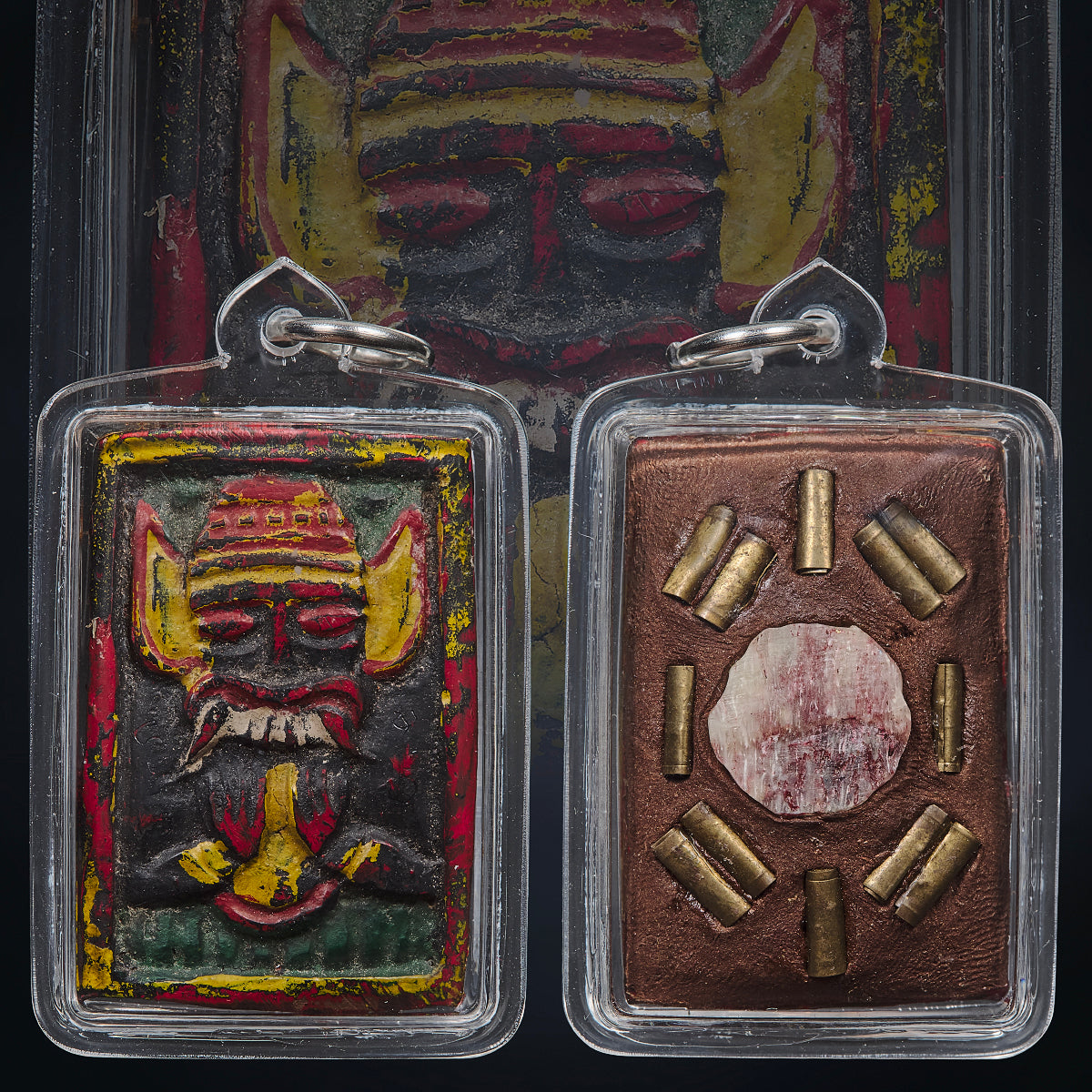
The artifact is a rectangular, individually hand-carved Mai Payom tablet depicting Phra Rahu on the front. Por Sala Tan finished the carving with traditional hand-applied pigments, using a predominantly dark face contrasted by aged red, yellow and green detailing. The irregular lines, pigment wear and carved surface preserve the character of a handmade working piece rather than a mechanically reproduced image.
The reverse reveals the more complex ritual construction. A pale, naturally patterned sacred cave stone is embedded prominently at the centre, with its mineral structure deliberately left visible. Numerous rolled brass-coloured takruts are positioned around it, forming a surrounding arrangement across the brown-backed surface.
The contrast between the painted Rahu on the front and the exposed sacred components on the reverse makes the construction especially distinctive. The entire artifact is now protected within a clear waterproof casing while allowing both sides and their original materials to remain visible.
Recommended Pairing
Phra Rahu works naturally with Baramee and wealth-oriented amulets, particularly when the objective is career advancement or overcoming a prolonged period of obstruction.
A Metta-focused piece can further strengthen the Mai Payom character when the keeper depends heavily upon clients, negotiations or assistance from influential people.
For those already carrying spirit-based or strongly Yin artifacts, Rahu may also provide a useful protective counterpart, with its traditional role centred upon absorbing and obstructing adverse influences.
Personal Notes
What makes this piece particularly interesting to me is the way Por Sala Tan constructed it.
At first glance, it is a straightforward hand-carved and painted Rahu. Turning it over reveals that the real complexity lies behind the image: a substantial sacred cave stone positioned at the centre and surrounded by numerous takruts.
The choice of Mai Payom is equally meaningful. Rather than creating Rahu purely as a force for blocking negativity, Por Sala Tan combined the consuming character of Rahu with a wood associated with Metta, support and advancement.
For this reason, I regard the piece as being less about simply “fighting bad luck” and more about changing direction after difficulty — removing what prevents progress while strengthening the relationships, support and opportunities needed to move forward.
That combination captures the old Rahu principle particularly well:
Klap Rai Klai Pen Dee — turning misfortune into good fortune.
-
Free Shipping for Singapore| $15 Worldwide | $60 USA For Items Below $350