
OOBThaiAmulets
Por Sala Tan
Por Sala Tan
Couldn't load pickup availability
PST05
Yant Suea Hua Khad
Por Sala Tan
B.E. 2550 (2007)
Mainstream Artifact
1.5 inches
Sacred Craftsmanship
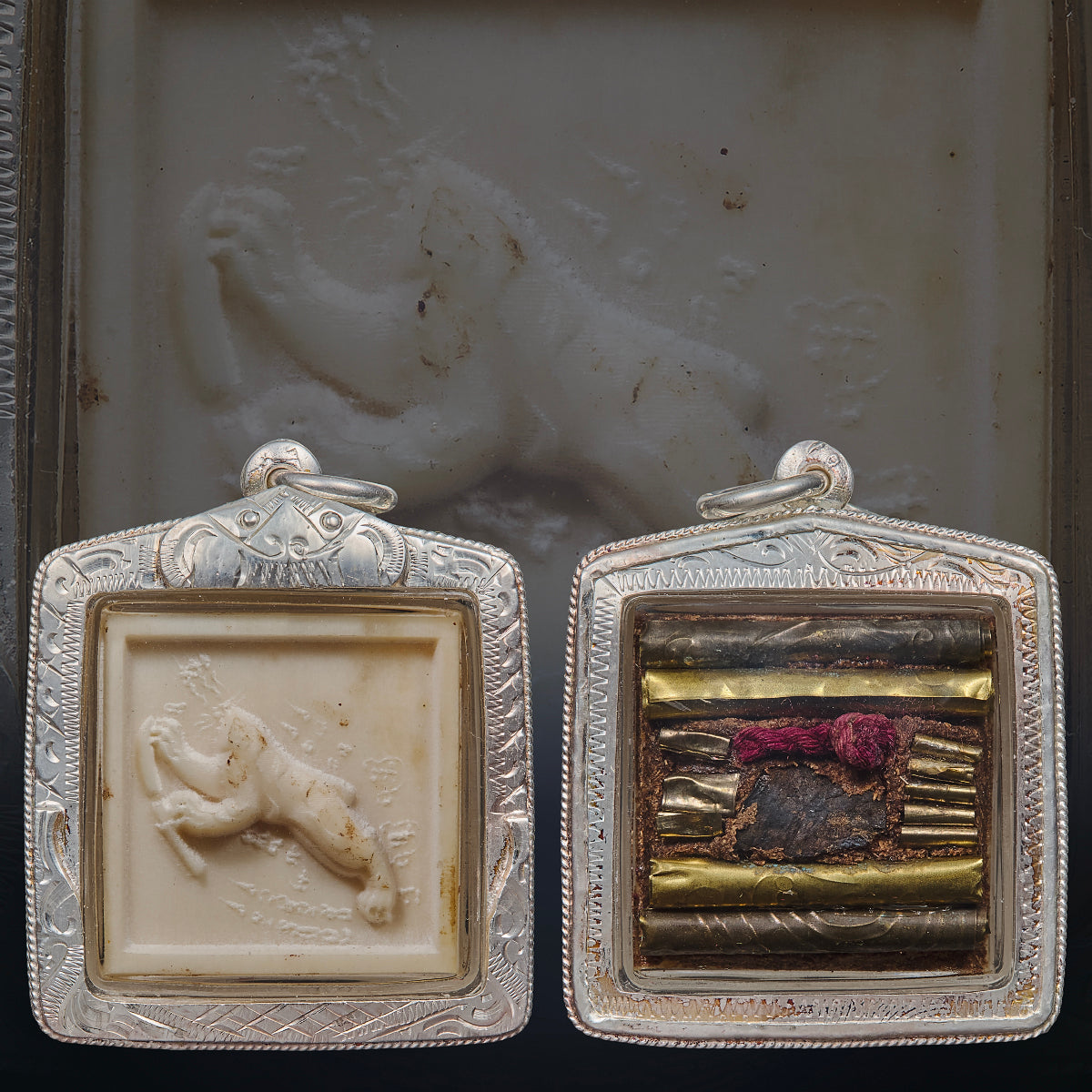
Every piece was individually assembled from available sacred materials. The dimensions and placement of relics, takruts, Sai Sin and other components therefore differ naturally from one example to another.
Personal Experiences Shared by Luksits
Among Por Sala Tan’s luksits, tiger wicha has traditionally been sought by people who need to stand firmly within competitive or demanding environments.
Business owners and people holding supervisory positions have described becoming more decisive when dealing with difficult negotiations or confrontational personalities. Rather than becoming aggressive, some felt that they were less easily pressured and more comfortable maintaining their position.
Other users associated Suea wicha with a noticeable change in personal presence. They described people listening more carefully when they spoke, negotiations becoming easier to control and competitors becoming less inclined to challenge them unnecessarily.
Collectors who combined the piece with Khun Paen or Metta-Saneh amulets often described another character emerging — stronger attraction accompanied by confidence and authority rather than attraction alone.
For experienced luksits, this combination of presence, restraint and controlled strength is regarded as one of the defining characteristics of properly practised Suea wicha.
Summary
The Yant Suea Hua Khad represents an uncommon branch of old tiger wicha in which the tiger is depicted without its head.
Older interpretations describe the headless form as symbolic of instinct beyond hesitation and fear. Later traditions introduced the idea of restraint — immense tiger force that remains controlled until circumstances genuinely require it.
Por Sala Tan's B.E. 2550 interpretation combines this principle with actual Suea relics, takruts, cave empowerment and subsequent blessing in Burma.
Within his practice, Suea wicha was not restricted to protection. When combined with appropriate Lersi and Metta wicha, its traditional applications extended into Baramee, authority, Saneh, wealth and the strengthening of other sacred objects.
Historical Background
Tiger wicha occupies an important position within older Northern Thai magical traditions.
The tiger represented far more than physical strength. Forest practitioners observed an animal capable of commanding territory largely through presence. It moved with confidence, remained alert to its surroundings and did not needlessly expend its strength.
These qualities gradually became spiritual metaphors for Amnaj, Baramee, courage, territorial authority and survival.
The Suea Hua Khad, or Headless Tiger, represents a more unusual development of this symbolism.
Oral traditions surrounding older Sak Yant practitioners describe an early form in which the tiger appeared without restraints. Removing the head symbolically removed hesitation, fear and ordinary emotional calculation, leaving only instinctive force.
Such imagery consequently acquired a formidable reputation among fighters, Nak Leng and people whose lives regularly exposed them to confrontation.
Later interpretations introduced restraint into the wicha. The tiger remained powerful, but its strength was understood as controlled rather than indiscriminately released.
Its principle became simple:
Do not seek conflict, but possess the strength to stand your ground when challenged.
Origins of the Materials
The central material of this piece is Suea relic, selected as the physical foundation for the tiger wicha.
For older practitioners, such material was valued not simply because it came from a tiger. The tiger itself represented command over territory, alertness, courage and the ability to survive within an unforgiving environment.
Por Sala Tan combined the relic with several sacred takruts, visible across the reverse of the artifact. Sai Sin and additional prepared ritual substances were incorporated around the central material, binding the different components together within a single working.
The piece was then placed within a cave during its preparation.
The cave environment has particular significance within Por Sala Tan's tradition because many of his practices developed through forest meditation, secluded ritual work and interaction with practitioners around the Northern Thai–Burmese border.
Ritual
The Suea Hua Khad underwent several stages rather than a single consecration.
After Por Sala Tan had assembled and activated the materials, the piece was left within a cave, allowing the tiger wicha to develop within an environment traditionally associated with wilderness, seclusion and concentrated spiritual practice.
It was subsequently taken across to Burma for approximately one month of further blessing before being retrieved.
Different kata could then be employed according to the purpose required.
The Itipiso kata was traditionally used when emphasising Baramee and protection.
Within Por Sala Tan's practice, Na Ka Lak and Hua Jai kata could also be employed when combining the tiger current with Khun Paen, helping strengthen its Metta-Saneh and attraction qualities.
The broader Suea current could additionally be worked alongside Lersi Ta Fai and Lersi Ser Ming Pai wicha, creating a combination centred upon authority, attraction, protection and wealth.
Blessings and Effects
Suea Hua Khad is fundamentally associated with controlled power.
Its traditional qualities include Baramee, personal authority, protection, courage and the ability to remain composed when confronted by pressure or intimidation.
The tiger component also carries a strong territorial character. For business owners or people responsible for others, this is interpreted as maintaining one's position, protecting what has already been established and developing sufficient presence to command respect.
When properly combined with Metta and Lersi practices, the same wicha takes on a broader character of Saneh, attraction and wealth.
This explains why Northern tiger wicha should not be understood solely as aggressive or protective magic. Its deeper principle concerns the strength of the keeper's presence.
Modern Application
The Yant Suea Hua Khad remains particularly relevant to people operating in competitive environments.
Business owners may carry it when protecting an established enterprise or negotiating against stronger competitors. Managers and professionals may approach it for confidence, authority and greater composure when difficult decisions have to be made.
Salespeople and those whose livelihood depends upon persuasion may combine its commanding character with Metta-Saneh practice, particularly where being likeable alone is insufficient and the individual must also project confidence.
It can likewise be meaningful for anyone who tends to become intimidated under pressure.
The traditional lesson behind Suea Hua Khad is not uncontrolled aggression. It is remaining calm while knowing that one possesses the strength to respond when necessary.
Physical Details
This B.E. 2550 example measures approximately 1 inch and is preserved within a substantial hand-worked 925 silver waterproof casing.
The front presents the sacred tiger-related form in pale material, with aged surface markings and fine sacred inscriptions visible around the image. The reverse reveals much more of the artifact's construction. A dark central section of Suea relic is surrounded by several rolled metal takruts of different sizes, together with old red Sai Sin and the prepared substances used to secure the arrangement.
The components remain deliberately visible rather than being concealed beneath a finished backing, allowing the construction of the artifact to be appreciated directly. The irregular placement of the relic, threads and individual takruts also reflects its handmade nature.
As with Por Sala Tan's other working pieces, every example was constructed differently according to the materials available at the time.
Recommended Pairing
The Suea Hua Khad is already a strong standalone piece for Baramee, protection and authority, but Por Sala Tan's system also allowed it to function as a supporting artifact.
One of its most interesting pairings is with Khun Paen. Through the appropriate Na Ka Lak and Hua Jai kata, the tiger's commanding presence is traditionally used to strengthen the Khun Paen's Metta-Saneh qualities, producing attraction accompanied by confidence and authority.
For deeper Northern practice, it may also be paired with Lersi Ta Fai or Lersi Ser Ming Pai, particularly where the objective involves leadership, business, wealth and personal command.
Personal Notes
This particular Suea Hua Khad carries additional meaning for me because of its journey.
The piece had been left within a cave, and I had the opportunity to explore that cave during one of my trips. It was subsequently taken into Burma and remained there for approximately a month for further blessing before I retrieved it.
I later brought the artifact down to Bangkok and had it properly enclosed in the 925 silver waterproof casing seen today.
What I appreciate most about Suea Hua Khad is that its symbolism is easily misunderstood. The headless tiger can initially appear violent or intimidating, yet the deeper wicha is concerned with something more disciplined.
The tiger possesses tremendous strength, but strength without control has little value.
For me, the most important character of this piece is therefore Baramee under pressure — the ability to remain composed, hold one's ground and release strength only when circumstances genuinely require it.
That principle is perhaps why old Northern practitioners regarded Suea wicha as far more than a simple protection charm. It was ultimately a wicha concerned with the character of the person carrying it.
-
Free Shipping for Singapore| $15 Worldwide | $60 USA For Items Below $350