
OOBThaiAmulets
Por Sala Tan
Por Sala Tan
Couldn't load pickup availability
PST05
Yin Tong Gaduk Pii
Por Sala Tan
Barang Artifact
2 inches
Sacred Craftsmanship
Every stage was individually prepared by hand. Differences in the original Gaduk Pii, carving, sacred powder, takrut placement and ritual binding naturally make each surviving example unique.
Personal Experiences Shared by Luksits
One account concerns a collector working in automobile sales.
Although knowledgeable about the vehicles he represented, he often found it difficult to speak naturally with prospective customers. Conversations could become awkward, and he struggled to develop the rapport needed to move an enquiry towards a sale.
After obtaining one of Por Sala Tan’s Yin Tong, he began noticing a change in his interactions.
Customers appeared increasingly comfortable speaking with him. Conversations became longer and more natural, with prospective buyers more willing to discuss their requirements instead of ending the interaction quickly.
Over time, he also felt that colleagues and superiors began noticing him more. His own confidence improved alongside these interactions, making it easier for him to approach customers, maintain conversations and follow through with potential buyers.
For him, the experience reflected the traditional character of Yin Tong particularly well: attraction expressed through approachability, communication and the ability to create favourable connections with others.
Summary
This is an uncommon Por Sala Tan Yin Tong carved from Gaduk Pii, combining an old relic medium with Pong Plai Guman, Metta powder and three purpose-specific takruts.
Its composition was directed strongly towards the interpersonal qualities traditionally associated with Yin Tong — Metta Mahaniyom, Maha Saneh and harmonious attraction — while the Chok Larp component extends its purpose towards favourable opportunities and fortune.
Rather than attraction being understood purely in a romantic sense, this form of Yin Tong is particularly relevant to situations where success depends upon rapport, personal chemistry, communication and people becoming comfortable enough to remain engaged.
This particular example is also significant for its provenance. It is one of the known pieces that I was eventually able to collect directly from one of Por Sala Tan’s luksits.
Historical Background
Yin Tong belongs to an old stream of Thai and regional attraction wicha centred upon the symbolic union of two figures.
The embracing male and female form represents attraction between complementary forces — people coming together rather than remaining apart. For this reason, Yin Tong became associated not only with romantic attraction, but also with Metta, popularity, reconciliation, negotiation and favourable human relationships.
Within Por Sala Tan’s practice, the physical medium was equally important.
He received this particular Gaduk Pii from a fellow practitioner living in the far north. Rather than carving it simply because the material was available, Por Sala Tan waited until he had accumulated suitable substances for the particular Yin Tong wicha he intended to create.
Only when those components came together was the relic carved and completed.
Origins of the Materials
At the centre of the artifact is the Gaduk Pii, from which the Yin Tong couple itself was hand-carved.
The reverse contains Pong Plai Guman mixed with sacred Metta powder. This provides the prepared ritual foundation behind the carved relic.
Three separate takruts were then incorporated, each carrying a specific purpose.
The first concerns Metta Mahaniyom — goodwill, acceptance and being favourably received by others.
The second concerns Maha Saneh — personal charm, attraction and magnetism.
The third concerns Chok Larp — the calling of luck, favourable circumstances and useful opportunities.
Together, these materials give the piece a broader character than attraction alone: people, opportunity and favourable circumstances are brought into the same composition.
Ritual
Por Sala Tan’s approach to this type of artifact depended heavily upon having the correct materials available at the same time.
The Gaduk Pii was therefore retained until he felt that suitable complementary substances had been gathered. The Yin Tong form was then carved directly into the relic rather than attached as a separate image.
The Pong Plai Guman and Metta powders were prepared for the reverse, after which the three takruts were positioned according to their respective wicha.
The completed artifact was bound with ritual cord, physically holding the various elements together while also serving the traditional purpose of binding and concentrating the intended qualities of the work.
The resulting construction brings together Yin Tong attraction wicha, Metta, Saneh and Chok Larp within a single piece.
Blessings and Effects
The primary emphasis of this Yin Tong is human connection.
Metta Mahaniyom is traditionally sought for being welcomed, remembered and treated with greater goodwill. Maha Saneh strengthens personal magnetism and attraction, while Chok Larp concerns favourable opportunities appearing around the keeper.
Together, these qualities are traditionally associated with smoother communication, easier introductions, stronger rapport and greater receptiveness from the people one encounters.
In relationship matters, Yin Tong may be approached for attraction, affection and harmony between partners.
In commercial situations, the same wicha translates naturally into customer relations, negotiation and sales — particularly occupations where people must first like, trust and feel comfortable with the individual before committing to a decision.
Modern Application
This Yin Tong is particularly suitable for professions involving regular interpersonal contact.
Salespeople, business owners, agents, consultants and those working in hospitality or customer service may find its traditional emphasis especially relevant. Rather than simply attracting attention, its symbolism concerns turning an initial encounter into a more comfortable and sustained interaction.
It may also be carried when attending meetings, networking events, interviews or negotiations where personal chemistry can influence the outcome.
For relationships, its traditional use centres upon attraction and harmony, while for everyday life it can simply represent becoming more approachable, socially confident and favourably received.
Physical Details
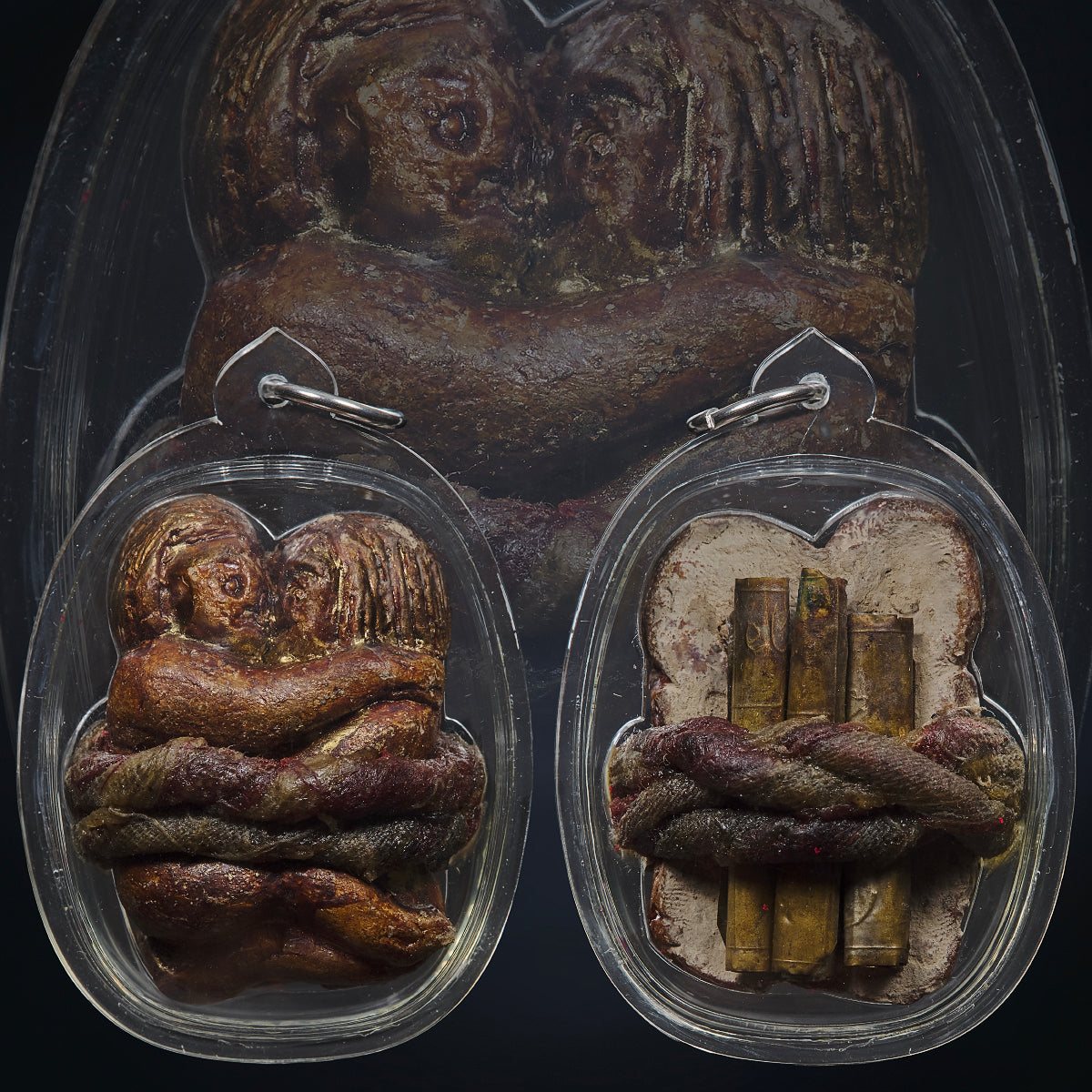
This is a relatively substantial Yin Tong carving, with the embracing couple carved directly from the original Gaduk Pii rather than formed separately. The figures are shown closely joined, their arms wrapping around one another in the characteristic Yin Tong posture. Ageing and darker surface tones remain visible across the carving, together with traces of older applied finish.
The lower portion is wrapped extensively with thick ritual cord, giving the front a particularly strong handmade character.
The reverse exposes the construction more clearly. A pale base of prepared Pong Plai Guman and Metta powdersupports three vertically positioned takruts. These correspond to Metta Mahaniyom, Maha Saneh and Chok Larp. The same old cord passes repeatedly across the reverse, binding the takruts and powder body firmly into the overall artifact.
Its irregular carving, aged surface, individually positioned takruts and hand-bound cord are characteristic of a piece assembled individually rather than produced as a uniform batch object.
Recommended Pairing
This Yin Tong is already well balanced for Metta, Saneh, luck and interpersonal opportunity, and can comfortably be carried alone.
For business use, pairing it with Nang Kwak can place greater emphasis upon customer flow and commercial activity.
A baramee-oriented monk amulet can complement it where the keeper requires authority or professional standing alongside Yin Tong’s softer interpersonal qualities.
For those primarily concerned with sales or negotiation, however, the existing combination of Metta Mahaniyom + Maha Saneh + Chok Larp already makes this a particularly complete relationship-based business artifact.
Personal Notes
This is one of the known examples that I had wanted to collect because of both its construction and its history.
The Gaduk Pii itself came to Por Sala Tan through another practitioner from the far north, and Por Sala Tan kept the material until he had gathered what he considered suitable ingredients to complete the Yin Tong properly. It was therefore not simply a carving made because a piece of relic happened to be available.
What I particularly appreciate is the straightforward construction. The front is dominated by a large hand-carved Yin Tong, while the reverse openly shows the three takruts, sacred powders and old binding cord. Almost every important component of the wicha can be physically seen.
I eventually managed to collect this particular piece from one of Por Sala Tan’s own luksits, making its provenance especially meaningful to me.
For me, its strongest character is not simply opposite-sex attraction. It is the broader Yin Tong principle of bringing people closer — creating rapport, making communication easier and allowing favourable relationships to develop naturally from an initial encounter.
-
Free Shipping for Singapore| $15 Worldwide | $60 USA For Items Below $350