
OOBThaiAmulets
Por Sala Tan
Por Sala Tan
Couldn't load pickup availability
PST05
Mae Per
Por Sala Tan
Barang Artifact
~1.5 inches
Sacred Craftsmanship
Each such artifact was individually prepared according to the available relic rather than produced from a standard mould. Natural differences in the Gaduk, carving, surface, ritual additions and finishing therefore make every surviving piece unique.
Personal Experiences Shared by Luksits
Among devotees who have kept Por Sala Tan's Mae Per, some of the strongest feedback concerns opposite-sex attraction and increased attention from others.
This was reported particularly by people working within the entertainment and nightlife trades, where personal presence, conversation and the ability to attract attention are closely connected with one's livelihood. Some owners described noticeably stronger approaches from the opposite sex, easier introductions and people becoming more willing to remain in conversation.
Salespeople have reported a slightly different expression of the same Saneh–Metta quality. Rather than romantic attraction, they experienced periods of continuous enquiries and successive sales, with customers appearing more receptive to conversation and transactions progressing with fewer obstacles.
These accounts are traditionally understood by devotees as different manifestations of the same principle: attracting attention first, creating favourable reception, and allowing opportunity to develop from that initial connection.
Summary
This is one of the rarer forms of Mae Per by Por Sala Tan, carved directly from old Gaduk Chang obtained during his travels in Burma.
Its background is particularly unusual. The elephant relic was given to Por Sala Tan by a hermit who practised an animist tradition involving communication with wild animals. The elephant was described as female and remembered as having produced many offspring during her lifetime.
Por Sala Tan interpreted the character of the relic as particularly suitable for Saneh and fertility-associated feminine symbolism. He therefore carved Mae Per upon it, later incorporating Paneang fragments, Saneh–Metta herbs and a Prai.
The result is a highly individual Barang artifact centred upon Maha Saneh, Maha Niyom, attraction and opportunity through human relationships.
Historical Background
During Por Sala Tan's travels through northern Thailand and Burma, he encountered practitioners whose traditions differed considerably from conventional temple-based amulet making.
One such practitioner was a hermit associated with older forms of animism and, unusually, practices concerning communication with wild animals. Por Sala Tan received this Gaduk Chang from him and retained it among his sacred materials.
He was told that the relic came from a female elephant that had been a mother many times.
This history became important when Por Sala Tan later considered what should be made from the material. He frequently allowed the origin and perceived character of an individual relic to determine the form of the finished artifact, rather than selecting a design first and forcing the material to serve it.
When he eventually worked with this Gaduk, he felt an immense Saneh quality within it and selected Mae Per as the appropriate form.
Origins of the Materials
The foundation is the old Gaduk Chang from Burma. Within the history attached to the relic, its female origin and long association with motherhood gave it a particularly distinctive character.
The reverse carries several visible Paneang fragments. Within Por Sala Tan's Barang practice, Paneang was incorporated into certain works where attraction, Saneh and interpersonal influence formed part of the intended purpose.
These were combined with Por Sala Tan's own mixture of Saneh and Metta herbs, creating the prepared layer visible across the reverse.
A selected Prai was also incorporated into the Mae Per. Rather than treating every available spirit in the same manner, Por Sala Tan would match particular materials and artifacts according to what he considered suitable for the intended wicha.
Ritual
Por Sala Tan first worked directly upon the Gaduk Chang, carving the female Mae Per image by hand while preserving much of the natural character of the relic.
The Paneang fragments were then positioned at the reverse together with the prepared Saneh–Metta herbal mixture. These components strengthened the attraction-oriented character that Por Sala Tan had already perceived within the elephant relic.
A Prai was subsequently incorporated into the completed Mae Per and brought under the discipline of the consecration.
The different components therefore served complementary purposes: the Gaduk Chang as the principal sacred body, Mae Per as the Saneh form, Paneang and herbs as attraction materials, and the Prai as the active spiritual element.
Blessings and Effects
The principal emphasis of this Mae Per is Maha Saneh and Maha Niyom — attraction, personal magnetism and favourable attention from others.
It is traditionally associated with stronger opposite-sex appeal, easier social interaction and becoming more noticeable or memorable in environments where many people compete for attention.
For commerce, the same qualities are applied towards customer attraction, enquiries, repeat business and sales conversion. Rather than wealth being its sole focus, the traditional principle is that opportunity comes through people: attracting the right person, encouraging conversation and creating favourable conditions for an agreement to develop.
The Prai element additionally connects the piece with responsiveness and spiritual assistance, while the elephant origin gives the artifact an underlying association with strength, abundance and enduring presence.
Modern Application
This Mae Per is particularly suited to circumstances where personal interaction directly influences opportunity.
Those working in entertainment, hospitality, beauty, nightlife, retail and sales may approach it for Saneh, visibility and favourable attention. Business owners may similarly keep it with the intention of attracting customers and encouraging smoother communication.
For personal use, it may be approached for relationships, confidence, social openness and meeting people with whom a genuine connection can develop.
As with Por Sala Tan's other Prai-based works, respectful conduct and reasonable intentions remain central to traditional practice.
Physical Details
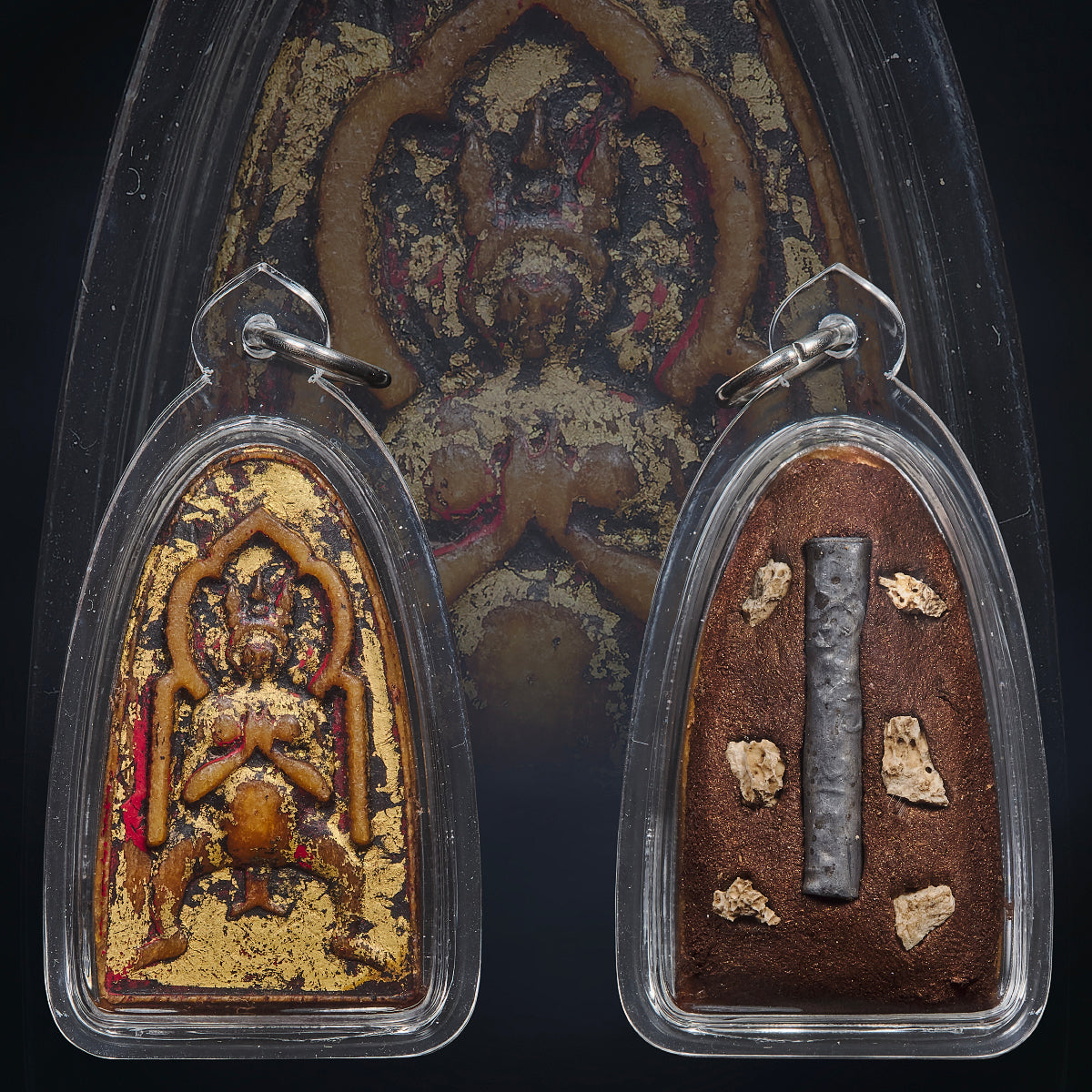
The Mae Per is carved directly onto an irregular section of aged Gaduk Chang, giving the artifact a substantial, organic appearance rather than the uniformity of a moulded amulet. The front depicts the seated female figure beneath an arched surround. Traces of red pigment and extensive gold leaf remain across the darker aged surface, giving the piece a strongly traditional handmade character.
The reverse is covered with Por Sala Tan's prepared Saneh–Metta herbal mixture, producing the fine brown textured background visible through the casing. A long metal ritual component is positioned vertically through the centre, surrounded by several pale Paneang fragments individually embedded into the mixture.
The artifact is now protected within a clear pendant casing, allowing both the hand-carved front and the ritual construction at the reverse to remain visible.
Recommended Pairing
Because this Mae Per already combines Saneh, Metta, Prai and attraction materials, it can comfortably be kept as the principal Saneh artifact without requiring another strong attraction piece.
For business use, it may be paired with Nang Kwak or Phra Sivali to place greater emphasis on customers, livelihood and prosperity.
For owners who prefer balance when carrying Barang, a Buddha amulet or a strong baramee and protection piece can provide a calmer complementary foundation.
Personal Notes
This is one of the more unusual Mae Per pieces I have encountered from Por Sala Tan, principally because of the story behind the Gaduk Chang itself.
The relic had already been with Por Sala Tan for many years after being given to him during his travels in Burma. He knew its background and understood it to have come from a female elephant remembered for having mothered many young, yet he did not immediately turn it into an artifact.
Only when he felt that the material carried the appropriate Saneh character did he decide upon Mae Per.
That process is characteristic of Por Sala Tan's individual Barang works. The artifact was not created simply because another Mae Per was required. The material came first; its history and perceived character determined what it eventually became.
Combined with the Paneang fragments, Saneh–Metta mixture and incorporated Prai, it resulted in a configuration that is seldom seen among his surviving works. For me, this relationship between the original Burmese Gaduk Chang and Por Sala Tan's eventual choice of Mae Per is what gives the piece its particular character and collector interest.
-
Free Shipping for Singapore| $15 Worldwide | $60 USA For Items Below $350