
OOBThaiAmulets
Por Sala Tan
Por Sala Tan
Couldn't load pickup availability
PST05
Yoni
Por Sala Tan
Mainstream Artifact
2 inches
Sacred Craftsmanship
As each Yoni was individually selected and worked from naturally formed Mai Rak, differences in grain, shape, carving and surface are inherent. No two pieces are expected to be completely identical.
Personal Experiences Shared by Luksits
Among collectors familiar with Por Sala Tan's Mai Rak works, pieces of this nature are generally kept for Metta, Saneh and interpersonal harmony, particularly where the owner wishes to improve how others receive and respond to them.
Luksits commonly associate Mai Rak pieces with smoother communication, greater friendliness from others and an easier atmosphere when approaching personal or relationship matters. Rather than being viewed solely as an artifact for romantic attraction, its qualities are also applied to situations where goodwill, acceptance and cooperation are important.
Because only a few Yoni were produced from this particular wood, examples have generally remained closely kept by those who originally received them.
Summary
This is an uncommon Yoni carved from Mai Rak by Por Sala Tan, distinguished by the unusual natural formation of the original Burmese wood.
The significance lies in the relationship between material and form. Por Sala Tan encountered sections of the Mai Rak whose natural growth reminded him of the Yoni. Feeling that the material was particularly suited to this wicha, he selected only suitable portions and completed the form through careful hand carving.
The reverse carries Maha Saneh and Maha Niyom takruts, strengthening the artifact's traditional emphasis on attraction, popularity, affection and favourable human relationships.
Only a small number were made from this particular piece of Mai Rak.
Historical Background
Mai Rak occupies an interesting place within Thai material symbolism. The word rak is closely associated with love and affection, and wood bearing this name has consequently entered various traditional practices concerned with Metta, Saneh and harmonious relationships.
For Por Sala Tan, however, the material was not selected simply because it was Mai Rak.
During his travels in Burma, he encountered this particular wood and noticed that portions of its natural branch growth had formed unusually suggestive contours. Some sections appeared naturally similar to a Yoni.
Por Sala Tan regarded this correspondence between the wood's natural formation and its traditional association with love as significant. The most suitable sections were therefore retained for a very small number of Yoni artifacts.
Origins of the Materials
The principal material is the specially selected Burmese Mai Rak.
Its importance comes from three characteristics working together: its traditional association with love, its Burmese provenance, and most importantly, the unusual natural formation of the wood itself.
Rather than carving an ordinary block of wood entirely into shape, Por Sala Tan selected areas where nature had already produced the basic Yoni-like formation.
At the reverse are Maha Saneh and Maha Niyom takruts. These were incorporated to complement the character of the Mai Rak, directing the piece towards attraction, affection, popularity and favourable reception from others.
Ritual
After identifying the appropriate portions of Mai Rak, Por Sala Tan refined each piece individually.
The natural shape was preserved wherever possible, while careful carving brought greater definition to the Yoni form. The takruts were subsequently positioned against the reverse and the construction secured with copper wire.
The finished artifact was then worked according to Por Sala Tan's Saneh and Metta wicha, bringing together the symbolism of Mai Rak, Yoni and the accompanying takruts within a single piece.
Because the material itself determined what could be made, this was never intended as a large or uniform batch.
Blessings and Effects
Traditionally, this Yoni is associated primarily with Maha Saneh and Maha Niyom. Its emphasis is therefore upon attraction, personal charm, favourable attention and becoming more readily liked or remembered by others.
Within relationships, it may be kept with intentions concerning affection, closeness and improved communication. Its Metta aspect extends beyond romance and may also be applied towards friendships, customers, colleagues and situations where goodwill or cooperation is valuable.
The combination of Yoni and Mai Rak gives the piece a particularly direct association with attraction and relationships, while the takruts reinforce its broader Maha Niyom qualities.
Modern Application
For modern owners, the piece may be carried where interpersonal relationships form an important part of everyday life.
This includes dating and relationships, but equally sales, customer-facing businesses, negotiations, networking and professions where communication and personal impression matter.
It can also be approached more simply as a reminder to conduct oneself with warmth, confidence and consideration — qualities traditionally aligned with Metta rather than coercion.
Physical Details
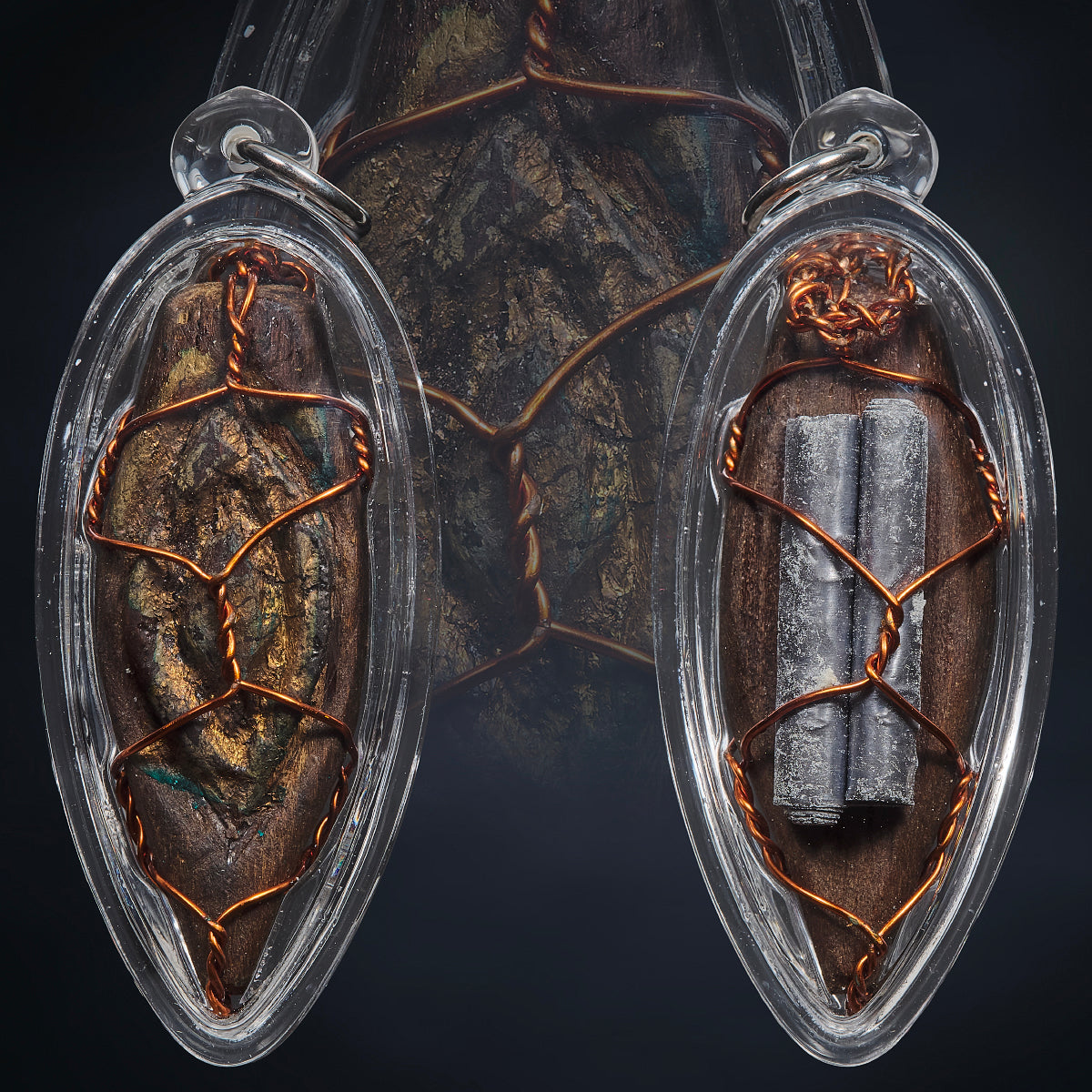
The artifact is formed from a narrow, naturally shaped section of Mai Rak, with the front retaining much of the wood's original grain and irregular character. Por Sala Tan refined the naturally suggestive formation into a clearly recognisable Yoni while deliberately preserving the organic appearance of the material.
The reverse remains comparatively plain and shows the darker natural wood surface. Two metal takruts for Maha Saneh and Maha Niyom are positioned lengthwise against the back. Copper wire runs around the entire artifact, securing the construction while leaving both the carved front and ritual components visible.
The piece is now protected within a clear pendant casing. Its irregular carving, aged surface, natural grain and individually arranged wirework are characteristic of a handmade artifact rather than a moulded production piece.
Recommended Pairing
Because this Yoni already carries a concentrated Metta–Saneh–Maha Niyom character, it can be worn independently.
For business or professional use, it may be paired with a wealth or baramee-oriented amulet to combine favourable reception with stability and opportunity. For personal relationships, a gentler Metta-based piece can complement its attraction qualities without unnecessarily complicating the arrangement.
Personal Notes
What makes this piece particularly appealing to me is that the Yoni form was not simply imposed upon an ordinary piece of wood.
Por Sala Tan first noticed something unusual already present in the Mai Rak itself. Certain portions of the Burmese branches had naturally grown into formations resembling a Yoni. He regarded this as a sign that the material was suitable for this particular work and only then added the necessary carving and ritual components.
This also explains why so few were produced. The limiting factor was not how many Por Sala Tan wanted to make, but how many naturally suitable sections existed within that particular Mai Rak.
For collectors of Por Sala Tan's older handmade Barang, this is an interesting example of his approach to materials: observing what was naturally presented, deciding which wicha best corresponded with it, and allowing the individual material to determine the final artifact.
-
Free Shipping for Singapore| $15 Worldwide | $60 USA For Items Below $350