
OOBThaiAmulets
Por Sala Tan
Por Sala Tan
Couldn't load pickup availability
PST05
Yoni
Por Sala Tan
Barang Artifact
1.5 inches
Sacred Craftsmanship
Each piece was individually selected, carved and assembled by hand. Natural variations in the relic, carving, wax, takruts and placement of the ritual materials make every example unique.
Personal Experiences Shared by Luksits
Older luksits who encountered Por Sala Tan’s stronger Yoni and Saneh works commonly associated them with opposite attraction, personal charisma and increased receptiveness from others.
One collector began keeping the Yoni Prai after going through a difficult relationship and becoming increasingly withdrawn from social life. Rather than asking specifically for another partner, she prayed for self-respect, emotional recovery and the opportunity to meet sincere people.
Over the following months, she noticed a gradual change. She became more willing to accept invitations, reconnected with old friends and found herself increasingly comfortable speaking with new people. Social interactions that had previously felt difficult began to come more naturally.
Eventually, she entered a new relationship with someone whom she described as respectful, patient and sincere. Looking back, she regarded the experience as Metta and Saneh gradually returning to her life — not simply as attraction from the opposite sex, but as greater warmth, openness and positive connections with those around her.
From a practical perspective, the amulet may also have served as a personal reminder of the qualities she wished to rebuild within herself, encouraging greater confidence and openness as she returned to social life.
Summary
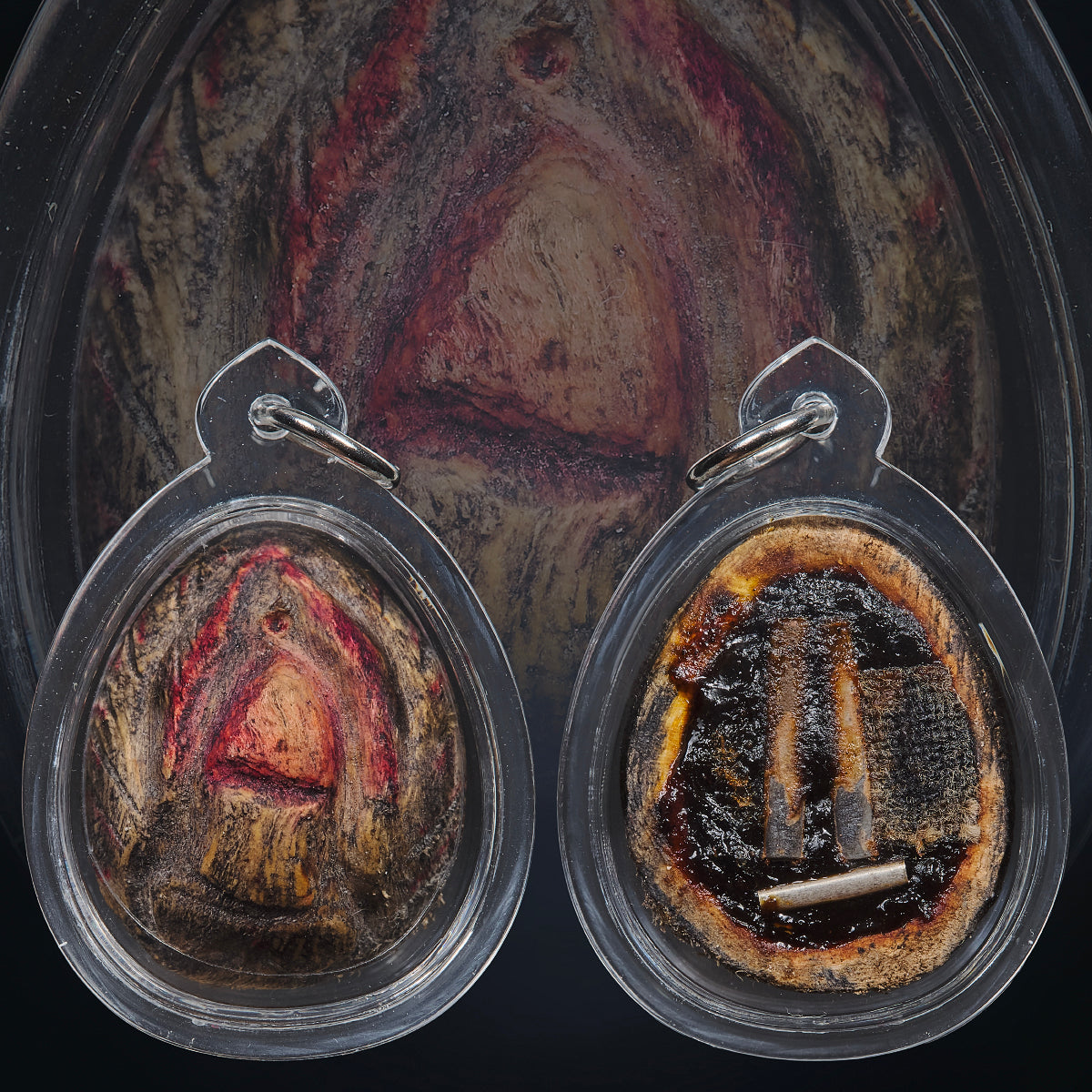
This Yoni is a highly specialised Saneh and Prai artifact created by Por Sala Tan from an old pelvic relic.
The front was personally carved into the form of a Yoni, while the reverse was prepared with Burmese wax, Tidjai, takruts, corpse cloth and Nam Man Prai. A Prai previously kept by Por Sala Tan was subsequently invited into the artifact once he considered the relic suitable.
Its traditional emphasis is principally upon Maha Saneh, Metta Maha Niyom, opposite attraction, charisma and relationships.
Unlike pieces made as part of a predetermined production, artifacts of this nature depended upon Por Sala Tan obtaining the right material. Suitable relics could take considerable time to acquire, and he would only proceed when he felt that the material and intended wicha were compatible.
For this reason, such pieces were naturally limited.
Historical Background
Por Sala Tan’s Barang practice was shaped by decades of travelling, meditation and exchanges of wicha with practitioners from different traditions along the northern Thai and Burmese border regions.
One characteristic of his work was his approach towards unusual ritual materials.
He did not regard every relic as suitable for every purpose. Instead, he would assess its history, character and the nature of the material before deciding whether it should become a Yoni, Yin Tong, Mae Per, Guman Thong or another type of artifact.
The pelvic relic used for this group was said to have belonged to a woman who had been a popular hostess in her younger years. Her strong social attraction became part of the reasoning behind using selected portions of the relic for Saneh-oriented work.
Por Sala Tan eventually determined that this particular section was suitable for a Yoni artifact.
At the same time, he had been keeping a Prai while waiting for an appropriate vessel. Only after the relic had been selected and prepared was the spirit invited into it.
Origins of the Materials
The central material is an old pelvic relic, selected by Por Sala Tan and personally carved into the form of the Yoni. Within this particular wicha, the Yoni represents feminine attraction, intimacy and the drawing together of male and female energies.
The reverse contains a thick preparation of Burmese wax blended with Tidjai. Por Sala Tan incorporated several takruts into this layer to reinforce and direct the Saneh wicha.
A piece of corpse cloth was also included, strengthening the connection with the Prai tradition.
Nam Man Prai formed another important component of the preparation and was incorporated with the materials at the reverse.
The final element was the Prai itself. Por Sala Tan had kept the spirit until a suitable material appeared, rather than immediately housing it in an unrelated artifact. The pelvic relic was eventually chosen as its vessel.
Ritual
The making began with Por Sala Tan’s selection of the relic.
Once he considered the material suitable, the Yoni was carved directly by hand into the pelvic relic. The carving established the principal form and intention of the artifact.
The reverse was then prepared with Burmese wax mixed with Tidjai. Takruts, corpse cloth and Nam Man Prai were incorporated as supporting materials for the Saneh and Prai wicha.
Only after the physical artifact had been properly prepared did Por Sala Tan perform the spirit work.
The Prai he had previously kept was invited into the Yoni and bound to the artifact through his own ritual method.
The process reflects an important principle found throughout Por Sala Tan’s older Barang work: the material, intended wicha and spiritual presence had to be compatible before the artifact was completed.
Blessings and Effects
The traditional blessings of this Yoni centre strongly upon Saneh and interpersonal attraction.
Maha Saneh supports personal magnetism, charm and attraction, particularly in matters involving the opposite sex.
Metta Maha Niyom is associated with goodwill, favourable treatment and making others more comfortable and receptive around the keeper.
The Yoni itself carries a strong association with love, intimacy and relationships, while the bound Prai is traditionally regarded as an assisting presence behind the work.
Collectors may therefore keep the piece for attraction, improving personal charisma, developing romantic opportunities and encouraging greater closeness between partners.
Its Saneh qualities can also extend beyond romance into situations where personal chemistry and favourable interaction are important.
Modern Application
In modern life, this Yoni is most naturally suited to love, relationships and personal interaction.
It may traditionally be carried when meeting someone important, developing a relationship or hoping to improve warmth and communication between partners.
Its Metta and charisma aspects can also be relevant to people working in sales, hospitality, entertainment, customer relations or networking, where being approachable and leaving a favourable impression can be valuable.
The emphasis of the piece, however, remains firmly rooted in Saneh, opposite attraction and relationship wicha.
Physical Details
This is an individually handmade Barang Yoni by Por Sala Tan of Fang, carved directly from a prepared section of pelvic relic. The natural relic forms the complete body of the artifact, with the Yoni carved prominently into its front surface.
The reverse is heavily prepared with Burmese wax mixed with Tidjai, together with embedded takruts, corpse cloth and Nam Man Prai. A Prai kept by Por Sala Tan was subsequently invited into the artifact after he determined that this particular relic was suitable for the work.
The irregular carving, aged surface and uneven placement of the ritual materials are characteristic of an individually handmade Barang artifact rather than a standard moulded production. As Por Sala Tan selected and worked each suitable relic separately, every surviving example naturally differs in form and construction.
Recommended Pairing
As the Yoni already carries a concentrated Maha Saneh and Prai orientation, it is best complemented by a different quality rather than another heavily attraction-focused piece.
For business use, a Maha Lap or wealth-oriented amulet can complement the Yoni particularly well — combining interpersonal attraction and receptiveness with opportunity, financial movement and commercial progress.
Personal Notes
Pieces of this nature are becoming increasingly difficult to encounter because Por Sala Tan did not create them as a regular or scheduled batch. Their making depended largely upon whether the appropriate relics and ritual materials became available to him.
What I find particularly significant about this Yoni is the way Por Sala Tan selected the material. He did not simply obtain a relic and immediately turn it into an artifact. He would first consider its background and character before deciding which wicha was most suitable.
In this case, the pelvic relic belonged to a woman remembered for having been a very popular hostess during her younger years. Por Sala Tan eventually selected the relic for a Yoni and matched it with a Prai that he had already been keeping while waiting for an appropriate vessel.
This relationship between the history of the relic, the Yoni form, the Saneh materials and the selected Prai is what makes the piece especially interesting to me.
It is also a very characteristic example of Por Sala Tan's older Barang work — individually made when the right materials came together rather than produced simply because there was demand for another batch.
-
Free Shipping for Singapore| $15 Worldwide | $60 USA For Items Below $350