
OOBThaiAmulets
Por Sala Tan
Por Sala Tan
Couldn't load pickup availability
PST05
Yin Tong
Por Sala Tan
Barang Artifact
2 inches
Sacred Craftsmanship
Each example was individually prepared and assembled by hand from naturally differing sacred materials. Variations in the relic, carved Yin Tong, inscriptions, Sai Sin and placement of the ritual components consequently make every surviving piece unique.
Personal Experiences Shared by Luksits
Only a limited number of these Yin Tong pieces are known among Por Sala Tan’s older circle, and this particular example was eventually obtained from a villager who had kept it for many years.
His experiences with the piece were particularly centred upon opposite attraction and relationships.
According to his account, during his younger years he was unusually successful with women and at one period maintained relationships with multiple partners simultaneously. What remained memorable to him was not simply the number of relationships, but that the women generally remained harmonious with him and serious conflict between the relationships was uncommon.
He regarded this unusual ease in attraction and relationship harmony as one of his strongest experiences with the Yin Tong and consequently kept the artifact for a considerable period.
It was only through chance and opportunity that the piece eventually became available for collection.
Summary
This Yin Tong belongs to the more intensive Saneh side of Por Sala Tan’s work.
It was not created as part of an ordinary large production. According to the history surrounding these pieces, Por Sala Tan would only undertake this particular type of work when the complete combination of suitable materials had become available.
Some ingredients could not simply be purchased or replaced. They required time, circumstance and, as Por Sala Tan’s circle would describe it, a certain degree of fate before the correct materials came together.
Its principal traditional purposes are:
- Maha Saneh — strong personal magnetism and attraction.
- Metta Maha Niyom — affection, friendliness and favourable treatment.
- Opposite Attraction — particularly directed towards attraction between men and women.
- Charisma — strengthening personal presence and appeal.
- Love & Relationships — encouraging closeness, affection and emotional receptiveness.
- Relationship Harmony — traditionally associated with reducing friction between partners.
Historical Background
The relic material used for this group was said to have belonged to a woman who had been a popular hostess during her younger years.
She was remembered as someone with considerable personal attraction and social popularity, but she passed away relatively early in life.
For Por Sala Tan, this history made the relic particularly relevant to Saneh work. Rather than using it untreated, however, he subjected the material to a lengthy ritual preparation.
The relic was immersed in a concoction of Maha Saneh and Metta herbs together with Nam Man Prai, after which portions could be selected for individual Yin Tong artifacts.
Because both the material and preparation were difficult to reproduce, only a small number of completed examples are known.
Origins of the Materials
Pelvic Relic
The principal foundation is a section of pelvic relic associated with the woman from whom the material originated.
Within the logic of this particular wicha, its bodily location was especially relevant to attraction, intimacy and the union represented by Yin Tong.
Maha Saneh & Metta Herbal Preparation
Before construction, the relic was soaked in a specially prepared herbal concoction directed towards Saneh and Metta.
This was not merely a surface application. The soaking formed part of the preparation of the relic itself before the remaining components were assembled.
Nam Man Prai
Nam Man Prai was incorporated at several stages.
It formed part of the preparation in which the relic was immersed, was used in attaching and activating the Yin Tong elements, and was finally applied across the reverse of the artifact.
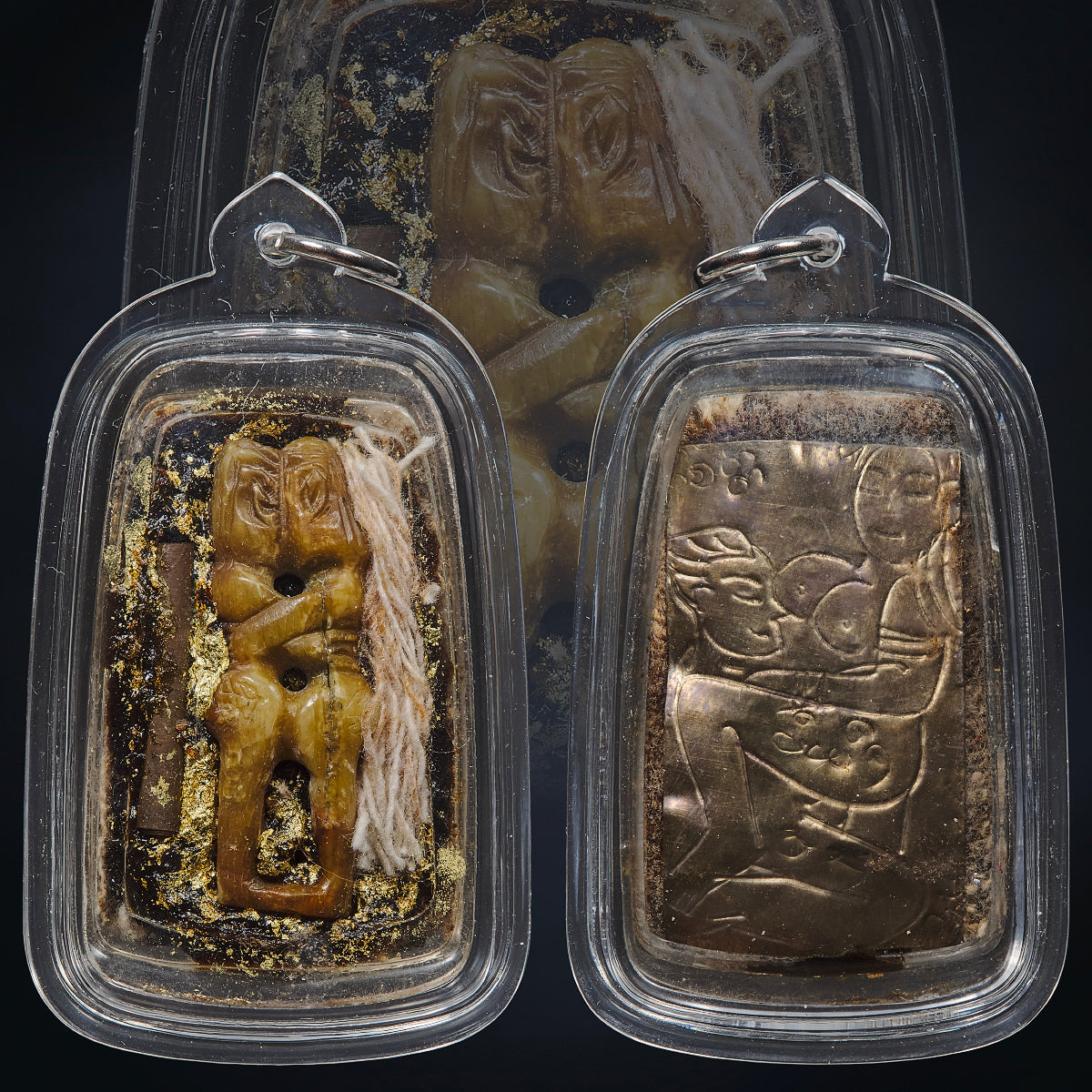
Hand-Drawn Yin Tong Sheet
A metal sheet carries a Yin Tong image drawn individually by hand.
Rather than relying solely upon a moulded representation, the image was prepared as a ritual inscription and physically joined to the prepared relic.
Hand-Carved Relic Yin Tong
On the reverse is a second Yin Tong, carved by hand from relic material.
This creates the unusual double configuration of the piece: a drawn Yin Tong forming one ritual layer and a three-dimensional relic Yin Tong forming another.
Saneh Takrut & Sai Sin
Saneh-oriented takrut were added to reinforce the intended attraction wicha, while Sai Sin was incorporated as part of the binding and consecration.
Ritual
The preparation began with the relic itself.
It was immersed in Por Sala Tan’s mixture of Maha Saneh herbs, Metta preparations and Nam Man Prai, allowing the material to remain within the concoction before being selected for use.
The hand-drawn Yin Tong sheet was subsequently attached to the prepared pelvic relic. A second Yin Tong carved from relic material was positioned on the reverse together with Saneh takrut and Sai Sin.
Nam Man Prai was then applied across the back, completing a construction in which virtually every major component was directed towards the same purpose.
This concentration of materials explains why the artifact is regarded within Por Sala Tan’s tradition as an extreme Saneh-oriented Yin Tong, rather than a general-purpose Metta piece.
Blessings and Effects
The traditional emphasis is strongly concentrated upon interpersonal attraction:
Maha Saneh — heightened personal magnetism and desirability.
Opposite Attraction — traditionally intended to strengthen attraction from the opposite sex.
Metta — encouraging warmth, friendliness and affectionate treatment.
Charisma — supporting personal presence, confidence and social appeal.
Love — traditionally kept for developing or strengthening romantic connections.
Relationship Harmony — encouraging partners to communicate and coexist with less friction.
Social Receptiveness — supporting situations where personal chemistry and favourable first impressions are important.
Modern Application
In modern use, this type of Yin Tong is most closely associated with those whose lives depend heavily upon personal interaction, attraction and relationship-building.
Beyond romantic use, its Metta and Saneh aspects may also be relevant to social environments, networking, hospitality, customer relations and occupations where personal charisma can influence how readily others engage.
Its primary identity, however, remains unmistakably centred upon love, attraction and relationship wicha.
Physical Details
This is an individually handmade Barang Yin Tong by Por Sala Tan of Fang, constructed around a prepared section of pelvic relic. The front carries a hand-drawn Yin Tong on a metal sheet, while the reverse is fitted with a second Yin Tong hand-carved from relic material.
The construction is further strengthened with Saneh takruts and Sai Sin, with Nam Man Prai incorporated into the preparation and applied to the reverse. The relic itself had previously been soaked in a mixture of Maha Saneh and Metta herbs with Nam Man Prai.
Only a limited number of these pieces are known to have been made. As each was individually prepared from natural relic material and assembled by hand, variations in shape, surface, inscriptions and placement of the ritual components are expected, making every surviving example distinct.
Recommended Pairing
Because this Yin Tong is already heavily concentrated upon Saneh and attraction, it may be paired with a stronger protective or Baramee-oriented amulet to create balance.
For business use, pairing it with a wealth or Maha Lap piece may complement its interpersonal qualities by combining attraction and receptiveness with opportunity and financial progress.
-
Free Shipping for Singapore| $15 Worldwide | $60 USA For Items Below $350