
OOBThaiAmulets
Por Sala Tan
Por Sala Tan
Couldn't load pickup availability
PST05
Nang Kwak
Por Sala Tan
Mainstream Artifact
2 inches
Sacred Craftsmanship
Because these pieces were produced through traditional small-batch casting from recycled old temple metals, differences in alloy tone, surface texture, casting marks, patina and finishing are natural. Each Roop Lor carries its own character rather than the uniform appearance of modern factory casting.
Personal Experiences Shared by Luksits
Because only a small batch was cast in Tachileik, a portion of the completed Nang Kwak was passed to Por Sala Tan after the ceremony.
Word of the unusual casting soon spread among his devotees. Those who heard that the Nang Kwak had been made from old Burmese temple metals began approaching Por Sala Tan personally, hoping to obtain one of the limited pieces.
Over the years, an interesting pattern emerged: those who managed to receive one rarely wished to part with it.
Several owners repeatedly described life and livelihood as becoming noticeably more “smooth sailing” after keeping the Nang Kwak. Farmers spoke of their agricultural work progressing more favourably, with their farms becoming increasingly productive and prosperous. Business owners similarly reported steadier trade, better opportunities and a gradual flourishing of their businesses.
For these early keepers, the Nang Kwak became less of a collectible and more of a long-term working piece associated with livelihood and prosperity. This helps explain why examples from the original small batch have seldom returned to circulation.
This makes the Tachileik casting particularly meaningful. Its purpose of attracting livelihood was built from metals that had already spent many years serving temples and receiving offerings from generations of devotees.
Summary
This Nang Kwak was created through a Thai–Burmese exchange of sacred craftsmanship between Por Sala Tan and monks in Tachileik.
At the time, the Burmese monks wished to begin making amulets but did not possess the established moulds, sacred-metal collections or accumulated casting materials commonly found among experienced Thai amulet-making lineages.
Por Sala Tan advised them not to regard this as a limitation.
Instead, he directed their attention towards the old sacred objects already surrounding them.
Damaged Buddha images, some associated with old temples and ruins and said to be more than two centuries old, were gathered together with fragments of temple bells and ritual implements. These metals were melted and given a new purpose through the form of Nang Kwak, traditionally associated with calling customers, attracting prosperity and supporting livelihood.
The result is therefore more than an ordinary Nang Kwak Roop Lor. It records a period when Por Sala Tan was transmitting practical amulet-making knowledge across the Thai–Burmese border.
Historical Background
Teaching Amulet Making in Tachileik
Por Sala Tan's travels repeatedly brought him into contact with practitioners outside northern Thailand.
In Tachileik, he encountered Burmese monks interested in learning the process of creating small sacred objects for devotees. Their local lineage, however, did not possess the same established amulet-making infrastructure familiar in many Thai temples.
There were no ready collections of sacred casting metals and no established moulds available for the project.
Por Sala Tan therefore adapted the process to the circumstances.
Rather than bringing everything from Thailand, he encouraged the monks to create the work from their own temple heritage.
Old sacred metal objects that could no longer serve their original purpose were collected. In this way, the monks learned not merely how to cast an amulet, but how older sacred materials could be respectfully given another devotional life.
Nang Kwak was selected as the form.
For communities dependent upon markets, small shops and cross-border trade, her symbolism of prosperity, customers and livelihood made the image particularly appropriate.
Origins of the Materials
Old Buddha Images
An important component came from broken and aged brass Buddha images preserved around temples and old religious sites.
Some were said to have been approximately 200 years old or more.
Rather than discarding damaged sacred images, usable metal was incorporated into the new casting, allowing material associated with earlier Buddhist devotion to continue in another sacred form.
Old Temple Bells
Fragments from old temple bells were included in the alloy.
Such bells had sounded through temple grounds during years of chanting, ceremonies and daily religious activity. Within traditional sacred-metal practice, their significance comes from this long association with worship and temple life.
Altar Bowls & Offering Trays
Old altar bowls and offering trays provided another source of ritual metal.
These objects had previously been used in the presentation of offerings and therefore carried a direct association with Dana — generosity and giving.
This symbolism is especially appropriate for Nang Kwak, whose traditional role concerns circulation: customers arriving, goods moving and livelihood returning to the household.
Incense Burners
Metal from old incense burners was also incorporated.
Their former ritual use connected the casting with repeated prayer, offerings and devotional practice.
Other Ritual Metal
Additional remnants from temple implements and previous sacred use were gathered wherever suitable.
Rather than relying upon one special metal, the strength of the alloy came from the collective history of many temple objects brought together into one casting.
Ritual
Once sufficient material had been collected, Por Sala Tan supervised the preparation of the casting.
Traditional plaster moulds were made for the Nang Kwak form. The old temple metals were cleaned and prepared before being melted together.
Casting was carried out in small batches within the temple grounds, with Por Sala Tan and several senior Burmese monks overseeing the work.
The process itself formed part of the ritual.
Objects that had once served as bells, Buddha images, offering vessels and incense burners lost their previous physical forms in the furnace, but their material was not discarded. It was redirected into a new sacred image intended to continue serving devotees.
Following casting, the Nang Kwak pieces underwent chanting and blessing according to the combined ritual arrangements of Por Sala Tan and the monks involved.
This gave the work its distinctive cross-border character: Burmese temple materials and monastic participation brought together through amulet-making knowledge taught by Por Sala Tan.
Blessings and Effects
Kha Khai Dee — traditionally associated with successful buying and selling, encouraging commercial activity and smoother trade.
Metta Mahaniyom — goodwill, approachability and favourable treatment from customers, colleagues and people encountered through work.
Calling Customers — Nang Kwak's best-known traditional quality, associated with attracting attention and bringing people towards a shop, service or business.
Chok Lap — fortunate opportunities, useful introductions and favourable circumstances.
Business Prosperity — supporting steady commercial development rather than prosperity through attraction alone.
Returning Customers — traditionally suitable for businesses where reputation, trust and repeat trade are important.
Baramee — the old temple materials provide an additional symbolic connection with accumulated religious practice, offerings and sacred use.
Modern Application
This Nang Kwak remains particularly relevant for shopkeepers, salespeople, entrepreneurs and those whose livelihood depends upon customers.
It may be carried personally or kept respectfully at a workplace, shop counter or business shrine.
For sales professionals, its Metta aspect may be directed towards warmer conversations and receptiveness. For business owners, the emphasis may instead be placed upon customer flow, returning trade and opportunities.
Those involved in cross-border business may find the history especially appropriate, as the artifact itself emerged from an exchange of knowledge between northern Thai and Burmese traditions in Tachileik.
Physical Details
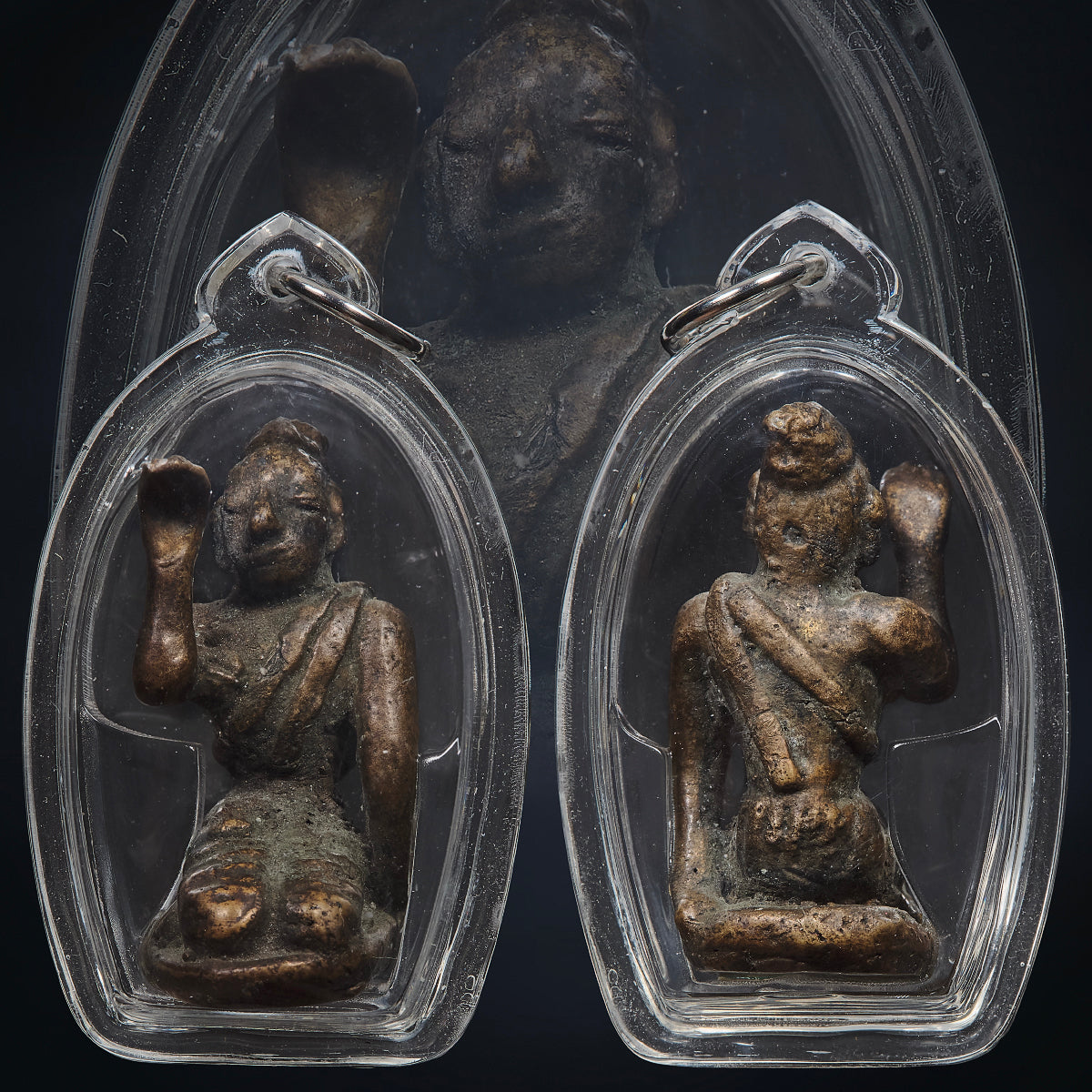
A small traditional metal Nang Kwak Roop Lor, depicting the female prosperity figure seated with one arm raised in the characteristic beckoning gesture. The surface displays an aged brown-bronze tone with darker oxidation and areas of natural wear. Casting irregularities and an uneven patina remain visible across the figure, consistent with small-batch traditional casting from mixed old metals. The example is presently preserved inside a fitted clear protective casing.
Recommended Pairing
For commercial use, Salika complements Nang Kwak particularly well where persuasive speech, negotiation and customer communication are important.
A Phra Sivali may be paired with it for a broader emphasis upon abundance, provisions, travel and benefactors.
For business owners who also keep Saneh or Barang pieces, a protective Wua Tanu can provide a defensive counterpart while Nang Kwak remains focused upon customers and commercial flow.
Personal Notes
What makes this Nang Kwak especially meaningful is not simply the age of the metal.
Its importance lies in why those metals were used.
The Burmese monks wished to learn amulet making but lacked the materials and moulds associated with an established amulet-producing lineage. Por Sala Tan responded by teaching them to recognise that sacred material was already present around them.
A damaged Buddha image, a cracked temple bell, an old offering bowl or an incense burner that had served generations of worshippers did not necessarily have to become waste.
They could be respectfully transformed.
The old objects were therefore melted together and given another purpose — this time as Nang Kwak, the traditional caller of customers and supporter of livelihood.
In that sense, the artifact preserves two histories at once: the accumulated religious life of the old Burmese temple metals, and the occasion on which Por Sala Tan helped a group of Burmese monks begin their own practice of sacred casting.
It is a small Roop Lor, but an unusually tangible record of the movement of wicha, craftsmanship and temple tradition across the Thai–Burmese border.
-
Free Shipping for Singapore| $15 Worldwide | $60 USA For Items Below $350