
OOBThaiAmulets
Por Sala Tan
Por Sala Tan
Couldn't load pickup availability
PST05
Mae Per
Por Sala Tan
Barang Artifact
2 inches
Sacred Craftsmanship
Only a limited number were made. Because the relics, soil and ritual components were individually divided and assembled by hand, no two Mae Per are exactly alike. Differences in carving, inscriptions, relic placement, colour and surface texture are part of the original construction.
Personal Experiences Shared by Luksits
Some of the first people to receive these Mae Per were not collectors.
They were the local villagers who had physically helped Por Sala Tan move the heavy rock and uncover the remains beneath it. In recognition of their assistance, Por Sala Tan gave each of them a piece.
Their subsequent accounts became part of the oral history surrounding this work.
Several villagers described the Mae as having a particularly noticeable presence. They sometimes experienced a strong sensation that someone was standing or remaining nearby, even when nobody else was visibly present.
More importantly, the feedback was generally associated with positive changes rather than fear.
Some spoke of new opportunities appearing in their work, while others noticed better circumstances surrounding small businesses and livelihood. Introductions came more easily, people appeared more willing to deal with them, and opportunities that had previously been difficult to obtain began opening.
Within the village, these experiences strengthened the reputation of the Mae as a presence that had changed from being trapped and unable to move forward into one associated with helping others progress.
Summary
The history of this Mae Per begins beside a river, where Por Sala Tan became aware of what he understood to be a female spiritual presence lingering around a large rock.
During meditation, the Mae communicated that her physical remains were buried beneath the ground and had been held beneath the rock for decades. According to the account, this condition was connected with her inability to move on.
Por Sala Tan sought assistance from villagers nearby.
Together they managed to move the rock and excavate the ground beneath it. Remains were subsequently discovered in the location indicated.
Rather than simply removing them, Por Sala Tan used part of the recovered relic material and surrounding soil to create a very limited group of Mae Per artifacts.
Each was individually carved, yanted and combined with his own sacred materials for Metta, Saneh, opportunity and spiritual assistance.
Historical Background
The Mae Beneath the Stone
While travelling near the river, Por Sala Tan became aware of an unusual presence concentrated around a particular rock.
He entered meditation to understand what was there.
According to the history preserved with the artifact, a female presence communicated that she was beneath the ground below the stone.
Many years had already passed.
The Mae conveyed that she had remained connected to the place because her remains had been buried beneath the rock. She had been unable to release herself from the location and move forward.
Por Sala Tan did not immediately disturb the site. He first approached villagers in the area and asked for their assistance.
The rock was sufficiently substantial that several people were required to help move it.
Once removed, the earth beneath was carefully opened.
There, the villagers and Por Sala Tan found remains buried in the ground.
The discovery became the physical foundation from which this Mae Per was subsequently created.
Origins of the Materials
Hand-Carved Relic
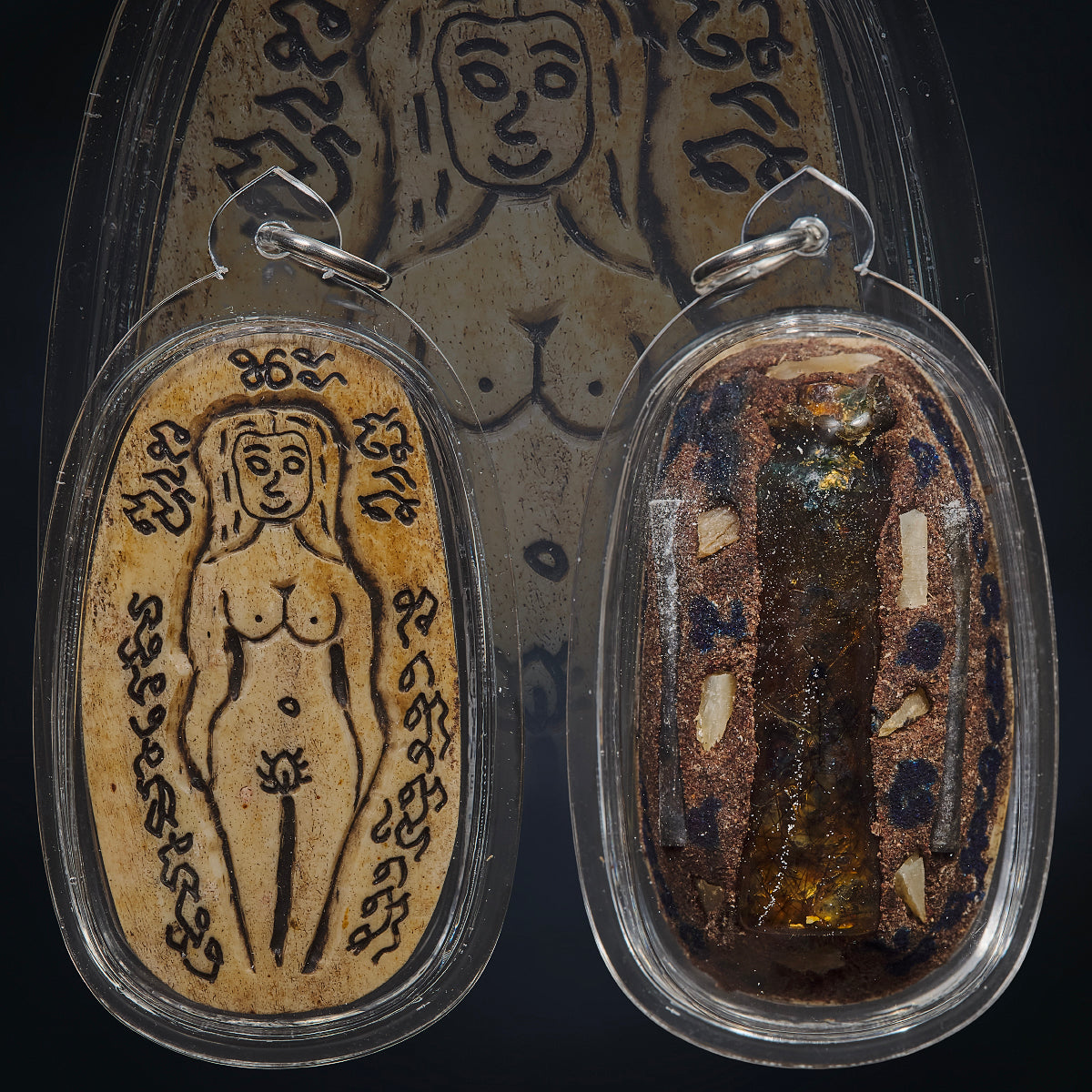
A portion of the recovered relic material was individually shaped into the female image seen on the front.
Rather than using a mould, Por Sala Tan carved each Mae by hand, preserving the direct relationship between the physical material and the story of the spirit associated with it.
Sacred yant were then written around the figure.
Soil Covering the Remains
The earth immediately surrounding and covering the recovered remains was retained.
For Por Sala Tan, this soil was significant because it belonged directly to the location where the Mae had remained for decades.
It was subsequently incorporated with his own prepared sacred mixture.
Metta–Saneh Soil
Por Sala Tan blended the recovered earth with sacred materials used within his own Metta and Maha Saneh wicha.
This shifted the purpose of the completed artifact away from merely preserving a connection with the site and towards practical qualities concerning goodwill, attraction, human relationships and opportunity.
Paneang & Relic Fragments
The reverse contains Paneang together with visible fragments of relic material.
These components were individually arranged within the sacred mixture rather than being completely ground down, leaving their presence visible in the finished artifact.
Nam Man Prai
A particularly distinctive component is the small bottle of Nam Man Prai embedded directly into the reverse.
It forms part of the Saneh structure of the work and sits alongside the other relic and sacred components rather than being applied only externally.
Takruts
Takruts were added to reinforce the specific kata and yant used during preparation.
Together with the handwritten inscriptions, they form the ritual framework through which Por Sala Tan directed the different materials towards their intended purpose.
Ritual
Following the recovery of the remains, Por Sala Tan prepared the Mae Per as a means of giving the lingering presence a new direction.
Pieces of relic were selected and individually carved into the female form.
The soil that had covered the remains was combined with Por Sala Tan's own prepared Metta–Saneh materials. Paneang, additional relic fragments, takruts and Nam Man Prai were then incorporated into the reverse.
Por Sala Tan personally applied the necessary yant before completing the work through chanting and meditation.
The purpose was not simply to maintain the Mae's attachment to the location where she had remained.
Instead, the work gave that connection a beneficial function — assisting those who cared for the artifact while allowing the Mae's story to continue through positive deeds and merit.
Because the available relic material was limited, only a small number could be completed.
Blessings and Effects
Metta Mahaniyom — traditionally associated with goodwill, approachability and receiving favourable treatment from others.
Maha Saneh — attraction and personal magnetism, particularly in social and interpersonal situations.
Chok Lap — fortunate circumstances, unexpected openings and useful opportunities.
Work & Career Opportunity — traditionally approached when seeking new employment, advancement, helpful contacts or improvement in one's working circumstances.
Business Support — associated with customer relations, negotiations, enquiries and opportunities for trade.
Benefactor Attraction — encouraging encounters with people willing to assist, introduce opportunities or provide useful connections.
Guidance & Presence — some keepers associate the Mae with heightened intuition or a distinct feeling of companionship nearby.
Modern Application
The Mae Per is particularly suited to those whose progress depends upon relationships, opportunity and interaction with other people.
For business owners, its Metta–Saneh character may be directed towards customer relations, enquiries, repeat business and smoother negotiations.
For those in employment, it may be approached for favourable opportunities, supportive colleagues, helpful superiors and openings for advancement.
Collectors may also keep it as a spiritual companion, particularly where they value the Mae's traditional association with guidance and a perceptible sense of presence.
The underlying story remains important: the Mae herself had been unable to move forward for decades. After Por Sala Tan and the villagers released the remains from beneath the stone, the resulting artifact became associated instead with helping others find openings and move forward in their own lives.
Physical Details
An oval Barang artifact presently preserved within a clear protective casing. The front consists of a pale relic individually carved into the form of a standing nude female figure, surrounded by dark handwritten sacred yant. The reverse contains a dense Metta–Saneh soil mixture with a central bottle of Nam Man Prai, visible pale relic fragments, Paneang and other ritual inclusions embedded around it. Natural differences in the relic, carving, soil mixture and placement of the rear components are characteristic of this small handmade group.
Recommended Pairing
For stronger commercial use, Nang Kwak complements the Mae Per's Metta and opportunity qualities with a more concentrated emphasis upon customers and incoming trade.
A Salika is suitable where communication, negotiation and persuasive speech are important.
For those wishing to balance the Mae Per's Saneh-oriented character with stronger defensive qualities, a Wua Tanumay be kept alongside it for protection and boundary-setting.
Personal Notes
This Mae Per is unusual because its history connects the spiritual account, the recovered physical materials and the earliest recipients directly together.
The villagers were not merely witnesses to the story. They helped Por Sala Tan move the rock and uncover what was beneath it. When the small group of Mae Per pieces was later completed, those who had assisted were each given one.
Their early experiences therefore became closely tied to the artifact's reputation.
They spoke of a strong sense that someone was nearby, yet the practical changes they associated with the Mae were largely favourable — particularly greater opportunity in work and improvement in business.
This example preserves that construction particularly clearly. The hand-carved female relic forms the front, while the reverse visibly brings together the Nam Man Prai bottle, Paneang, relic fragments, sacred soil and ritual components used by Por Sala Tan.
Only limited pieces could be made from what was recovered, and each was individually constructed.
For that reason, every surviving Mae Per is not simply another example from a uniform batch, but a separate handmade artifact carrying its own portion and arrangement of the original materials.
-
Free Shipping for Singapore| $15 Worldwide | $60 USA For Items Below $350