
OOBThaiAmulets
Por Sala Tan
Por Sala Tan
Couldn't load pickup availability
PST05
Guman Thong
Por Sala Tan
Barang Artifact
2.5 inches
Sacred Craftsmanship
Each piece was individually prepared and assembled by hand. Natural differences in the cemetery-earth mixture, herbs, inscriptions, takrut placement and embedded components therefore make every surviving example distinct.
Personal Experiences Shared by Luksits
Luksits who kept Por Sala Tan's Guman Thong works commonly approached them for practical matters rather than expecting dramatic manifestations.
Some spoke of people becoming noticeably easier to approach. Conversations that initially seemed difficult could become more relaxed, while requests, negotiations and introductions sometimes progressed more favourably than expected.
Others associated the Guman with small but timely strokes of luck — meeting the right person, receiving an unexpected opportunity, having someone offer assistance, or finding that a previously stalled matter suddenly began moving again.
The sixth-sense aspect was described differently.
Rather than necessarily seeing or hearing anything supernatural, some keepers spoke of a stronger instinct about people and situations: an unexplained feeling to contact someone, delay a decision, avoid a particular arrangement or pursue an opportunity that later proved useful.
Within Por Sala Tan's tradition, these quieter experiences were often considered more meaningful than dramatic phenomena. The Guman was intended to assist and guide, while the keeper still had to recognise the opportunity and act upon it.
Summary
This Guman Thong was created by Por Sala Tan as a synthesis of three regional streams of wicha — Thailand, Burma and Laos.
During his years of travelling, meditation and learning, Por Sala Tan encountered practitioners whose methods differed considerably from one another. Rather than simply copying a particular tradition, he studied the principles behind their practices and later incorporated selected elements into his own work.
For this Guman Thong, cemetery soil formed an important physical foundation.
The mixture incorporated soils associated with nine cemetery sources from each of the three countries — Thailand, Burma and Laos. These were blended with sacred Metta and Saneh herbs prepared according to wicha Por Sala Tan had encountered during his travels.
The finished artifact was further strengthened through handwritten yant, Metta takruts and an embedded Guman Thong Roop Lor.
Its principal traditional qualities are Saneh, Chok Lap and sixth sense.
Historical Background
Por Sala Tan's practice developed through more than one geographical lineage.
His travels brought him into contact with monks, hermits, forest practitioners and traditional wicha holders in different areas of mainland Southeast Asia. Thailand, Burma and Laos each preserved their own approaches towards sacred herbs, cemetery materials, spirit practice, yantra and consecration.
Certain teachings concentrated upon attraction and human relationships. Others emphasised intuition, protection, spirit communication or the manipulation and balancing of particular ritual materials.
Por Sala Tan gradually incorporated compatible teachings into his own practice.
This Guman Thong is therefore significant as a cross-border work, reflecting not simply where the ingredients originated, but the different bodies of knowledge that informed their preparation.
Origins of the Materials
Cemetery Soil of Thailand, Burma & Laos
The principal sacred mixture incorporates cemetery soil gathered from 9 cemetery sources from Thailand, 9 from Burma and 9 from Laos.
In the context of this work, the importance of the soils lies in their ritual preparation and their relationship with the respective traditions Por Sala Tan studied.
The three groups were brought together to establish a single foundation representing the three lands from which the wicha originated.
Metta–Saneh Herbs
Sacred herbs associated with Metta Mahaniyom and Maha Saneh were incorporated into the cemetery-earth mixture.
These were selected and prepared according to knowledge Por Sala Tan had gathered from practitioners encountered during his travels.
Their role was to soften the otherwise heavy cemetery foundation and direct the finished work towards attraction, goodwill, social receptiveness and favourable opportunity.
Metta Takruts
Metal takruts were embedded into the artifact as concentrated carriers of yant and kata.
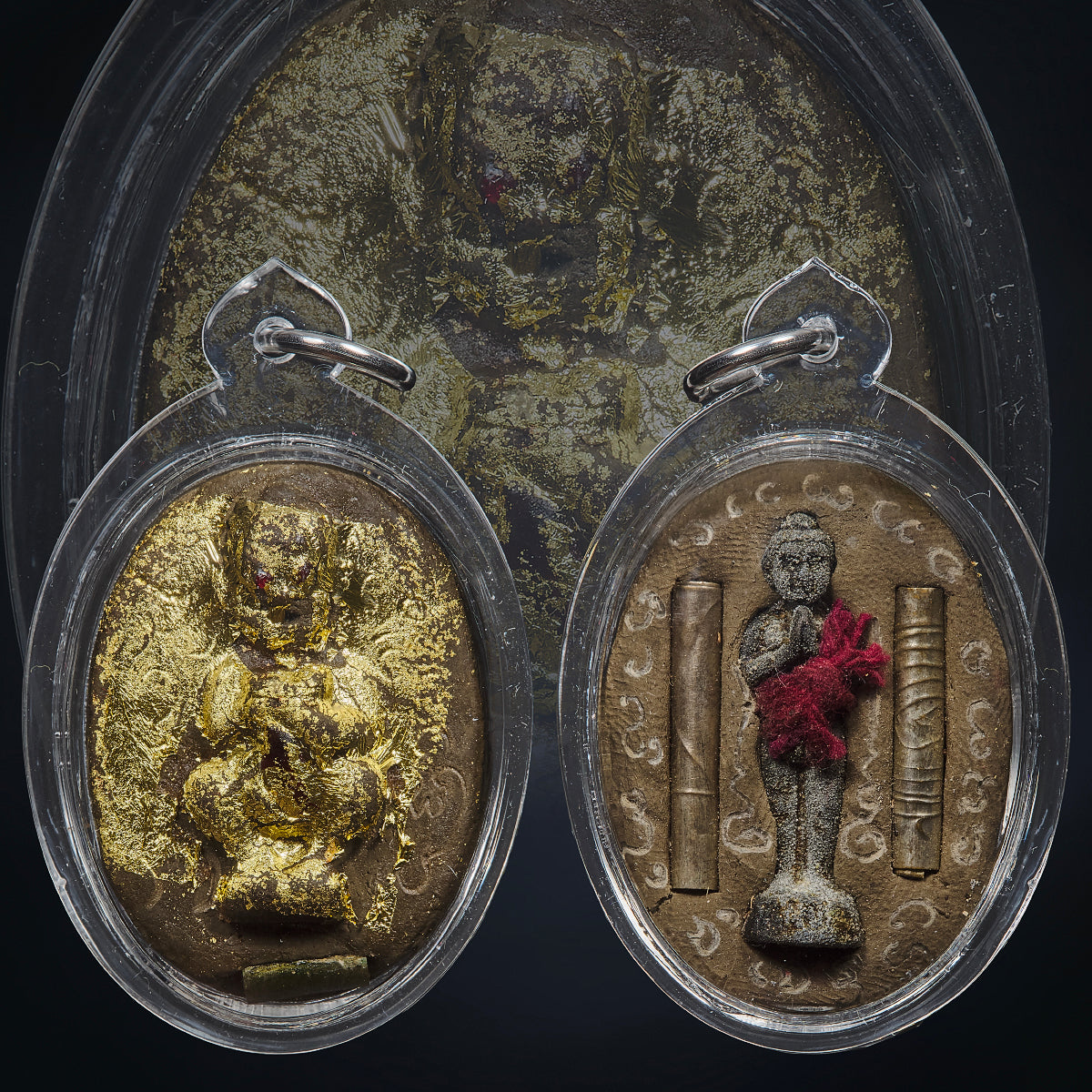
In the example shown, the reverse visibly carries two takruts, positioned beside the central Guman figure.
Guman Thong Roop Lor
A small standing Guman Thong Roop Lor was embedded directly into the reverse.
Rather than remaining merely an ingredient within the sacred mixture, the Roop Lor provides a clear physical representation of the Guman within the construction.
Handwritten Yant
Por Sala Tan further completed the work with handwritten sacred inscriptions.
The yant surrounding the artifact forms part of the ritual structure of the piece, connecting the physical materials with the specific wicha applied during consecration.
Ritual
The preparation began by bringing together the cemetery soils and sacred herbal materials associated with the three regional traditions.
Por Sala Tan did not treat these merely as ingredients to be mixed together. Each represented knowledge acquired through different teachers and practitioners, and the materials had to be brought into a compatible ritual structure.
The sacred mixture was prepared and formed before the additional components were installed.
Metta takruts were embedded to reinforce attraction and favourable human response. A Guman Thong Roop Lor was placed within the reverse as the central representation of the Guman.
Por Sala Tan then applied the necessary yant and performed the accompanying kata and meditation.
The completed work was directed towards three principal purposes:
Saneh — attraction and personal magnetism.
Chok Lap — luck and favourable opportunities.
Sixth Sense — intuition, awareness and guidance.
Blessings and Effects
Metta Mahaniyom — traditionally associated with being received warmly, gaining goodwill and encouraging others to respond favourably.
Maha Saneh — personal attraction and magnetism, particularly useful where communication, social interaction and personal presence are important.
Chok Lap — fortunate opportunities, unexpected assistance and circumstances that open at the right moment.
Sixth Sense — heightened intuition concerning people, decisions, opportunities and potentially troublesome situations.
Business & Customer Relations — supports approachable communication, returning customers, negotiation and smoother commercial relationships.
Guidance — traditionally associated with subtle prompting or intuition when the keeper is uncertain about a direction or decision.
Opportunity — encourages the meeting of helpful people and circumstances that may assist progress when the keeper acts upon them.
Modern Application
The character of this Guman Thong makes it particularly relevant to people whose daily lives depend heavily upon human interaction and judgment.
Business owners may keep it for customer relations and favourable trade. Salespeople and those working in negotiation may approach it for Saneh and receptiveness. Those regularly making important decisions may place greater emphasis upon its sixth-sense aspect.
Its traditional purpose is not to replace personal effort.
Rather, the Guman is approached to create favourable conditions around that effort — helping the keeper communicate more effectively, recognise opportunities and develop greater awareness of the people and circumstances around them.
Physical Details
An oval earth-based Guman Thong artifact prepared from a dark brown sacred mixture and presently protected within a clear casing. The front depicts a seated child figure covered extensively with gold leaf, with sacred markings visible around the surrounding surface and a small metal component positioned beneath the figure. The reverse carries a small standing Guman Thong Roop Lor tied with red sacred thread and positioned between two embedded metal takruts. Handwritten yant markings surround the composition, while the uneven surface, mineral-like inclusions and differences in texture reflect its individually prepared cemetery-soil and herbal construction.
Recommended Pairing
For stronger commercial application, this Guman Thong may be paired with Nang Kwak to place greater emphasis upon customers, trade and incoming wealth.
For those emphasising protection alongside intuition, a Wua Tanu provides a more defensive counterpart while allowing the Guman to retain its role in attraction, luck and guidance.
Personal Notes
What distinguishes this Guman Thong is the way its construction records Por Sala Tan's own journey as a practitioner.
The cemetery soils represent three countries. The sacred herbs reflect different bodies of Metta and Saneh knowledge. The handwritten yant carry Por Sala Tan's personal ritual work, while the embedded takruts and Guman Thong Roop Lor complete the physical structure.
It is therefore not simply a Guman made from cemetery soil.
It is a piece built around the combination of wicha Por Sala Tan gathered through travelling, meeting practitioners and learning across Thailand, Burma and Laos, before bringing those teachings together through his own experience.
Its character follows the same balance: Saneh to open people, luck to open circumstances, and sixth sense to help the keeper recognise which opening is worth following.
-
Free Shipping for Singapore| $15 Worldwide | $60 USA For Items Below $350