
OOBThaiAmulets
Por Sala Tan
Por Sala Tan
Couldn't load pickup availability
PST05
Mae Hong Prai
Por Sala Tan
Barang Artifact
2.5 inches
Sacred Craftsmanship
Only a handful were prepared.
Each artifact was individually carved from the available relic, so differences in colour, grain, surface marks, proportions and carving are natural characteristics of the material and make every surviving piece unique.
Personal Experiences Shared by Luksits
According to Ac Lek, very few people received one of these Mae Hong Prai pieces, and the feedback he heard from their keepers was consistently positive.
One particularly memorable account concerned a collector who kept the Mae Hong Prai at home and regarded her principally as a guardian of the household.
During a period when a serial thief had reportedly been targeting homes around the area, an attempt was made to enter the collector's property.
The attempt was unsuccessful.
What made the incident unusual was the explanation later attributed to the thief after he surrendered. He claimed that whenever he attempted to approach or enter the house, he repeatedly perceived the figure of a woman obstructing his view and preventing him from proceeding further.
He eventually abandoned the attempt.
For the keeper, the incident became closely associated with the Mae Hong Prai. Rather than viewing her only through the usual Saneh or Metta associations of Mae Prai practice, he came to regard her primarily as a Fao Sap guardian — a female presence watching over the home, property and people under her care.
Other collectors similarly spoke of a protective female presence, improved circumstances and assistance when sincere requests were made.
Summary
This Mae Hong Prai traces its origin to a village near Por Sala Tan's area, where residents had become aware of what they believed to be a wandering female spirit near a river.
The woman was said to have died in a river accident while pregnant.
Because unusual disturbances continued around the river, villagers eventually approached Por Sala Tan and asked him to assist.
Through meditation and ritual communication, Por Sala Tan concluded that the woman was not deliberately attempting to harm anyone. According to the account preserved with these pieces, her inability to move on was connected particularly with her attachment to the unborn child she had lost together with her own life.
Rather than forcibly removing the presence, Por Sala Tan sought another resolution.
He encouraged the Mae to accumulate merit for both herself and her child by assisting people who approached her sincerely.
Her presence was subsequently invited into old relic material held by Por Sala Tan, from which only a small number of figures were individually carved.
The example shown here has particularly close provenance, having been obtained directly from Ac Lek, who was among the few people to have retained one.
Historical Background
The Woman by the River
The account begins in a neighbouring village not far from Por Sala Tan.
A woman had lost her life following an accident in the river. At the time of her death, she was pregnant.
Afterwards, villagers reported an unexplained female presence lingering around the river area. Concern gradually grew, and because the circumstances involved an unexpected death, some feared that the presence might eventually disturb or harm people living nearby.
Por Sala Tan was therefore asked to visit the village.
After investigating and entering meditation, his understanding of the situation differed from the villagers' initial fears.
The Mae was not seeking revenge.
She had no intention of harming the villagers.
Instead, Por Sala Tan understood her continued presence as arising from an inability to let go of what had happened — particularly her concern and attachment towards the baby she had been carrying.
This distinction became important to the subsequent wicha.
Por Sala Tan did not approach her as a hostile spirit requiring suppression. He approached her as a mother whose attachment had prevented her from moving forward.
Origins of the Materials
Old Relic
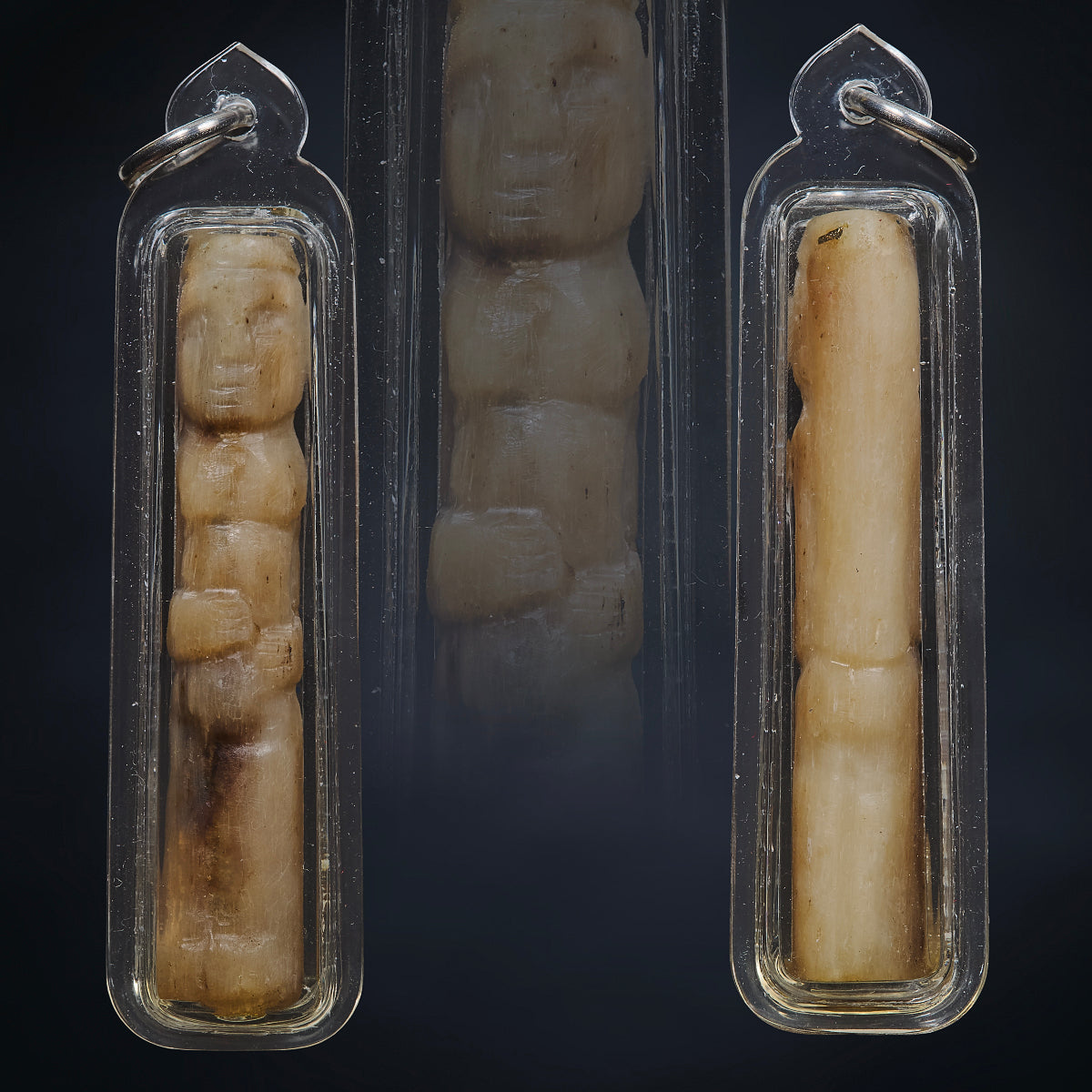
The physical body was carved from an old relic collected and retained by Por Sala Tan.
Rather than producing a large batch from newly prepared powder or metal, he used the limited relic material available to him. This naturally restricted the number that could be made.
The elongated form was carved directly from the relic, with only enough shaping to establish the representation of the Mae.
The Mae and Her Child
Within the oral history of the artifact, the spiritual foundation is inseparable from the woman's pregnancy.
Por Sala Tan's intention was not simply to provide the wandering Mae with a vessel. The arrangement was understood as an opportunity for mother and child to accumulate merit together through beneficial assistance given to devotees.
For this reason, the artifact's traditional character combines the familiar qualities of Mae Prai practice with a noticeably strong emphasis on care, guardianship and protection of the household.
Ritual
After establishing through meditation that the Mae did not intend harm, Por Sala Tan communicated a different path to her.
Rather than remaining beside the river because of attachment and grief, she could assist people in need. Through beneficial actions performed on behalf of sincere devotees, merit could be dedicated towards both herself and her unborn child.
The Mae accepted this arrangement according to the history passed down with the piece.
Por Sala Tan then prepared portions of his old relic material and carved the small figures individually. Through chanting and meditation, the spiritual presence was invited to establish a connection with these vessels.
Only a handful were completed and passed to people within the close circle around the work.
Ac Lek was one of those who retained an example.
Blessings and Effects
Although identified as Mae Hong Prai, this particular work became remembered as much for guardianship as for attraction.
Fao Sap is one of its most notable qualities — watching over the home, possessions and livelihood of the keeper.
Protection concerns warning against suspicious people, harmful intentions and situations that may threaten the household.
Metta Mahaniyom supports goodwill, smoother interaction and favourable treatment from people encountered in everyday life.
Chok Lap concerns fortunate circumstances, opportunities and unexpected assistance.
The Mae is also approached for wish assistance, particularly where the request is sincere and does not involve deliberately harming another person.
Because of the history surrounding the mother and unborn child, some keepers regard the artifact as carrying an especially strong affinity with home, family and those placed under one's care.
Modern Application
For modern keepers, the Mae Hong Prai may be carried personally or respectfully kept within the home or workplace.
Its Fao Sap character makes it particularly suitable for those wishing to establish a guardian presence around a house, shop, office or personal property.
Business owners may also approach the Mae for smoother relationships, helpful customers and favourable opportunities, while household keepers commonly emphasise protection and peace within the home.
The underlying principle taught through this particular piece is merit through assistance.
Requests should therefore be made respectfully and with reasonable intentions. When positive circumstances arise, merit may be dedicated to the Mae and her child as acknowledgement of the relationship established through Por Sala Tan's original ritual.
Physical Details
A slender, pale old-relic figure individually carved into a simplified female form, with a rounded head and a series of gently defined sections forming the upper body, waist and lower body. The reverse remains comparatively plain, allowing the natural grain and aged colouration of the relic to remain visible. Small dark inclusions, uneven tones, tool marks and differences in the hand-shaped surface are consistent with its individually carved construction. The artifact is presently preserved inside a long fitted clear protective casing.
Recommended Pairing
For household protection, the Mae Hong Prai can be paired with a protective Wua Tanu or another guardian-oriented artifact of Por Sala Tan.
For business use, Nang Kwak complements its Fao Sap qualities by concentrating more specifically upon customer attraction and commercial prosperity.
A Salika may be added where communication, negotiation and interpersonal receptiveness are important.
For collectors working with several Barang pieces, a mainstream Buddha-form amulet may serve as the principal devotional foundation, while the Mae retains her specialised role of guardianship, Metta and assistance.
Personal Notes
This particular Mae Hong Prai is significant not because of elaborate workmanship, but because of its direct and unusually personal history.
The original account is not one of a hostile spirit being captured or subdued. It concerns a woman who died unexpectedly while carrying her child and, according to Por Sala Tan's meditation, remained because she could not release that attachment.
Por Sala Tan's solution was therefore centred upon merit rather than force.
Instead of driving the presence away, he offered the Mae another purpose: help those who genuinely needed assistance, and allow the resulting merit to benefit both mother and child.
Only a handful of the old relic figures were carved.
This example carries further provenance through Ac Lek, one of the few people who personally retained one before it later entered the present collection.
Among the experiences subsequently associated with the batch, the account of the thief remains particularly representative. Whether understood spiritually or as the keeper's interpretation of an unusual event, the story established the Mae's reputation among that circle as something more than a conventional attraction piece.
She became remembered as a motherly Fao Sap presence — watching the household, guarding what belongs to the keeper, and accumulating merit through the help she gives in return.
-
Free Shipping for Singapore| $15 Worldwide | $60 USA For Items Below $350