
OOBThaiAmulets
Por Sala Tan
Por Sala Tan
Couldn't load pickup availability
PST05
Guman Thong Fao Sap
Por Sala Tan
Barang Artifact
4 inches
Sacred Craftsmanship
Each artifact was individually prepared and bound by hand. Natural differences in the aged coffin wood, funerary cloth, metal inscriptions, cord, surface wear and construction therefore make every surviving piece unique.
Personal Experiences Shared by Luksits
One account associated with the Guman Thong Fao Sap comes from a small market vendor who kept her Guman on a clean shelf immediately behind the cash drawer of her stall.
Every morning before opening for business, she would place a glass of clean water and a small sweet beside it. She would then make a simple request:
“Please guard this shop, protect the money earned honestly, and bring kind customers.”
After keeping the Guman for some time, she began noticing changes around the stall.
Regular customers appeared to return more frequently. More interestingly, some people who previously came only to browse began purchasing small items before leaving. Conversations also became warmer, and she felt that customers were generally more comfortable spending time at her stall.
For her, however, the strongest impression concerned the Fao Sap aspect.
Whenever she needed to leave the stall briefly, she found herself considerably less anxious about the cash area. She developed a strong personal belief that the Guman remained behind as a small guardian, watching over both the premises and the money she had earned.
She eventually came to regard the piece not simply as an artifact for attracting customers, but almost as another presence within the shop — one entrusted with guarding the livelihood of the household while encouraging steady trade and returning customers.
Summary
Guman Thong Fao Sap may be understood as the Golden Child who watches over wealth and the household.
Its history begins at an abandoned cremation hall in the northern borderlands, where Por Sala Tan encountered an old child-form carving beneath the remains of a former temple structure.
According to the account preserved with the piece, the carving had originally been made by a travelling monk who had cared for orphaned children. Before his death, he fashioned small child images from timber associated with the temple's old coffin house and wrapped them with funerary cloth.
Years later, when Por Sala Tan encountered the abandoned site, he sensed a presence around the structure.
Through meditation, he understood this presence not as something seeking to frighten people, but as a child spirit seeking a place where it could remain useful and remembered.
Por Sala Tan subsequently prepared the artifact as a guardian rather than an aggressive spirit object.
Its principal traditional purposes became household protection, guarding money and possessions, business support, customer attraction, early warning, finding misplaced objects, good fortune and companionship.
Historical Background
The Child Beneath the Cremation Hall
During one of Por Sala Tan's journeys into the northern border region, he came across the remains of an old cremation hall beside what had once been a temple.
The temple itself had largely disappeared into the surrounding forest. The structure had deteriorated, and knowledge of the site survived mainly among elderly villagers.
Local accounts spoke of a travelling monk who had once stayed there and cared for orphaned children.
Before his passing, the monk was said to have carved small child figures from old timber associated with the coffin house. The figures were wrapped with funerary cloth and bound with cord.
The intention, according to the story, was not imprisonment.
The wrapping represented remembrance and care — acknowledging a child presence so that it would no longer be forgotten or alone.
While examining the abandoned structure, Por Sala Tan sensed an unusual presence and eventually discovered one of these old carvings beneath the damaged floorboards.
He sat in meditation at the site.
Rather than immediately attempting to command or remove the presence, he approached it respectfully. Through meditation, Por Sala Tan understood the child spirit's intention simply:
it wanted a home, and in return it wished to protect the home that remembered it.
This became the foundation of the Fao Sap wicha applied to the artifact.
Origins of the Materials
Old Coffin Wood
The central figure was carved from old wood associated with the former temple's coffin house.
Within this particular construction, coffin wood represents the boundary between death and continued remembrance. Its significance lies especially in its provenance and its connection with the original child carving.
Funerary Cloth
Old funerary cloth was retained with the figure.
Rather than functioning merely as wrapping, the cloth represents the original act of remembrance associated with the carving — giving the child presence a recognised place rather than allowing it to remain forgotten.
Inscribed Metal & Takrut Elements
Por Sala Tan added metal elements carrying protective inscriptions.
These strengthen the guardian aspect of the construction, particularly its traditional association with safeguarding the household, possessions and livelihood.
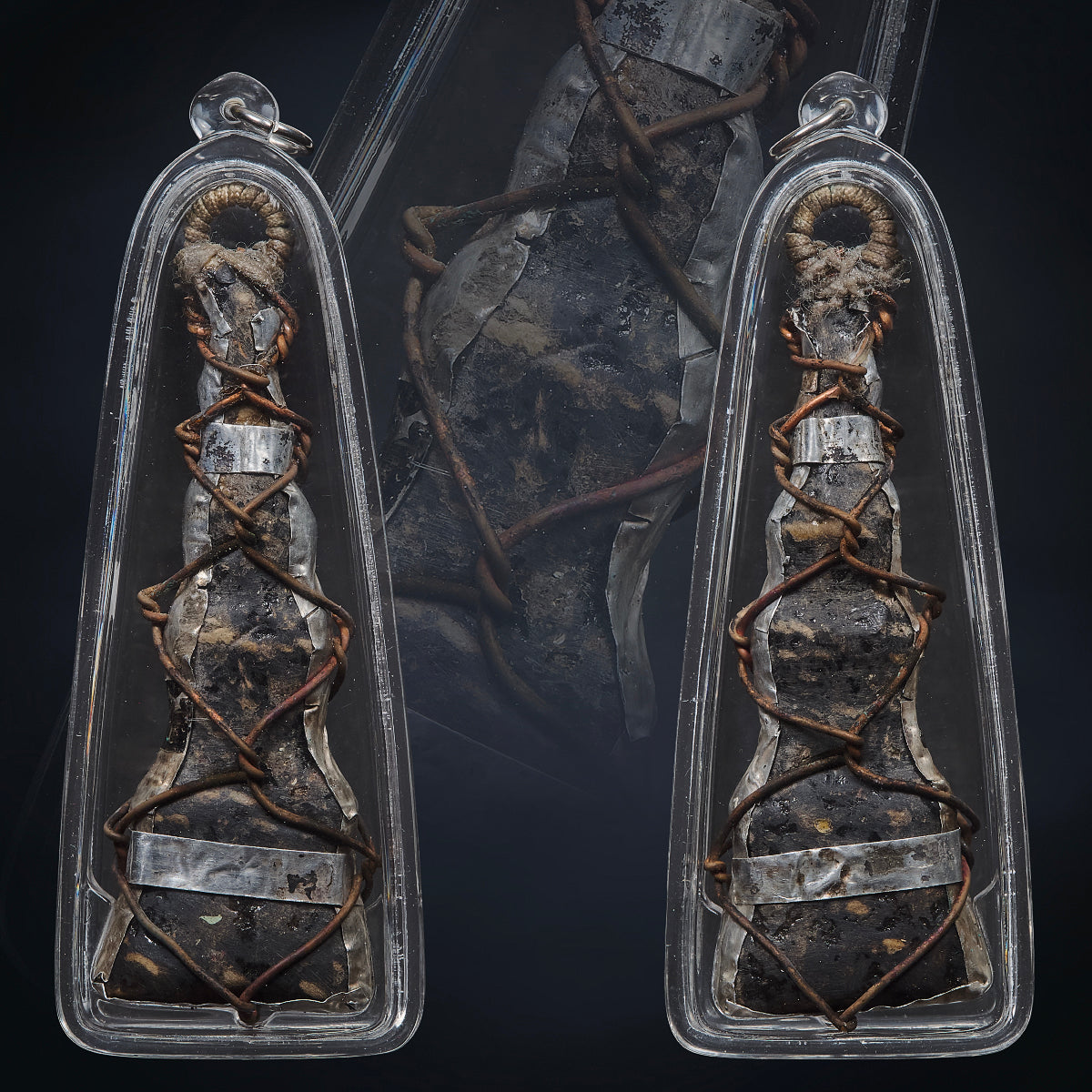
The visible metal bands also physically reinforce the old carving.
Ritual Cord
The entire figure is extensively bound with cord.
Within the construction, the binding represents the relationship between the guardian, the keeper and the place under its care. It establishes responsibility rather than ownership: the Guman is cared for, while the Guman is entrusted with watching over the household.
Ritual
After encountering the carving, Por Sala Tan first meditated at the site and acknowledged the presence associated with it.
The subsequent ritual centred upon giving that presence a constructive purpose.
The old carving was placed respectfully upon clean cloth before blessing. Protective inscriptions and metal elements were added, after which the body was bound repeatedly with ritual cord.
Por Sala Tan then performed chanting and meditation to establish its principal duty:
Fao Sap — to watch over what has been entrusted to it.
The intention was protective rather than aggressive.
Por Sala Tan taught that such a Guman should not be treated as a slave, nor instructed to attack or harm another person. It was better regarded as a young guardian — spoken to respectfully, remembered and entrusted with beneficial responsibilities.
Blessings and Effects
The defining quality of this Guman is Fao Sap, literally centred upon watching over wealth, property and possessions.
For a household, this traditionally extends towards protection of the home from theft, danger and hostile intentions.
For business owners, the same wicha is applied towards guarding the shop and its takings while encouraging favourable customer activity.
Metta Mahaniyom supports friendliness and goodwill, while its business aspect is associated with customers returning, people entering the premises and conversations developing more easily.
Chok Lap concerns favourable opportunities, household fortune, work and improved financial movement.
The Guman is also traditionally associated with early warning. Some keepers interpret unusual dreams, sounds or sudden intuitive feelings as indications to pay closer attention to their surroundings.
Another old association concerns finding lost belongings, particularly objects misplaced within the home or workplace.
Its traditional qualities can therefore be summarised as guarding the household, protecting money and property, supporting business, encouraging returning customers, attracting goodwill, bringing favourable opportunities, giving warnings and watching over the keeper during travel.
Modern Application
The Fao Sap character makes this Guman particularly appropriate for a shop, office or household.
A business owner may keep it respectfully near the cash counter or another clean area overlooking the premises. The emphasis is not simply upon drawing money, but upon guarding what has already been earned while supporting continued trade.
At home, it may be regarded as a guardian of the household and possessions.
For those who prefer to carry the artifact, its compact form also allows it to accompany the keeper during work or travel.
Offerings need not be elaborate. Following the practice described by luksits, simple clean water or a small sweet may be offered with a sincere acknowledgement.
The relationship is traditionally understood through reciprocity: remember the guardian, treat it respectfully, and entrust it with beneficial duties rather than harmful commands.
Physical Details
This is an elongated, individually constructed Guman artifact formed around a dark, heavily aged coffin-wood core. Remnants of old cloth and sacred material remain incorporated into the body, while several silver-coloured metal bands secure different sections of the figure. Brown ritual cord is repeatedly crossed and knotted from top to bottom, producing the characteristic bound appearance associated with its Fao Sap preparation. The upper section retains a circular cloth or cord element, while the irregular surface, ageing, bindings and exposed materials clearly reflect its handmade construction. The complete artifact is now preserved within a fitted clear protective casing.
Recommended Pairing
For business use, Salika provides a natural complement. Salika concentrates upon speech, customer communication and receptiveness, while Guman Thong Fao Sap watches over the shop and livelihood.
A Nang Kwak may be paired where customer attraction and commercial prosperity are the principal intentions.
For household use, pairing the Guman with a mainstream Buddha-form amulet creates a balanced arrangement: the Buddha image serves as the principal devotional foundation, while the Guman retains its specialised role as guardian of the home and possessions.
Personal Notes
The most distinctive aspect of this Guman is contained in its name:
Fao Sap — guarding wealth.
It is not simply an artifact concerned with obtaining more.
Its tradition is equally concerned with watching over what one already has — the home, shop, money, possessions and livelihood built through one's own work.
The old coffin wood, funerary cloth, protective metal elements and extensive bindings each contribute to that concept. The cloth represents remembrance; the bindings establish the relationship of care; and the inscribed metal strengthens the protective boundary around the guardian.
The market vendor's experience captures this character particularly well. Increased returning customers mattered to her, but so did the feeling that someone remained behind watching the stall when she briefly stepped away.
That combination of Fao Sap, Metta and livelihood support is what distinguishes this piece within Por Sala Tan's Guman tradition.
Rather than a child spirit intended to be commanded, Por Sala Tan taught that it should be treated as a young member of the household — remembered with kindness, entrusted with responsibility, and asked to protect only what has been gained through honest means.
-
Free Shipping for Singapore| $15 Worldwide | $60 USA For Items Below $350