
OOBThaiAmulets
Por Sala Tan
Por Sala Tan
Couldn't load pickup availability
PST05
Lersi Relic
Por Sala Tan
Barang Artifact
1.5 inches
Sacred Craftsmanship
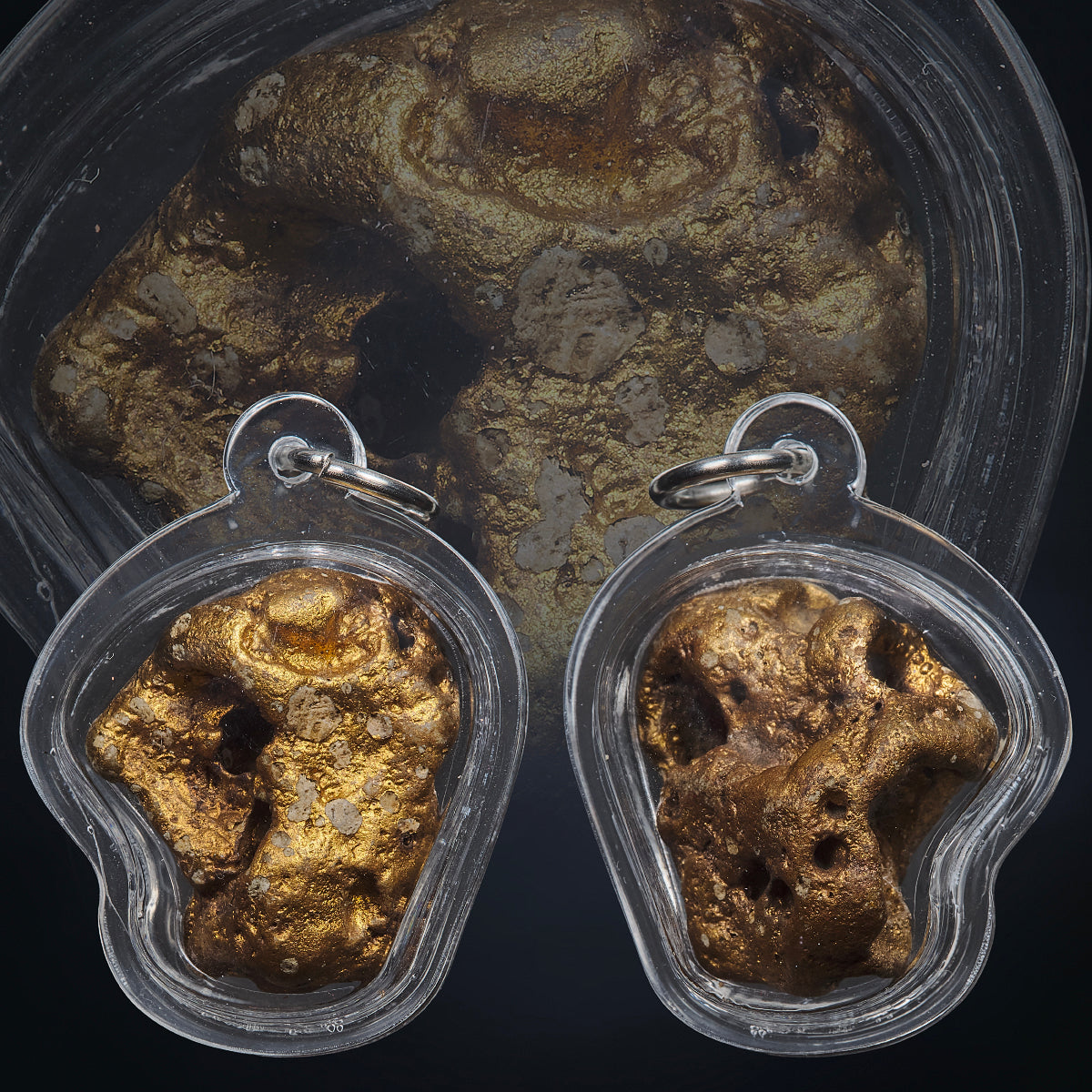
Each example was individually worked from the available relic itself. Natural cavities, irregular contours, colour, surface texture and traces of the original material therefore differ considerably from one piece to another, making every surviving example physically unique.
Personal Experiences Shared by Luksits
Among Por Sala Tan's students, Lersi-related artifacts are generally spoken of somewhat differently from purely Saneh or wealth-oriented pieces.
The recurring theme is guidance.
Some luksits describe becoming unusually alert to situations around them. At important moments they may suddenly reconsider a decision, feel that something should be delayed, or become strongly inclined towards one course of action over another.
Others speak of greater calm when meeting people, conducting business or entering unfamiliar places. Instead of feeling pressured into making an immediate decision, they find themselves observing first and responding with greater clarity.
There are also accounts from those involved in sales and business who felt that people became more receptive towards them. Conversations flowed more naturally, introductions appeared at useful moments, and previously difficult discussions became easier to continue.
Another commonly reported quality is Klaew Klaad. Keepers sometimes associate the piece with narrowly avoiding troublesome situations — changing a route, delaying a journey or deciding not to enter a particular situation shortly before discovering there had been a problem.
These remain personal accounts within the lineage rather than guaranteed outcomes, but collectively they explain why Por Sala Tan's older Lersi relic pieces are regarded as much for judgement and guidance as for attraction or fortune.
Summary
This Lersi relic belongs to the more unusual category of Por Sala Tan's forest-derived sacred objects.
Its history is associated with one of his journeys through the remote border region between Thailand and Myanmar. During such journeys, Por Sala Tan travelled not merely to collect materials but to meditate, exchange wicha and learn from practitioners whose traditions survived outside the larger temple centres.
According to the account preserved with the relic, Por Sala Tan encountered the remains of an old Lersi practitioner in a secluded forest or cave-associated hermitage.
He did not immediately remove anything.
Por Sala Tan first entered meditation and sought permission before accepting the relic material for subsequent ritual use. The Lersi was understood to have been a practitioner whose cultivation concerned Metta, protection, spiritual discipline and assistance to others.
The relic was therefore retained not merely because of its age or unusual origin, but because of its direct connection to a former practitioner and the wicha Por Sala Tan subsequently applied to it.
Its traditional qualities centre upon Metta Mahaniyom, Maha Saneh, Maha Lap, Klaew Klaad, spiritual protection and guidance.
Historical Background
The Lersi, or hermit practitioner, occupies an important place within Thai and wider Southeast Asian sacred traditions.
Lersi are associated with specialised knowledge, meditation, healing, herbs, astrology, sacred inscriptions and different branches of wicha. Within practitioner lineages they are particularly respected as Kru — teachers.
For this reason, an authentic relic connected with a deceased Lersi carries a meaning very different from an ordinary raw material.
Por Sala Tan spent considerable periods travelling through forest and border areas for meditation and learning. Such journeys brought him into contact with monks, hermits, village practitioners and older traditions that were often preserved through direct teacher-to-student transmission.
The story attached to this relic belongs to that period of his practice.
Upon encountering the old remains, Por Sala Tan is said to have meditated before them rather than simply taking the material. During this meditation he understood that the former practitioner had devoted his wicha towards helping and protecting others.
Permission was sought before the relic was removed.
This principle is important within Por Sala Tan's approach: the origin of a material alone did not determine its sacred function. Its history, the spiritual circumstances surrounding it, the intention of the former practitioner and the wicha subsequently applied by Por Sala Tan were all considered together.
Origins of the Materials
Old Lersi Relic
The principal body of the artifact was prepared from an old relic associated with the remains of the Lersi encountered during Por Sala Tan's border travels.
The surviving material naturally displays an aged, irregular structure. Its cavities, mineralised appearance and uneven surface remain visible beneath the ritual finish rather than being completely concealed.
For Por Sala Tan, its importance came from its connection with the former practitioner and the circumstances under which it was received.
Lersi-Associated Materials
The original account also speaks of other materials found in association with the old practitioner, including remnants connected with his meditation practice.
Such materials were treated as lineage relics rather than decorative additions. Their significance lay in preserving a tangible connection with the life and cultivation of the former Lersi.
Gold Finish
The completed relic was finished with gold, portions of which remain visible across the surface.
The gold does not disguise the underlying material. Instead, the natural cavities and irregularities remain clearly apparent, giving the piece the unmistakable appearance of something formed from an older relic rather than a conventional moulded amulet.
Ritual
Before the relic was worked upon, Por Sala Tan meditated at the location and sought permission for its removal and subsequent use.
The understanding was that the relic should continue to serve a beneficial purpose.
After returning with the material, Por Sala Tan prepared it according to his own Lersi wicha. The relic was cleaned and worked without removing the natural character of the original substance.
Chanting and meditation were then directed towards the qualities traditionally associated with the former practitioner:
Metta for goodwill.
Maha Saneh for personal attraction.
Maha Lap for favourable opportunities.
Klaew Klaad for avoidance of danger.
Baramee for authority and stability.
Lersi wicha for wisdom and guidance.
The intention was therefore broader than creating an attraction artifact. It was conceived as a compact Kru-associated relic, connecting the keeper with protection, favourable circumstances and disciplined judgement.
Blessings and Effects
The principal traditional quality is Metta Mahaniyom — encouraging goodwill and favourable reception from those encountered in everyday life.
Maha Saneh complements this through personal presence and magnetism, particularly where communication, negotiation or social interaction is important.
Maha Lap concerns fortunate openings: useful introductions, unexpected opportunities, assistance and circumstances that appear at an advantageous moment.
Klaew Klaad is the protective dimension — traditionally understood as avoidance or escape from accidents, dangerous circumstances and harmful influences.
The Lersi aspect adds another important quality: guidance.
Rather than simply drawing something towards the keeper, Lersi wicha concerns knowing how to respond when an opportunity or difficulty appears.
For this reason, the artifact is traditionally associated with:
- wisdom and clearer judgement;
- meditation and spiritual discipline;
- Metta and favourable reception;
- Saneh and personal presence;
- business and negotiation;
- opportunity and Maha Lap;
- avoidance of danger;
- protection from harmful influences;
- intuition and timely warnings;
- connection with Kru and lineage guidance.
Modern Application
The piece is particularly suited to those whose lives require both interaction with people and careful judgement.
Business owners may keep it where important negotiations take place. Salespeople and professionals may carry it when meeting clients, presenting proposals or entering discussions where receptiveness matters.
For practitioners, its Lersi association makes it suitable for meditation. Rather than constantly making requests, the keeper may simply sit quietly with the artifact and use it as a focus for concentration and respect towards the Kru lineage.
Travellers may traditionally look towards its Klaew Klaad aspect for safe movement and awareness in unfamiliar surroundings.
Its broader character is therefore one of balance:
attraction without losing judgement, opportunity without recklessness, and spiritual strength moderated by the discipline of the Kru.
Physical Details
An individually formed Lersi relic with an irregular organic structure, preserved rather than reshaped into a conventional symmetrical amulet. The surface carries an aged brown tone beneath extensive gold finishing, while numerous natural cavities and pale relic inclusions remain visible throughout the body. The unusual open areas and asymmetrical profile reflect the original relic material from which the artifact was prepared. It is now protected within a clear wearable casing with a metal suspension ring.
Recommended Pairing
For meditation and spiritual development, the relic pairs naturally with a Lersi Roop Lor or another Kru-associated artifact.
For practitioners working with stronger Barang or Prai artifacts, a Buddha-form amulet may also provide a balanced merit-centred foundation.
Personal Notes
What makes this piece particularly interesting is that its importance does not begin with the finished amulet.
It begins with Por Sala Tan's journey.
He travelled into the borderlands for meditation and learning, encountered the remains of an older practitioner, and — according to the history handed down with the relic — did not simply take what he found. He first meditated, acknowledged the former Lersi and sought permission.
That distinction matters.
Por Sala Tan repeatedly placed importance on the wicha and intention attached to a material, rather than claiming that every old bone, cave relic or unusual substance automatically possessed the same qualities.
Here, the material was significant because it was understood to have belonged to a Lersi whose own practice had been directed towards protection, Metta and helping others. Por Sala Tan then continued that purpose through his own preparation and consecration.
The surviving artifact still shows the character of the original relic — rough, irregular and naturally formed beneath its gold surface.
For collectors of Por Sala Tan's older works, it represents something beyond a conventional charm.
It is a relic of a practitioner, subsequently prepared by another practitioner — a physical connection between an older Lersi tradition and Por Sala Tan's own forest wicha.
-
Free Shipping for Singapore| $15 Worldwide | $60 USA For Items Below $350