
OOBThaiAmulets
Por Sala Tan
Por Sala Tan
Couldn't load pickup availability
PST05
NMP 5 Tii Mae Yu
Por Sala Tan
B.E. 2550 (2007)
Barang Artifact
~ 1.5 inches
Sacred Craftsmanship
The NMP 5 Tii Mae Yu was individually prepared by Por Sala Tan from a concentrated combination of Nam Man Prai, personal relic materials and cemetery-associated ingredients connected with Mae Yu. The contents were sealed within a tubular container and completed with Por Sala Tan's handwritten yant inscriptions.
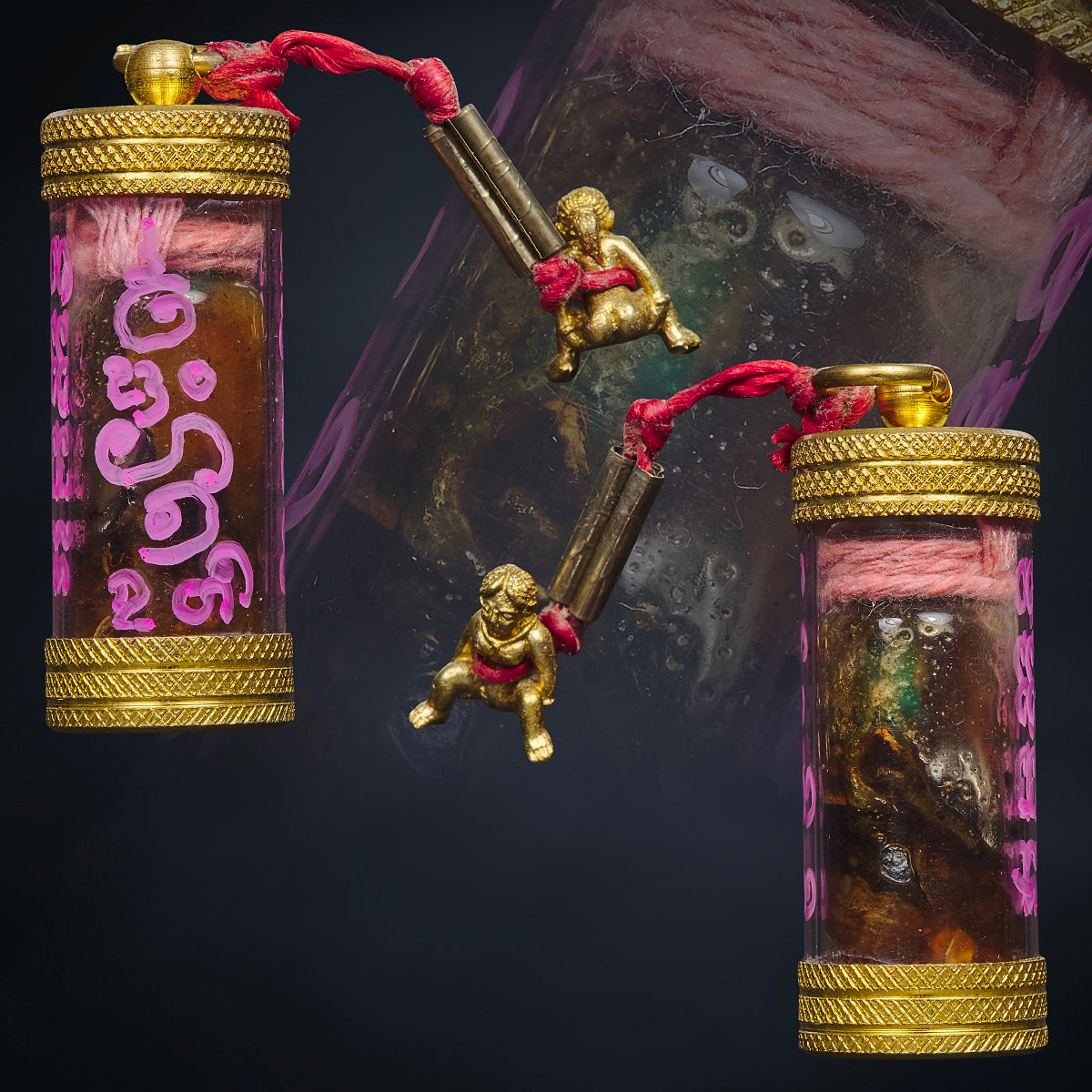
This example also retains the distinctive ritual assembly attached to the container, including takruts, red binding cord and small figures. Each was assembled and finished individually by hand; variations in the oil, relic materials, bindings and inscriptions are therefore part of the character of every surviving piece.
Personal Experiences Shared by Luksits
The feedback surrounding NMP 5 Tii Mae Yu has remained particularly positive among Por Sala Tan's luksits.
One of the most frequently mentioned changes concerns relationships and communication.
Keepers have described relationships improving tremendously after carrying or keeping the piece. People who were previously distant or reserved appeared friendlier, while conversations that had once been difficult became noticeably easier.
Some found that others became more outspoken with them — not necessarily in an aggressive sense, but more willing to express what they genuinely thought and felt. Partners, friends, customers and colleagues appeared more open to discussion, making it easier to address misunderstandings and reach common ground.
This quality is especially interesting because it extends beyond simple physical attraction. Luksits often describe Mae Yu's Saneh as creating an atmosphere where people are willing to approach, talk and engage.
Another recurring experience concerns sincere requests.
Keepers who approached Mae Yu respectfully with a clear request sometimes reported that circumstances subsequently developed in a positive direction. Help might arrive, a conversation could reopen, someone might become more cooperative, or an opportunity that appeared closed could begin moving again.
For this reason, many older collectors came to regard Mae Yu not simply as a strong Saneh working, but as a particularly responsive wish-granting and interpersonal piece.
Summary
The NMP 5 Tii Mae Yu, prepared by Por Sala Tan in B.E. 2550, belongs to the more concentrated Saneh works associated with his Fang period.
The foundation of the batch was Mae Yu, a woman remembered locally for an exceptionally strong social and romantic presence during her lifetime. Following her death, Por Sala Tan encountered the circumstances surrounding her spirit and understood that considerable merit was required for her to progress from her existing condition.
He agreed to assist.
From this developed a complex ritual working in which Nam Man Prai was gathered from five specific points — lips, chin, chest, yoni and belly — hence the designation 5 Tii, or "five places".
These were combined with other personal and cemetery-associated materials, including hair, burial soil, earth from seven cemeteries, cloth associated with her final garments and bone ash collected after cremation.
Mae Yu subsequently became an important Ong Krut, or central spiritual foundation, for a number of Por Sala Tan's Saneh workings.
The result is a piece traditionally associated with Maha Saneh, Metta Maha Niyom, improved relationships, social openness, opportunity and sincere wish fulfilment.
Historical Background
Por Sala Tan's work with Mae Yu was not simply the acquisition of materials for making an artifact.
According to the history preserved among his students, Mae Yu required substantial merit before she could move towards another realm. Por Sala Tan therefore approached the undertaking as both a spiritual responsibility and a specialised Saneh working.
Mae Yu was remembered within her community as a woman with a particularly powerful attraction towards others. Her personality and reputation became significant to the subsequent wicha because Saneh traditions frequently place importance upon the qualities associated with a person during life.
The preparation of the batch was consequently difficult and highly specific.
Rather than relying upon a single relic or oil, Por Sala Tan gathered materials representing different aspects of Mae Yu's physical existence and final resting place.
Her essence eventually became important enough that Por Sala Tan used Mae Yu as an Ong Krut for later Saneh consecrations, placing her among the more significant spiritual foundations associated with this branch of his practice.
Origins of the Materials
Nam Man Prai 5 Tii
The defining material is the NMP gathered from five locations: lips, chin, chest, yoni and belly.
Each location was understood symbolically within the attraction working.
The lips relate naturally to speech, persuasion and communication. The facial area concerns personal presence and how one is received by others. The chest represents feeling and emotional attachment, while the lower centres connect with attraction, desire and generative vitality.
Together, the five points created a more complete Saneh formula than reliance upon a single source.
Hair Relic
Hair associated with Mae Yu was incorporated as a direct personal relic.
Within this form of wicha, personal material establishes continuity between the ritual preparation and the individual around whom the working was originally formed.
Burial Soil
Soil associated with Mae Yu's burial site was included as an anchoring material.
Its significance lies in provenance: it connects the completed preparation with the physical location in which the original spiritual circumstances developed.
Soil from Seven Cemeteries
Earth gathered from seven cemeteries expanded the grave-associated foundation of the formula.
Within Por Sala Tan's Barang practice, such materials were prepared and combined according to their intended ritual function rather than being treated as ordinary soil.
Cloth from Her Final Garments
Cloth associated with Mae Yu's final clothing was incorporated as another personal connection.
Like the hair, it provides a material link to Mae Yu herself rather than relying solely upon symbolic Saneh ingredients.
Bone Ash
Bone ash collected following cremation was included to complete the personal relic component of the preparation.
Together, the oil, hair, cloth, soil and ash created a layered construction linking the Saneh working directly with Mae Yu.
Ritual
The preparation of NMP 5 Tii Mae Yu required several stages.
Por Sala Tan first dealt with Mae Yu's spiritual condition and the merit required for her progression. Only within that broader process were the materials gathered and subsequently prepared for the Saneh working.
The five-point NMP formed its central liquid medium.
Hair, burial earth, cemetery soil, cloth and bone ash were then incorporated according to the ritual formula. The different materials were not regarded as interchangeable: each established a particular aspect of the connection.
The completed mixture was placed within the tubular vessel and sealed.
Por Sala Tan then performed the necessary chanting and consecration, directing the preparation towards Metta, Maha Saneh, interpersonal attraction, opportunity and responsiveness to sincere requests.
The exterior was completed with his handwritten yant work.
This B.E. 2550 batch is additionally valued because it belongs to the later period in which Por Sala Tan was still personally applying such inscriptions to his pieces.
Blessings and Effects
The principal traditional quality of Mae Yu is Maha Saneh — attraction and personal magnetism.
Closely connected is Metta Maha Niyom, encouraging goodwill, friendliness and greater receptiveness from those around the keeper.
What distinguishes the reported character of Mae Yu, however, is the emphasis upon openness.
Rather than attraction being understood solely in romantic terms, luksits describe people becoming easier to approach and more willing to communicate. This makes the piece relevant to relationships, friendships, customer interaction and negotiations alike.
Traditional applications include:
- Maha Saneh and personal magnetism;
- Metta Maha Niyom and favourable treatment;
- improved communication between partners;
- greater openness and willingness to discuss problems;
- relationship harmony and reconciliation;
- customer and social attraction;
- persuasive speech and easier negotiation;
- opportunity and favourable encounters;
- business relationships and commercial goodwill;
- sincere wish granting.
Its wealth association is therefore largely connected with people and opportunity — attracting the relationships, conversations and openings through which practical results can develop.
Modern Application
NMP 5 Tii Mae Yu remains particularly relevant where success depends heavily upon relationships.
For couples, its traditional application concerns restoring warmth, encouraging conversation and creating circumstances where both parties become more willing to communicate openly.
For salespeople and business owners, the same Saneh principle may be directed towards customer rapport. Friendlier conversations, greater willingness to listen and easier discussion can all be valuable where trust precedes a transaction.
Those working in negotiation, networking or customer-facing professions may similarly appreciate its combination of Saneh and communication.
For personal wishes, the traditional approach is to make a sincere and clearly defined request while continuing to work towards the desired result. Mae Yu is regarded as assisting circumstances rather than replacing personal action.
Physical Details
This NMP 5 Tii Mae Yu is preserved within its distinctive cylindrical ritual container with decorative gold-toned fittings at both ends. The interior contains dark amber-brown oil together with clearly visible organic and relic materials, while pink handwritten sacred characters appear directly around the transparent exterior. Pink fibrous material is visible near the upper interior, and the assembly is completed with red ritual cord, paired metal takruts and small gold-toned figures attached externally. The surviving construction retains the dense, individually assembled character associated with Por Sala Tan's older Barang work.
Recommended Pairing
For relationship purposes, Mae Yu may be paired with Yin Tong or Salika, particularly where communication and mutual receptiveness are the principal intentions.
A Khun Paen can strengthen the broader Saneh orientation where personal charisma and attraction are desired.
For business, pairing it with a wealth or Chok Lap piece creates a practical division of functions: Mae Yu supports the interpersonal opening, while the accompanying artifact concentrates upon financial movement and opportunity.
For balanced everyday use, a mainstream Buddha-form amulet such as Somdej or Phra Kring provides a suitable merit-centred foundation.
Personal Notes
What I find particularly significant about NMP 5 Tii Mae Yu is that its reputation among luksits is not limited to romantic attraction.
The repeated feedback is broader.
Relationships improve. People become friendlier. Those who were previously quiet become more willing to speak. Difficult subjects become easier to discuss, and conversations that once seemed closed can begin moving again.
That makes Mae Yu particularly interesting as a Saneh artifact.
Attraction may draw someone closer, but communication is what allows a relationship — whether personal or professional — to develop.
The wish-granting reputation follows a similar pattern. Keepers speak positively of making sincere requests and subsequently seeing circumstances move in a favourable direction, especially when they themselves continue putting effort into what they are asking for.
Its physical construction also preserves an important period of Por Sala Tan's work: the five-point NMP, personal relic materials, cemetery earth, bone ash, original ritual assembly and his own handwritten yant all remain together within a single preparation.
Mae Yu later becoming an Ong Krut for Por Sala Tan's other Saneh works further demonstrates the importance he placed upon this particular spiritual foundation.
For me, that is the character of this piece: not attraction alone, but attraction that opens people — to conversation, understanding, opportunity and sincere requests.
-
Free Shipping for Singapore| $15 Worldwide | $60 USA For Items Below $350