
OOBThaiAmulets
Por Sala Tan
Por Sala Tan
Couldn't load pickup availability
PST04
Yoni Amulet
Por Sala Tan
around 2.5"
Sacred Craftsmanship
Every example was individually prepared by hand. Natural differences in the Nang, handwritten inscriptions, sacred powders, embedded relics and finishing therefore make each piece unique.
Personal Experiences Shared by Luksits
One female devotee working professionally in sales began wearing a Yoni amulet daily. Before doing so, she meditated upon her intentions, focusing particularly on charisma, customer relationships and success in her work.
Over time, she began noticing a distinct change in how people responded to her.
Men approached her for dates with noticeably greater frequency — sometimes even on days when she was tired, casually dressed or personally felt that she was not looking her best. What surprised her was that the attention appeared without her deliberately trying to attract it.
The same pattern became noticeable professionally.
Customers seemed unusually comfortable around her. Conversations became easier, male clients were more playful and open, and some openly flirted with her. A few even jokingly spoke about marrying her.
More generally, she noticed that strangers appeared warmer and more willing to engage in conversation. This made her working environment feel lighter and helped her establish rapport with customers more naturally.
What stood out most to her was the apparent effortlessness of the attention. In her experience, she did not need to consciously project charm — people simply seemed more inclined to notice, approach and engage with her.
She came to associate this with the particular Metta and Maha Saneh character of Por Sala Tan's Yoni wicha.
Summary
Por Sala Tan's Yoni Amulet belongs to the attraction branch of his traditional wicha.
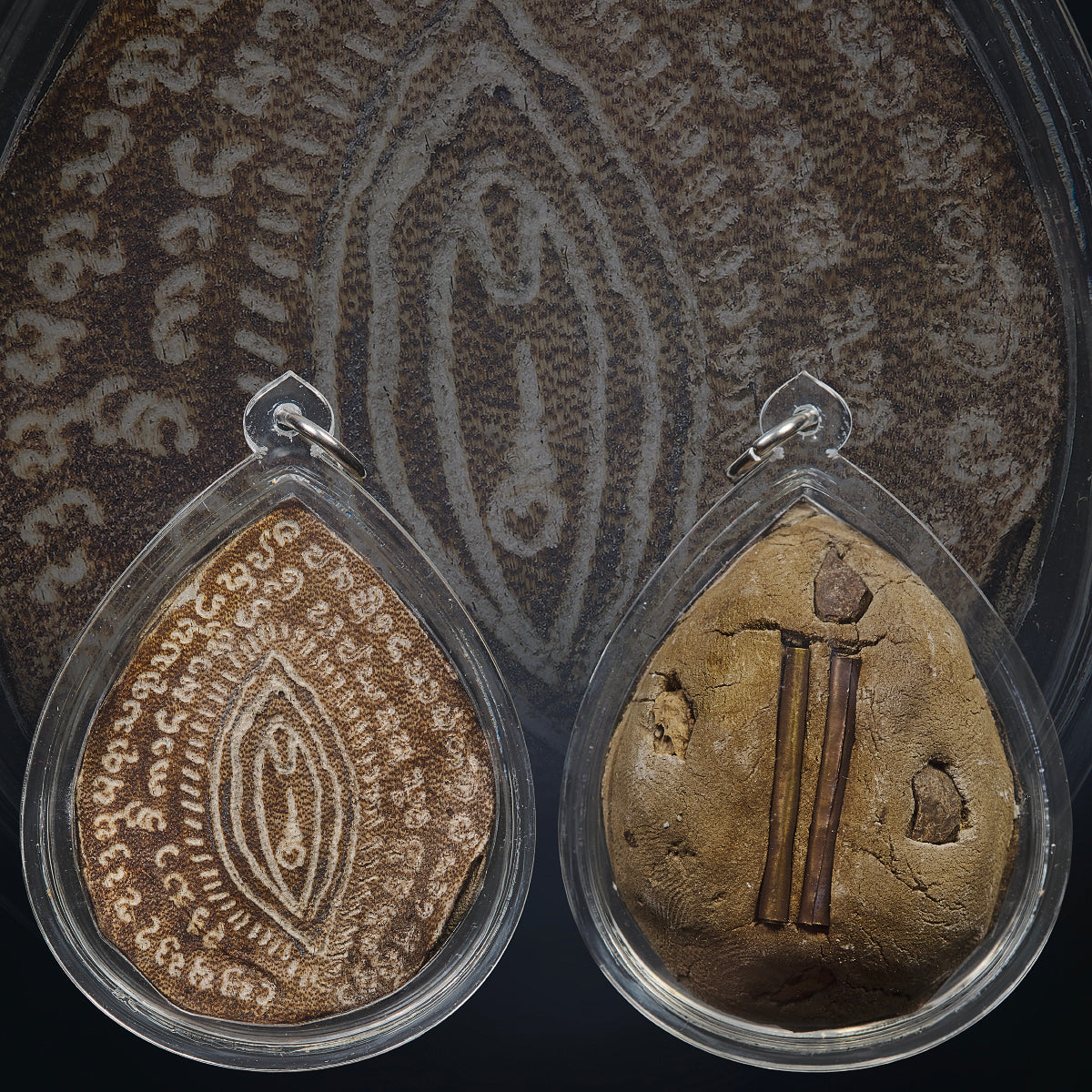
Its principal material is Nang Tua Ngern Tua Thong, upon which Por Sala Tan personally drew the Yoni and surrounding sacred inscriptions. The reverse combines his own sacred powders with takruts and fragments of Yoni relics.
The piece was specifically prepared around three closely related intentions:
Metta Maha Niyom — goodwill, acceptance and favourable treatment from others.
Maha Saneh — personal charm, magnetism and attraction.
Opposite Attraction — traditionally associated with attracting attention and interest from the opposite sex.
While its symbolism is unmistakably connected with attraction, its practical tradition extends beyond romance. For this reason, such pieces were also valued by those working in sales, business, negotiation and other professions where personal rapport is important.
Historical Background
The Yoni is an ancient symbol of feminine generative power, creation and fertility. Within South and Southeast Asian sacred traditions, it represents the feminine principle and is historically encountered alongside the Lingam as an expression of complementary creative forces.
Within certain folk-wicha lineages, the Yoni became particularly associated with Saneh — attraction and personal magnetism. Its symbolism was adapted into powders, inscriptions, carved objects and portable amulets intended to strengthen the practitioner's social presence.
Por Sala Tan's interpretation belongs to this esoteric tradition rather than conventional temple Buddhist iconography.
His purpose was not simply to reproduce the physical Yoni symbol. The image served as the central ritual form around which specific kata, sacred materials and attraction wicha could be assembled.
Origins of the Materials
Nang Tua Ngern Tua Thong
The front was prepared from Nang of the Tua Ngern Tua Thong.
The Thai name Tua Ngern Tua Thong carries the literal imagery of “silver and gold”.
For Por Sala Tan, the importance of the material came from the specific wicha applied to it, rather than from claiming that all Tua Ngern Tua Thong material inherently possesses the same sacred qualities.
The Nang provided the physical surface upon which he personally wrote the sacred inscriptions and drew the Yoni.
Sacred Powders
The reverse contains a specially prepared mixture of Por Sala Tan's own sacred powders.
These powders were blended with the specific intention of strengthening Metta, Maha Saneh and opposite attraction, creating the foundation into which the remaining ritual components were placed.
Takruts & Yoni Relics
Multiple takruts were embedded vertically into the reverse.
Fragments of Yoni relic material were also inserted into the sacred-powder body, further concentrating the piece around its intended attraction wicha.
Ritual
The preparation of this amulet involved several stages rather than a single blessing after manufacture.
Por Sala Tan first prepared the Nang and sacred materials according to his lineage. The Yoni and surrounding yant were then drawn and written directly by hand, turning the natural material into the principal ritual face of the piece.
The sacred-powder mixture formed the reverse and provided a medium for embedding the takruts and Yoni relic fragments.
The completed piece was then worked through kata and consecration focused specifically upon Metta Maha Niyom, Maha Saneh and attraction.
Within this form of wicha, the different components perform complementary roles: the Yoni establishes the symbolic centre, the handwritten yant carries the ritual formula, the takruts hold additional inscriptions, and the sacred powders bind the complete construction together.
Blessings and Effects
The principal traditional quality of the amulet is Maha Saneh — strengthening personal attraction and the ability to naturally draw attention.
Closely connected is Metta Maha Niyom, traditionally understood as encouraging others to feel comfortable, receptive and favourably disposed towards the keeper.
Its opposite-attraction wicha is particularly associated with romantic attention, desirability and increased interest from the opposite sex.
Yet attraction in this context is not restricted to romance.
For salespeople and those dealing regularly with customers, the same qualities are traditionally applied towards approachability, persuasive communication, easier rapport and favourable interpersonal relationships.
The amulet is therefore as much concerned with drawing people towards the keeper as it is with purely romantic attraction.
Modern Application
The Yoni Amulet is particularly suited to professions where personal interaction directly influences results.
Salespeople, business owners, agents, negotiators and others working with customers may appreciate its traditional emphasis on Metta and social magnetism. The intention is not to replace skill or professional ability, but to support an atmosphere in which conversation and relationships develop more naturally.
For personal use, it may be carried with intentions concerning confidence, attraction, relationships and social presence.
As with all Saneh practice, attraction should be understood alongside respect for another person's choice and boundaries. Within disciplined practice, the emphasis is better placed upon strengthening one's own presence and likeability rather than attempting to control another person.
Physical Details
This is a teardrop-form Yoni amulet constructed from multiple individually prepared sacred components. The front retains the natural brown texture of the Nang Tua Ngern Tua Thong, covered extensively with Por Sala Tan's handwritten sacred script surrounding a prominent central Yoni design. The reverse consists of aged sacred powder containing three visible takruts and embedded Yoni relic fragments, with natural cracking and irregularities arising from the handmade powder composition. The entire piece is preserved within a fitted clear protective casing.
Recommended Pairing
For those using the piece professionally, it pairs naturally with amulets associated with Chok Lap, wealth and business prosperity. The Yoni can provide the Metta and interpersonal element while the accompanying piece represents financial stability and opportunity.
A Khun Paen may also complement its Maha Saneh orientation where attraction and personal charisma are the principal intentions.
For a more balanced everyday arrangement, it may instead be accompanied by a mainstream Buddha-form amulet, allowing the Yoni to retain its specialised role in Metta and Saneh while the principal Buddhist image serves as the foundation of the set.
Personal Notes
One of the most interesting aspects of this piece is how directly its physical construction reflects its intended wicha.
The Nang Tua Ngern Tua Thong, hand-drawn Yoni, handwritten yant, Por Sala Tan's personal sacred-powder mixture, multiple takruts and Yoni relic fragments were not assembled randomly. Each was selected and prepared around the same central purpose.
The experience shared by the female sales professional is particularly representative of how luksits describe this tradition. She did not speak only of romantic attention; she noticed friendlier customers, easier conversations, greater engagement from strangers and an overall increase in social warmth.
For that reason, Por Sala Tan's Yoni is best understood as an amulet of personal magnetism — combining attraction, Metta and interpersonal presence within one specialised piece of his wicha.
-
Free Shipping for Singapore| $15 Worldwide | $60 USA For Items Below $350