
OOBThaiAmulets
Por Sala Tan
Por Sala Tan
Couldn't load pickup availability
PST04
Yin Tong
Por Sala Tan
Sacred Craftsmanship
Each Yin Tong was individually prepared and carved by hand from naturally occurring Mai Rak. Differences in wood grain, form, ritual finishing and preparation give every surviving piece its own individual character.
Personal Experiences Shared by Luksits
The examples seen today were collected from Por Sala Tan's luksits who personally assisted him during the preparation of these Yin Tong.
According to one of these luksits, obtaining the correct Mai Rak was itself one of the most difficult parts of the process. Por Sala Tan imposed strict conditions upon the material he would accept. The wood had to come from the environment he considered suitable, particularly jungle areas where the Mai Rak grew naturally amongst an abundance of herbs associated with Saneh and Metta Maha Niyom.
Because of these requirements, suitable wood was difficult to locate and only a limited quantity could be prepared.
Luksits and devotees who subsequently carried the Yin Tong commonly spoke about improvements in relationships and interpersonal harmony.
Some owners reported that relationships with their partners became noticeably better, with communication becoming easier and disagreements settling more readily. Rather than describing attraction alone, they spoke of greater understanding, affection and willingness from both sides to listen to one another.
Another recurring experience concerned the workplace. Junior staff carrying the piece reported that superiors seemed more receptive towards them — listening more readily to suggestions, communicating with less resistance and becoming more approachable when assistance or approval was required.
These experiences closely reflect the traditional character of Yin Tong wicha: not simply drawing another person towards the owner, but encouraging mutual receptiveness, affection and smoother human relationships.
Summary
This Yin Tong by Por Sala Tan was created as a focused Saneh and Metta Maha Niyom artifact, centred upon attraction and harmony between two people.
Its principal material is Mai Rak, carefully selected from remote natural surroundings where Saneh and Metta herbs were found growing abundantly around it.
Por Sala Tan regarded the environment surrounding the tree as part of the material's significance. Rather than treating the wood independently from its surroundings, he sought Mai Rak growing within a landscape already naturally abundant in plants connected with attraction and Metta traditions.
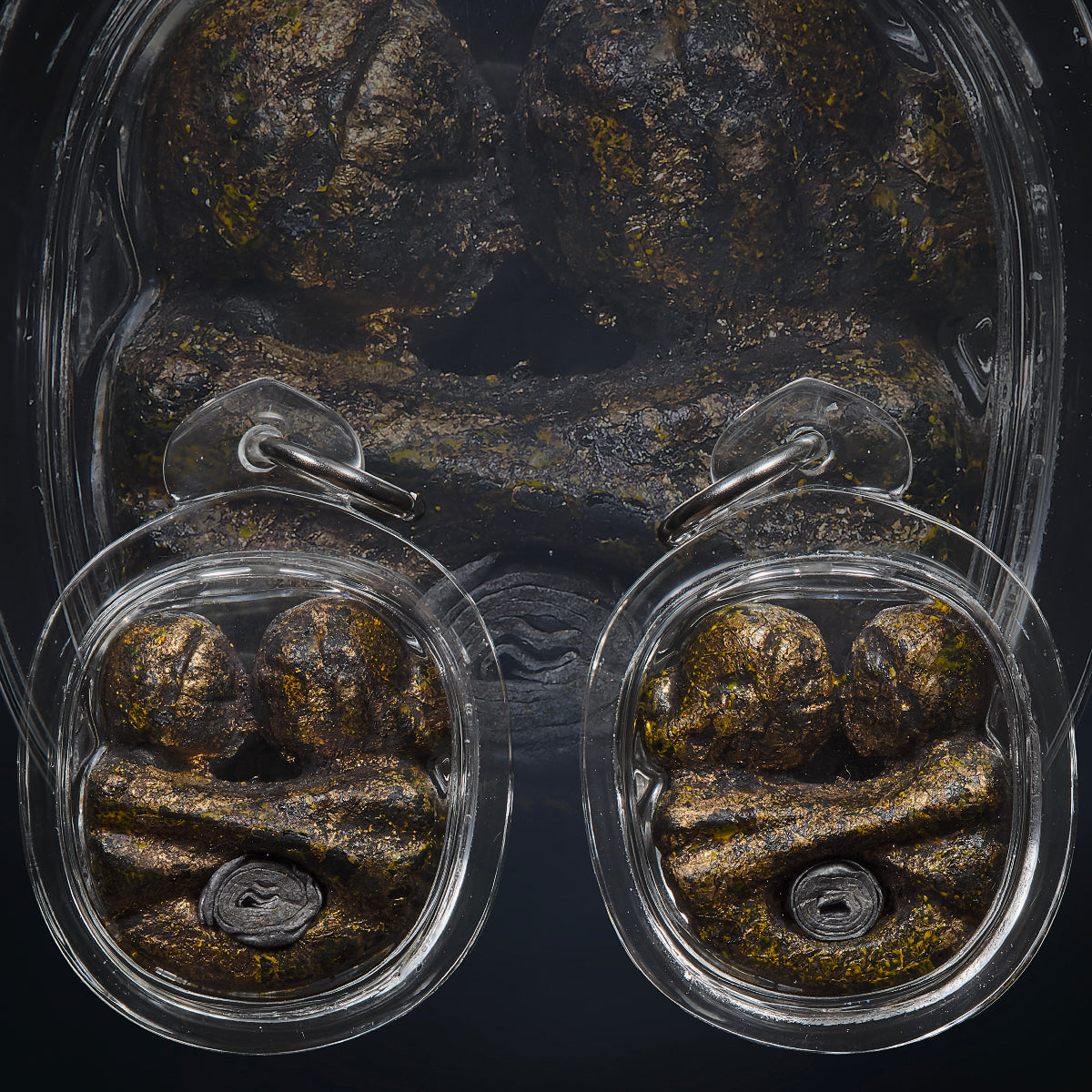
The paired Yin Tong figures represent two individuals drawn together, while the incorporated opposite-attraction Saneh takrut strengthens the intention towards attraction, affection and receptiveness.
The resulting piece was intended for relationships in the broadest sense — partners, customers, colleagues, superiors and people encountered throughout everyday life.
Historical Background
Yin Tong belongs to an old family of Thai Saneh and Metta imagery based upon the union of a male and female figure.
The paired form represents attraction between complementary sides. Within traditional wicha, this symbolism extends beyond romantic attraction into the broader principle that people should feel naturally inclined towards one another.
This makes Yin Tong relevant not only to romantic relationships but also to commerce and social life.
A merchant needs customers to feel comfortable approaching.
A junior employee needs a superior willing to listen.
A negotiator needs the other party to remain receptive.
Partners need affection and understanding to remain present even when disagreements occur.
Yin Tong therefore represents attraction as a relationship between two sides, rather than attention flowing in only one direction.
Origins of the Materials
The foundation of this artifact is Mai Rak.
The Thai word Rak carries a direct association with love, making this wood particularly meaningful within traditional Saneh practices.
For these pieces, however, Por Sala Tan applied an additional condition.
He specifically sought Mai Rak growing naturally deep within jungle environments where traditional Saneh and Metta Maha Niyom herbs were also abundant.
This was important to his preparation of the material. The tree had matured for years within the same ground and environment as those naturally occurring plants.
Only Mai Rak meeting Por Sala Tan's requirements was collected for the Yin Tong.
An opposite-attraction Saneh takrut was then incorporated into the finished piece, concentrating its intended wicha upon interpersonal attraction and receptiveness.
Ritual
The ritual direction of this Yin Tong centred upon Saneh, Metta Maha Niyom and opposite attraction.
The paired figures provided the principal symbolic foundation: two individuals brought into closeness rather than remaining separated.
Por Sala Tan's selection of Mai Rak from areas rich in naturally occurring Saneh herbs established the material foundation, while the dedicated takrut reinforced the attraction aspect of the finished artifact.
Importantly, the intended quality was not limited to physical or romantic attraction.
The broader purpose was to make interactions warmer, more receptive and easier to develop — helping people listen, communicate and respond favourably towards the owner.
Blessings and Effects
The principal traditional qualities of this Yin Tong are Saneh and Metta Maha Niyom.
For couples, it is associated with affection, closeness, reconciliation and maintaining harmony within an established relationship.
Its opposite-attraction aspect is traditionally sought for increasing personal appeal and making interaction between men and women more natural.
In professional settings, the emphasis shifts towards Metta and favour — encouraging superiors, clients and colleagues to receive the owner's words more positively.
For commerce and sales, the same principle concerns approachability: customers feeling comfortable speaking with the owner, conversations developing naturally and relationships becoming easier to maintain.
Its overall character is therefore less about commanding another person and more about reducing the distance between people.
Modern Application
Yin Tong remains particularly relevant for anyone whose daily life depends heavily upon relationships.
Couples may keep it as a symbolic focus for maintaining affection and communication.
Salespeople and business owners may carry it where customer rapport and repeated relationships are important.
Employees may relate to its Metta qualities when communicating with managers and senior figures, particularly where proposals, approvals or cooperation are required.
It is equally suitable for individuals who regularly network or meet unfamiliar people and wish to cultivate a warmer, more approachable personal presence.
Physical Details
This example is carved from Mai Rak into the compact paired Yin Tong form, showing the two figures seated closely together. The dark aged surface retains traces of ritual finishing, while an opposite-attraction Saneh takrut is incorporated into the piece.
It is presently preserved within a clear protective casing.
Recommended Pairing
Yin Tong pairs naturally with dedicated wealth or Choke Lap pieces for business use, particularly where prosperity depends upon customers, negotiations and maintaining good relationships.
It may also be combined with a Baramee amulet when the owner requires both personal favour and professional credibility.
For relationships and social interaction, however, Yin Tong may comfortably be carried alone. Its wicha is already specifically directed towards the human connection between one person and another.
Personal Notes
The most interesting aspect of Por Sala Tan's Yin Tong is perhaps not the familiar paired imagery, but how particular he was about the wood.
Mai Rak alone was not sufficient.
He wanted Mai Rak growing naturally in remote jungle surroundings where the land itself supported an abundance of herbs traditionally connected with Saneh and Metta Maha Niyom.
The luksits who helped prepare these pieces remembered how difficult those conditions made the search. Suitable material could not simply be obtained whenever another batch was required.
This helps explain why relatively few were prepared and why examples retained by the original luksits carry a particularly direct connection with their creation.
The experiences later shared by devotees are equally consistent with the character of the piece. Partners described improved relationships. Juniors found senior figures more receptive. Interactions became easier rather than forceful.
That distinction is important.
The character of this Yin Tong is not Maha Amnaj — making another person submit.
It is the softer principle of Saneh and Metta Maha Niyom — creating the conditions in which two people become more willing to approach, listen, understand and remain close to one another.
In that sense, the two figures themselves explain the entire wicha:
two sides, drawn closer together.
-
Free Shipping for Singapore| $15 Worldwide | $60 USA For Items Below $350