
OOBThaiAmulets
Por Sala Tan
Por Sala Tan
Couldn't load pickup availability
PST04
Palakit Nang Kot
Por Sala Tan
Each Palakit was individually hand-carved by Por Sala Tan from carefully selected Mai Niu Dam. As the wood is naturally formed and every figure was carved separately by hand, variations in grain, colour, texture and form make each completed artifact truly unique.
Personal Experiences Shared by Luksits
Only a small number of these Mai Niu Dam Palakit were created by Por Sala Tan, and pieces from this group were rarely encountered outside those who received them directly or lived within the surrounding communities.
One account preserved with this batch concerns a villager from a nearby village who was known to possess one of these Palakit.
People around him began noticing that members of the opposite gender would frequently approach him first, sometimes simply beginning conversations without any obvious introduction or reason.
The encounters were not limited to people already familiar with him. According to those who knew him, strangers also appeared more comfortable approaching him, starting conversations and remaining around him.
This became associated with the Palakit he carried, particularly because the Mai Niu Dam used for these pieces had originally been discovered growing amongst forest herbs traditionally connected with Metta, Maha Saneh and opposite-gender attraction wicha.
For those familiar with Por Sala Tan's work, this account became one of the experiences associated with this small group of Palakit — particularly for personal attraction, approachability and attention from the opposite gender.
Summary
This unusual Palakit by Por Sala Tan was individually hand-carved from Mai Niu Dam, a dark sacred wood personally harvested by Por Sala Tan during one of his expeditions into the remote jungle along Thailand's border region.
What made this particular source of Mai Niu Dam especially significant was the environment in which Por Sala Tan discovered it.
The wood was naturally surrounded by numerous traditional forest herbs used in the preparation of Metta, Maha Saneh and opposite-gender attraction powders.
Recognising the unusual combination, Por Sala Tan harvested the Mai Niu Dam and later selected it for the creation of only a small number of Palakit.
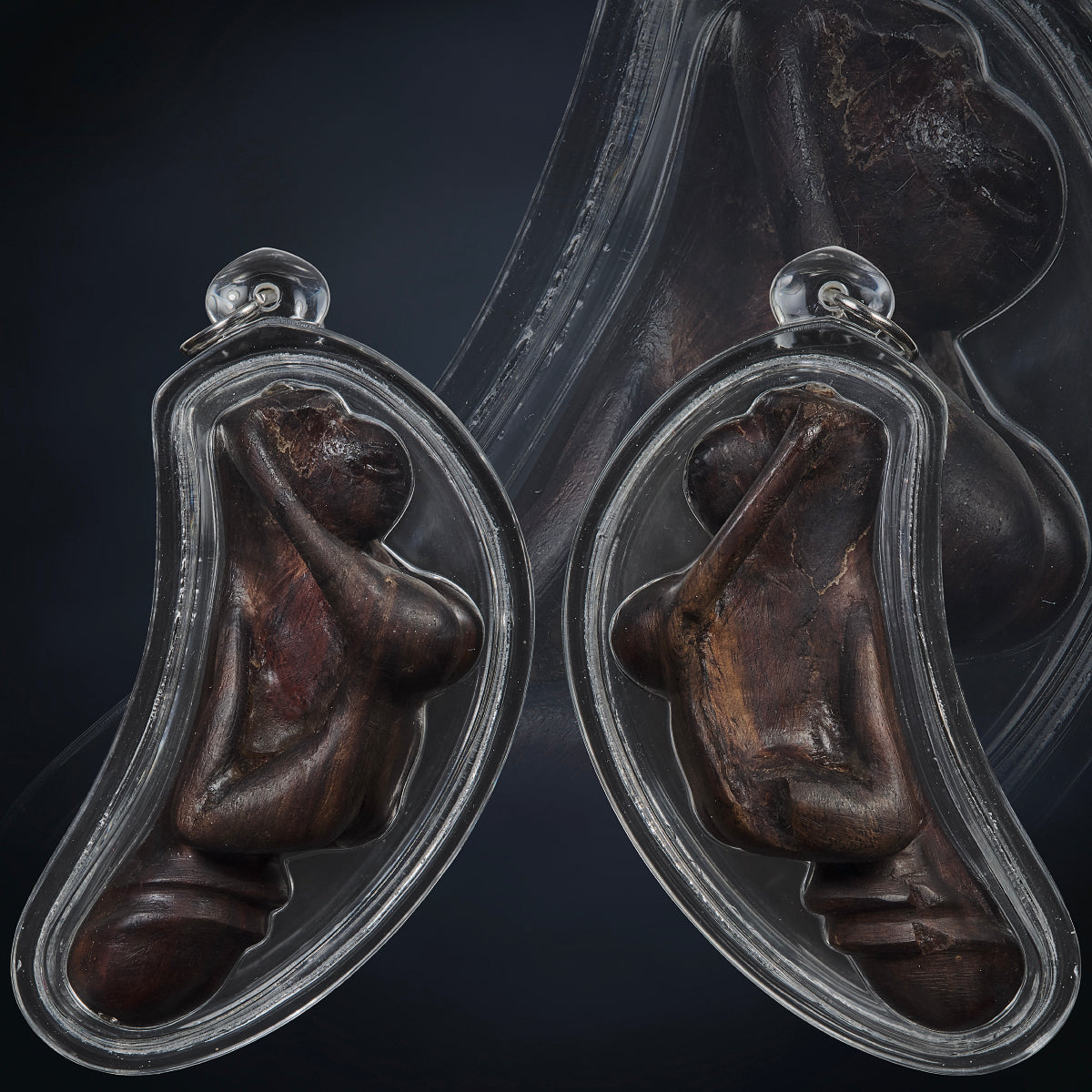
The carving incorporates a female figure embracing the Palakit, bringing together the traditional generative symbolism of the form with the feminine qualities of attraction, receptivity and companionship.
Its principal traditional qualities are centred upon Maha Saneh, Metta Maha Niyom, opposite-gender attraction, social approachability, customer attraction and favourable opportunities.
Origin of the Mai Niu Dam
The Mai Niu Dam used for this piece was personally collected by Por Sala Tan during an expedition into a remote jungle area along Thailand's border.
Sacred woods discovered in isolated forest environments have long occupied an important place within Thai folk and wicha traditions. Practitioners traditionally considered not only the wood itself, but also its location, age, surrounding environment and the circumstances under which it was discovered.
For this particular source of Mai Niu Dam, Por Sala Tan observed something unusual.
Growing naturally around the wood were numerous traditional herbs associated with the preparation of Metta and Saneh powders.
This surrounding environment became an important reason for his decision to harvest the material and preserve it for a specialised sacred creation.
The Metta & Saneh Herbs
The herbs surrounding the Mai Niu Dam were varieties traditionally used by practitioners when preparing sacred compounds for Metta Maha Niyom and Maha Saneh.
Within traditional belief, these herbs are associated with increasing personal magnetism and encouraging warmer responses from others.
They are particularly connected with approachability, affection, persuasive communication, popularity and attraction between people.
For Por Sala Tan, the fact that this Mai Niu Dam had grown naturally amongst such herbs made the wood especially suitable for an attraction-based sacred object.
He therefore selected the material for the Palakit form, allowing the natural provenance of the wood to correspond with the intended wicha of the finished piece.
Palakit – Traditional Symbolism
The Palakit is one of the longstanding forms found within Thai folk talisman traditions.
Although recognised by its distinctive phallic form, its traditional symbolism extends beyond sexuality. It represents generative life force, fertility, abundance, prosperity and protective vitality.
Palakit have traditionally been carried or kept as auspicious objects for protection and the strengthening of personal fortune.
They also became associated with merchants and commerce, where the symbolism of fertility and multiplication could be interpreted as the growth of customers, opportunities and income.
Within attraction wicha, this same generative symbolism becomes associated with personal magnetism, confidence and the ability to draw people towards the keeper.
The Embracing Female Figure
This example is distinguished by the female figure carved directly around and embracing the Palakit.
The figure forms an integral part of the overall composition.
The Palakit represents active generative energy, while the embracing female form represents attraction, receptivity, companionship and the drawing together of complementary energies.
The imagery therefore reinforces the Maha Saneh character already associated with the Mai Niu Dam and the surrounding forest herbs from which it was collected.
Within traditional interpretation, the combined form is particularly associated with opposite-gender attraction, greater social warmth, relationship harmony and being more readily noticed or approached by others.
Mai Niu Dam
Mai Niu Dam is regarded within sacred-wood traditions as a material suitable for specialised hand-carved talismans.
The naturally dark wood gives this Palakit its distinctive deep brown appearance, with variations in tone, grain and texture remaining visible throughout the carving.
For this particular creation, however, its importance lies especially in its provenance.
Por Sala Tan personally harvested the wood from the remote jungle where it had grown surrounded by herbs traditionally connected with attraction wicha.
The material, surrounding herbs and chosen Palakit form therefore share the same ritual direction, giving the completed artifact a particularly focused character.
Traditional Blessings (Summary)
The strongest traditional emphasis of this Palakit is Maha Saneh, supporting personal attraction and the ability to naturally draw attention from others.
Metta Maha Niyom complements this quality through goodwill, approachability and smoother interpersonal relationships.
Its more specialised aspect is opposite-gender attraction, reflecting both the embracing female imagery and the traditional qualities associated with the herbs surrounding the original Mai Niu Dam.
For commerce, the same attraction quality may be directed towards calling customers, encouraging enquiries and creating favourable social opportunities.
The traditional Palakit form further contributes associations with fertility, abundance, prosperity and multiplication.
Together, the piece is centred upon Saneh, Metta, social magnetism, opposite-gender attraction, favourable encounters and prosperity.
Modern Application
The character of this Palakit makes it particularly relevant to people whose opportunities depend upon personal interaction and favourable first impressions.
Those involved in sales, business, hospitality, customer service and negotiation may value its traditional association with making others more willing to approach, communicate and engage.
For personal relationships, its symbolism is directed towards attraction and greater social openness.
Those who are naturally reserved may also appreciate its traditional association with confidence, approachability and greater ease when meeting new people.
Its commercial character follows the same principle. Attraction brings people closer, creating more opportunities for conversation, relationships and business to develop naturally.
Physical Details
The piece is individually carved from a single section of Mai Niu Dam, retaining the naturally deep reddish-brown and dark tones of the old wood.
Its form follows the traditional Palakit shape, with a female figure carved closely against and embracing the central form.
The carving is rounded and organic, allowing the natural grain, contours and irregularities of the Mai Niu Dam to remain part of the finished artifact.
The reverse retains a simpler profile, emphasising the natural form and aged surface of the sacred wood.
As an individually hand-carved creation, subtle carving marks, differences in proportion and natural variations within the wood remain visible throughout.
The complete artifact is presently protected within a custom clear casing.
Recommended Pairings
Khun Paen — particularly suitable where the emphasis is upon personal charisma, Maha Saneh and attraction.
A Rare Mai Niu Dam Creation of Por Sala Tan
Only a few of these Palakit were created by Por Sala Tan, making surviving examples particularly difficult to encounter.
Its significance lies in the close relationship between material, environment and intended wicha.
Por Sala Tan personally harvested the Mai Niu Dam during an expedition into the remote border jungle after discovering that the wood was naturally surrounded by numerous traditional herbs used for Metta, Maha Saneh and opposite-gender attraction preparations.
Recognising the suitability of the material, he individually carved the wood into this distinctive Palakit form, incorporating an embracing female figure to further express its attraction symbolism.
The account of the nearby villager who possessed one — and was repeatedly noticed being approached by members of the opposite gender for conversation — later became closely associated with this small group of carvings.
For collectors of Por Sala Tan, this represents an uncommon example of his forest-material wicha: a naturally sourced and individually hand-carved Mai Niu Dam Palakit focused upon Maha Saneh, Metta Maha Niyom, opposite-gender attraction, social magnetism and favourable opportunities.
-
Free Shipping for Singapore| $15 Worldwide | $60 USA For Items Below $350