
OOBThaiAmulets
Por Sala Tan
Por Sala Tan
Couldn't load pickup availability
PST03
Phra Yama
Por Sala Tan
Barang artifact
Personal Experiences Shared by Luksits
After wearing this type of amulet, many who collect protective pieces from Por Sala Tan have shared experiences of avoiding dangerous situations, overcoming difficult people, receiving timely warnings and finding unexpected help when serious problems arise.
Some luksits describe suddenly feeling that they should change their route, delay a journey or reconsider an arrangement, only to discover later that doing so helped them avoid an unfavourable situation. Others speak of greater confidence when facing confrontation, workplace politics or people attempting to create difficulties for them.
Those who travel frequently, work late at night or regularly enter unfamiliar environments often describe a stronger sense of security while carrying Phra Yama. Collectors also share accounts of disturbing spiritual experiences becoming quieter and of feeling more composed when entering places they consider spiritually heavy.
In disputes and situations involving unfair treatment, some devotees report circumstances gradually turning in their favour, hidden matters becoming known or helpful people appearing at important moments.
Summary
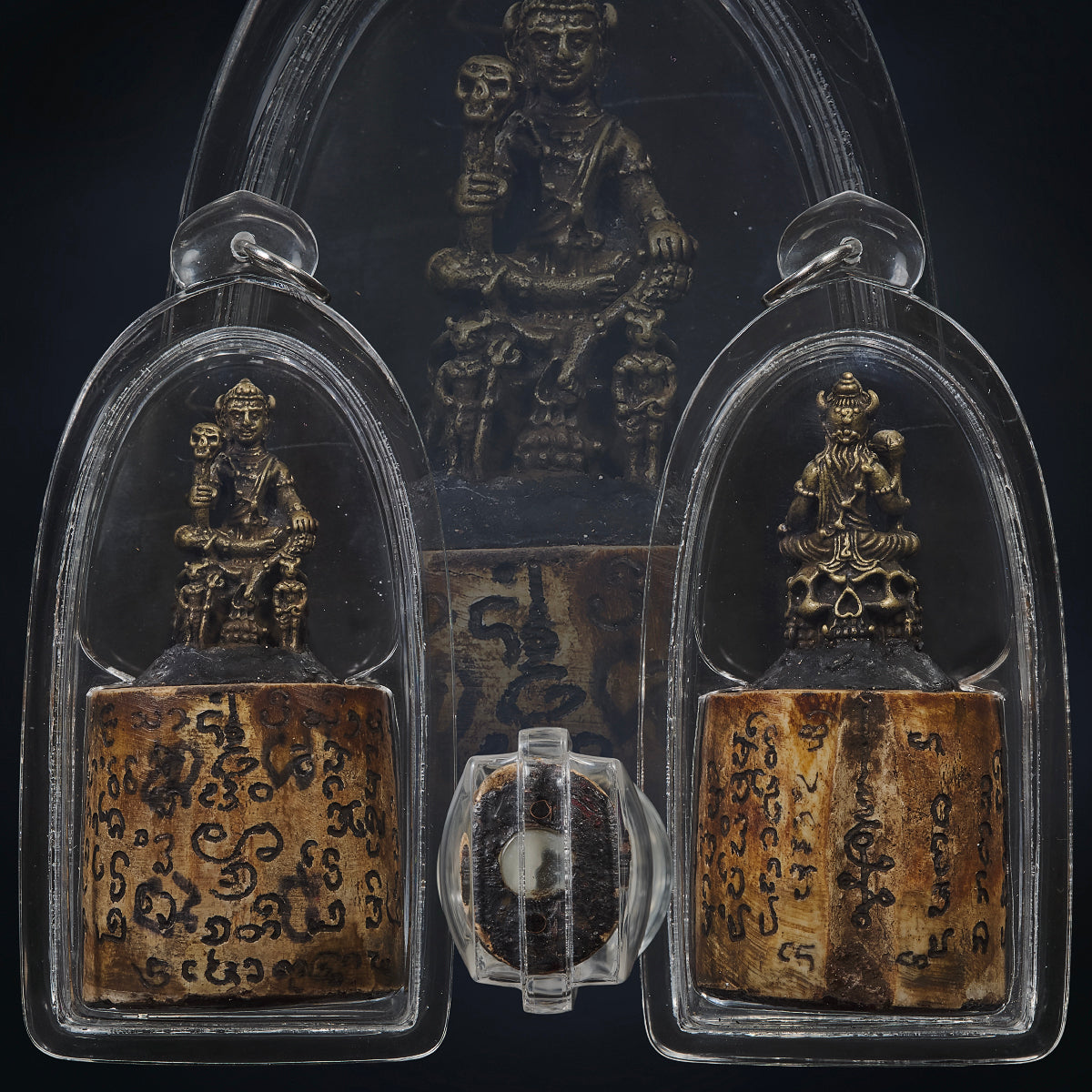
This distinctive Phra Yama by Por Sala Tan combines a brass sacred image with an extensively prepared relic base, bringing together several layers of Por Sala Tan's protective Barang Wicha.
The figure depicts Phra Yama seated above the sacred foundation. Phra Yama, also known in Thailand as Phra Yom or Phaya Yommaraj, represents judgement, karmic consequence, spiritual authority and protection against dangerous unseen influences.
The brass image is seated directly upon a sacred limb relic. Por Sala Tan personally covered the exterior of this relic with handwritten Yant, making the foundation itself part of the ritual construction.
The interior of the relic was then stuffed with Tidjai relics, forming a concealed sacred core beneath the seated Phra Yama.
To complete the preparation, candle wax used during the consecration ceremony was placed into the bottom, enclosing the internal sacred materials and completing the ritual process.
The finished artifact therefore combines the authority of Phra Yama with sacred limb relic material, handwritten Yant, concealed Tidjai relics and wax directly connected with its consecration ceremony.
Historical Background
Phra Yama, commonly called Phra Yom or Phaya Yommaraj in Thailand, developed from the ancient figure of Yama found in Indian religious traditions.
As these traditions entered Buddhist cosmology and Southeast Asian culture, Yama became closely associated with the realm of the dead and the judgement of beings according to their karma.
Within Thai belief, Phra Yama is regarded as a figure of immense authority.
His role concerns justice, consequence and the moral order governing life and death. The dead are traditionally understood to face judgement according to the wholesome and harmful actions accumulated during life.
For this reason, Phra Yama carries a stern and formidable appearance.
Images may incorporate skulls, spirits or other symbols connected with mortality. These elements express his authority over the realm of death and the spiritual beings associated with it.
Among devotees, this authority has also given Phra Yama a strong protective reputation. Harmful spirits and unseen entities are traditionally believed to recognise his position, making his image particularly valued for spiritual defence, protection and the suppression of disturbing influences.
Sacred Brass Image
The principal image is cast in brass, portraying Phra Yama seated in a commanding posture on a skull holding skull staff.
The figure carries the stern appearance traditionally associated with Yama and incorporates imagery connected with mortality and his authority over the spiritual realm.
Within this piece, the brass image represents the visible protective presence of Phra Yama.
The sacred materials beneath the figure form the concealed ritual foundation supporting that presence.
Brass is also a longstanding material within Thai sacred-object traditions. Its durability allows fine sacred figures to survive generations of worship and handling while gradually developing their own individual surface character.
Sacred Limb Relic & Handwritten Yant
The brass Phra Yama sits upon a sacred limb relic.
This relic forms the entire rectangular foundation beneath the deity.
Por Sala Tan personally prepared its exterior and covered the different surfaces with handwritten Yant inscriptions.
The handwriting remains clearly visible around the base, making Por Sala Tan's personal ritual preparation an important physical feature of the piece.
Within Thai esoteric practice, Yant inscriptions are used according to the particular Wicha of the practitioner. Their traditional purposes may include protection, spiritual authority, Klaew Klaad and reinforcement of the sacred materials upon which they are written.
Here, the relic is both the physical pedestal supporting Phra Yama and an individually inscribed sacred object in its own right.
Tidjai Relics
Further sacred materials are concealed inside the relic foundation.
Before completion, the interior was stuffed with Tidjai relics.
These materials form a hidden ritual core positioned directly beneath the brass Phra Yama.
Their inclusion creates a layered construction. The brass image occupies the upper level, the handwritten sacred limb relic forms the foundation, and the Tidjai relics remain enclosed within.
Ceremonial Candle Wax
The final physical stage of preparation involved the use of candle wax from the consecration ceremony.
Candles form an important part of many traditional Thai ceremonies, accompanying chanting, meditation, prayer and the formal blessing of sacred objects.
For this piece, Por Sala Tan retained wax associated with the ceremony and used it to stuff and complete the bottom of the relic foundation.
The ceremonial wax therefore has a direct physical connection with the consecration itself.
Its placement at the bottom completed the preparation and enclosed the sacred materials already contained within the relic.
This final stage joined the physical construction of the amulet with the ceremony through which it received its blessing.
Ritual & Consecration
The preparation of this Phra Yama involved several carefully arranged stages.
The Phra Yama image was prepared as the principal sacred figure, while the limb relic beneath it was selected and individually prepared as its foundation.
Por Sala Tan then personally inscribed the exterior with handwritten Yant according to his Wicha.
The interior of the relic was subsequently stuffed with Tidjai relics, creating the concealed sacred core of the artifact.
The completed components were then subjected to the appropriate chanting and consecration according to Por Sala Tan's ritual practice.
Candle wax connected directly with this ceremony was retained and used to complete the bottom of the relic base, enclosing the internal sacred materials and bringing the preparation to its conclusion.
Every major component therefore contributes to the completed object: image, relic, Yant, internal stuffing and ceremonial wax.
Traditional Blessings
Within Por Sala Tan's tradition, this Phra Yama is particularly associated with:
-
Klaew Klaad – avoidance of danger and serious misfortune.
-
Strong protection against harmful spiritual influences.
-
Protection from hostile spirits and unseen disturbances.
-
Authority when confronting difficult people or situations.
-
Courage and composure under pressure.
-
Protection during travel and night work.
-
Assistance when facing conflict or intimidation.
-
Justice and favourable resolution of unfair circumstances.
-
Greater awareness of potentially dangerous situations.
-
Spiritual defence against harmful occult influences.
-
Strength when overcoming major obstacles.
Phra Yama's authority over the realm of death gives the image a particularly strong traditional association with spiritual boundaries and protection against unseen entities.
The handwritten Yant, sacred limb relic, Tidjai relics and ceremonial wax further connect these qualities with Por Sala Tan's own Wicha.
Modern Application
This Phra Yama is particularly suited to people who regularly encounter uncertain environments, difficult personalities or situations requiring courage and clear boundaries.
Those who travel frequently, drive long distances, work late at night or regularly enter unfamiliar places may appreciate its traditional association with Klaew Klaad and spiritual protection.
Business owners, managers and professionals may also wear Phra Yama when dealing with disputes, difficult negotiations, workplace politics or circumstances requiring greater personal authority.
Collectors concerned with spiritual disturbance may value the traditional symbolism of Yama as an authority recognised by beings connected with the realm of death.
The amulet may also be kept within a home, vehicle or workplace as a guardian associated with protection, justice and firm spiritual boundaries.
Physical Details
This Phra Yama was individually prepared by Por Sala Tan as a layered Barang artifact. The principal image depicts Phra Yama seated above a rounded sacred foundation. The pedestal itself is made from a sacred limb relic, with its exterior personally covered by Por Sala Tan in handwritten Yant.
Inside the relic base are Tidjai relics, deliberately concealed within the foundation beneath the brass image. The bottom was subsequently stuffed and completed with candle wax used during the consecration ceremony, physically preserving a material directly associated with the final blessing process.
The completed artifact is protected inside a waterproof casing suitable for wearing, while the transparent construction allows the brass image, relic foundation and handwritten inscriptions to remain visible.
Each piece was individually assembled and inscribed by hand. Natural differences in the relic material, handwriting, surface texture, brass casting and placement of the sacred components make every completed example individually distinctive.
Recommended Pairing
Phra Yama + Tao Wessuwan
A strong combination for spiritual protection, authority and defence against harmful unseen influences.
Phra Yama carries the symbolism of judgement and authority over the realm of death, while Tao Wessuwan is traditionally revered as a powerful guardian against hostile spirits and supernatural disturbance.
Together they provide a focused protective pairing for those who place particular importance on spiritual defence.
Phra Yama + Keow Moo Paa
Suitable for those seeking courage, toughness, Klaew Klaad and protection during difficult circumstances.
Keow Moo Paa is traditionally associated with survival, strength and protection, complementing the commanding spiritual authority represented by Phra Yama.
Personal Notes
This Phra Yama demonstrates Por Sala Tan's characteristic layered approach to Barang construction, where the visible sacred image forms only one part of the complete artifact.
The brass Phra Yama provides the commanding external presence. Beneath him, the sacred limb relic covered with Por Sala Tan's handwritten Yant becomes both pedestal and sacred component.
Within that foundation are the concealed Tidjai relics, creating another ritual layer that cannot be seen once the piece is completed.
The final addition of candle wax used during the consecration ceremony is especially significant. By placing the ceremonial wax into the bottom to complete the process, a physical material from the blessing ceremony itself became permanently incorporated into the finished amulet.
The sacred components were individually prepared, inscribed, stuffed and assembled by hand before the consecration was completed. Natural variations in the relic, handwriting and construction ensure that each example carries its own individual character.
For collectors of Por Sala Tan, this Phra Yama represents a concentrated protective artifact combining sacred relic material, handwritten Wicha, Tidjai relics and ceremonial material with the traditional authority of Yama.
Its deeper symbolism centres upon protection, justice, courage and karmic consequence — the authority to stand firmly against harmful influences while reminding the wearer of the importance of one's own actions and conduct.
-
Free Shipping for Singapore| $15 Worldwide | $60 USA For Items Below $350