
OOBThaiAmulets
Por Sala Tan
Por Sala Tan
Couldn't load pickup availability
PST03
Mae Nak
Por Sala Tan
Barang Artifact
Personal Experiences Shared by Luksits
After wearing this type amulet, many who collect Mae Nak pieces from Por Sala Tan have experienced stronger personal attraction, improved relationships, smoother communication and greater favour from people around them. Business owners and those working with customers have also shared accounts of returning clients, easier negotiations and unexpected opportunities developing through new connections.
Some luksits describe reconciliation after periods of disagreement, increased affection from a partner or someone becoming unexpectedly willing to communicate again. Others speak of stronger intuition towards people and situations, including subtle feelings that encouraged them to reconsider a decision or avoid an unfavourable situation.
For those involved in business, sales and commission-based work, personal accounts frequently centre on Metta, customer attraction and people becoming more receptive to proposals or negotiations.
The combination of Mae Nak symbolism with Nam Man Prai and traditional love herbs gives this piece a particularly strong traditional association with attraction, affection, relationships and favourable human connections.
Summary
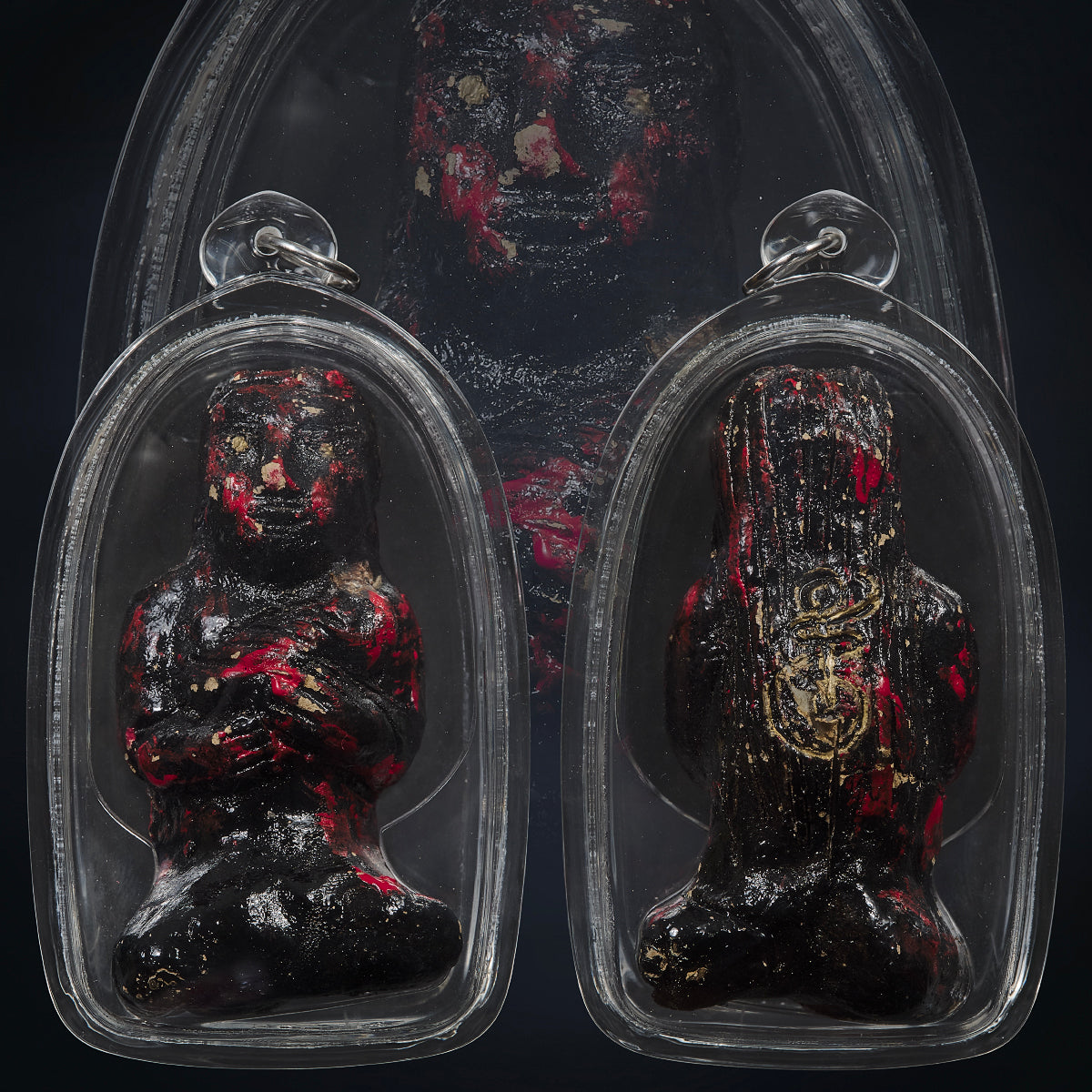
This unusual Mae Nak by Por Sala Tan depicts Mae Nak carrying her baby, preserving the maternal imagery at the centre of Thailand's famous Mae Nak Phra Khanong tradition.
The figure was created using a sacred mystical relic preserved by an old practitioner and later passed down to Por Sala Tan. Such inherited materials carry particular significance within traditional Barang practice because they preserve a physical connection with an earlier practitioner and lineage.
Por Sala Tan prepared the figure with a distinctive ritual coating. The paint was mixed with Nam Man Prai and traditional love herbs, making the external finish itself an important part of the sacred preparation.
Further ritual components were concealed within the figure. The bottom was stuffed with a Yoni seed and Takrut, while additional unknown mystical relics were reportedly placed inside the body.
After these materials were installed, the lower cavity was sealed with Nam Man Prai.
The completed Mae Nak therefore brings together an inherited sacred relic, Nam Man Prai, love herbs, Yoni symbolism, Takrut and concealed mystical materials within a single hand-prepared Barang artifact.
Historical Background
Mae Nak Phra Khanong, also known as Nang Nak, is perhaps Thailand's most famous female spirit legend.
The traditional story tells of a woman named Nak who lived with her husband, Mak, in the Phra Khanong area. While Mak was away, Nak became pregnant and later died during childbirth together with her child.
Her profound love and attachment to her husband were believed to have kept her spirit from departing.
When Mak returned home, he initially believed that Nak and their baby were still alive. In the best-known versions of the legend, he eventually discovered her supernatural nature after witnessing an impossible act, commonly described as Nak extending her arm to retrieve something from beneath the house.
Mak fled and sought sanctuary within Buddhist sacred ground. Mae Nak's spirit was eventually subdued or pacified by a spiritually accomplished monk.
Over generations, the story became deeply embedded within Thai popular culture.
Mae Nak came to represent devoted love, motherhood, attachment, family protection and the powerful bond between husband, wife and child.
Her famous shrine at Wat Mahabut in Bangkok remains associated with devotees making personal petitions concerning relationships, family matters, childbirth and other important life circumstances.
Sacred Material & Origins
The principal material used to create this Mae Nak has an unusual history.
According to the provenance passed together with the piece, the material originated from a mystical sacred relic kept for many years by an old practitioner.
The relic was eventually entrusted and passed down to Por Sala Tan, who incorporated it into his own Barang practice.
Within traditional esoteric lineages, inherited ritual materials may be particularly valued because their history extends beyond the master currently using them. Their significance comes from their previous ritual association as well as the ceremonies subsequently performed by the receiving practitioner.
Por Sala Tan prepared the inherited material according to his own Wicha before forming it into the image of Mae Nak holding her child.
The figure itself therefore forms the foundation upon which the remaining sacred ingredients and ritual components were assembled.
Nam Man Prai & Love Herbs
The dark ritual surface is one of the most distinctive characteristics of this piece.
Por Sala Tan prepared the paint by mixing it with Nam Man Prai and traditional love herbs before applying it to the figure.
Within Thai Barang traditions, Nam Man Prai is traditionally associated with Metta, Maha Saneh, attraction, persuasive influence and the movement of opportunities.
Love herbs contribute further traditional associations with affection, charm, emotional connection and favourable attention.
The black surface retains irregular traces of red and gold throughout the figure. These variations reflect its individually prepared character and give each example a distinctive appearance.
The ritual coating therefore serves both as the visible finish and as part of the sacred material construction of the Mae Nak.
Yoni Seed, Takrut & Concealed Relics
The lower portion of the figure contains several important ritual components.
A Yoni seed was placed within the bottom.
Within esoteric symbolism, the Yoni represents the feminine principle and carries associations with female generative power, attraction, fertility, sexuality and creation. Its placement within an image of Mae Nak is particularly relevant to her identity as a woman, wife and mother.
A Takrut was also incorporated into the bottom as an additional component of Por Sala Tan's Wicha.
According to the history accompanying the piece, other unknown mystical relics were placed inside the body before it was closed.
The precise identity of these internal materials was not disclosed.
After the Yoni seed, Takrut and other mystical relics had been installed, the bottom was sealed with Nam Man Prai, permanently enclosing the sacred contents within the Mae Nak.
Ritual & Consecration
The preparation of this Mae Nak involved several stages.
The inherited mystical relic first formed the sacred foundation of the figure.
Por Sala Tan then prepared the ritual paint using Nam Man Prai blended with traditional love herbs and applied the mixture across the surface.
The Yoni seed and Takrut were placed within the lower portion, together with the undisclosed mystical relics contained inside the figure.
The cavity was subsequently sealed at the bottom with Nam Man Prai.
Once the physical preparation was completed, the figure underwent Por Sala Tan's appropriate chanting, invocation and consecration according to his Barang Wicha.
The resulting artifact combines the traditional spiritual identity of Mae Nak with the sacred materials and ritual methods characteristic of Por Sala Tan's practice.
Traditional Blessings
Within this tradition, Mae Nak is particularly associated with:
-
Maha Saneh – attraction and personal charm.
-
Metta Maha Niyom – goodwill, affection and favourable treatment.
-
Love and emotional connection.
-
Reconciliation and relationship harmony.
-
Customer attraction and favourable business interactions.
-
Persuasive communication and smoother negotiations.
-
Family and household protection.
-
Intuition concerning people and situations.
-
Assistance with personal petitions.
-
Opportunity and movement in stagnant circumstances.
-
Feminine and maternal protective qualities.
The Nam Man Prai and love-herb mixture gives this particular piece a pronounced traditional emphasis on attraction and interpersonal relationships.
The Yoni seed further reinforces its association with feminine energy, attraction and fertility, while the Takrut contributes the protective and ritual qualities of Por Sala Tan's Wicha.
Modern Application
This Mae Nak is especially suited to collectors whose daily lives depend heavily upon relationships, communication and personal interaction.
Business owners, sales professionals, property agents, freelancers and people working on commission may value its traditional associations with Metta, customer attraction and persuasive communication.
Those facing relationship difficulties may approach Mae Nak for affection, reconciliation and smoother communication.
It may also be kept for family protection, personal guidance and circumstances where the wearer wishes to encourage goodwill from the people around them.
As with other spirit-related Barang artifacts, respectful keeping, gratitude, ethical behaviour and merit-making traditionally form part of the relationship between the keeper and sacred object.
Physical Details
Master: Por Sala Tan
Type: Mae Nak / Nang Nak
Category: Barang Artifact
Form: Mae Nak carrying her baby
Primary Material: Sacred mystical relic preserved by an old practitioner and passed down to Por Sala Tan
Surface: Black ritual coating with surviving red and gold details
Paint Mixture: Nam Man Prai blended with traditional love herbs
Bottom Contents: Yoni seed and Takrut
Internal Contents: Undisclosed mystical relics according to the provenance accompanying the piece
Bottom Seal: Nam Man Prai
Casing: Waterproof protective casing suitable for wearing
The front clearly portrays Mae Nak holding her baby across her body, an important visual reference to the maternal identity of the Mae Nak legend.
The reverse retains the dark ritual coating together with visible sacred markings and traces of red and gold decoration.
Each figure was individually prepared by hand. Differences in surface texture, ritual coating, red and gold details and placement of sacred components occur naturally during preparation, giving every completed piece its own individual character.
Recommended Pairing
Mae Nak + Nang Kwak
A particularly suitable combination for business, sales and customer attraction.
Mae Nak contributes traditional qualities of Metta, Maha Saneh, emotional connection and favourable interpersonal relationships. Nang Kwak is traditionally honoured for beckoning customers, trade and prosperity towards a business.
Together they form a strong pairing for shop owners, online sellers, salespeople and those whose income depends upon maintaining good relationships with customers.
Mae Nak + Khun Paen
A focused combination for Metta, Maha Saneh, relationships and personal charisma.
Khun Paen's traditional associations with charm, persuasive communication and social favour complement the love and attraction qualities associated with Mae Nak.
Personal Notes
This Mae Nak is a distinctive example of Por Sala Tan's Barang work, combining several different layers of sacred material and ritual preparation within a single figure.
The inherited mystical relic passed down from an old practitioner forms its sacred foundation. Por Sala Tan's Nam Man Prai and love-herb mixture covers the exterior, while the Yoni seed, Takrut and undisclosed mystical relicsform its concealed ritual core.
The final sealing of the bottom with Nam Man Prai completes the construction.
The image itself is equally significant. Mae Nak is shown carrying her baby, immediately connecting the piece with the central themes of her story — profound attachment, motherhood, family and enduring love.
The sacred materials were individually prepared and assembled by hand before each figure received its ritual coating and consecration. Natural variations in the surface, colouring, sacred markings and internal preparation make every example individually distinctive.
For collectors of Por Sala Tan, this Mae Nak represents an unusual combination of old inherited sacred material, Prai Wicha, Metta, Maha Saneh, feminine symbolism and traditional Mae Nak devotion within the characteristic hand-prepared style of his Barang artifacts.
-
Free Shipping for Singapore| $15 Worldwide | $60 USA For Items Below $350