
OOBThaiAmulets
Por Sala Tan
Por Sala Tan
Couldn't load pickup availability
Summary
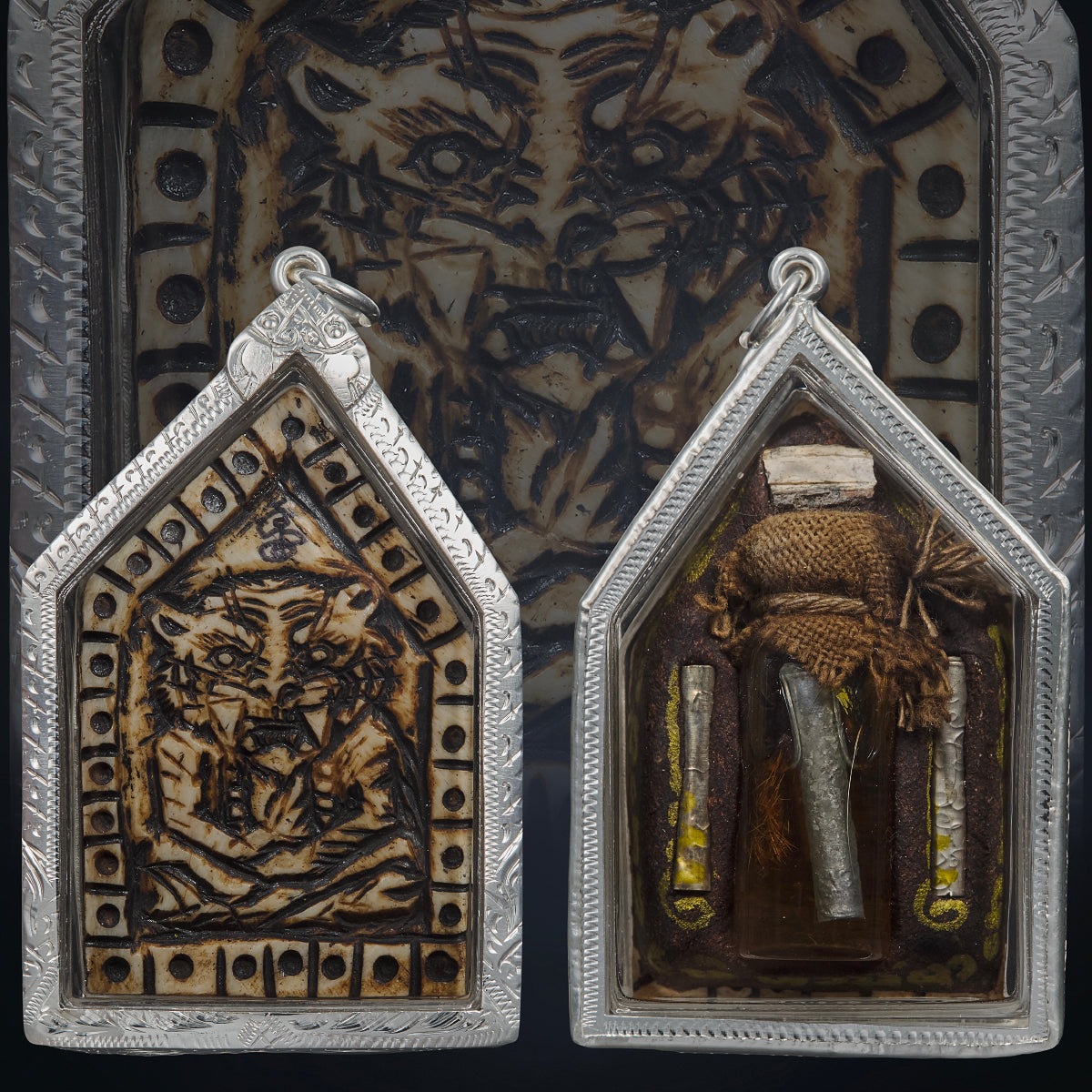
This Lersi Ser Ming Pai by Por Sala Tan was one of the long-standing “ong krut” master pieces kept continuously within the ritual space during the making of many tiger-related amulets across several decades. The piece carries the image of a Lersi in his fierce “Ser Ming Pai” form — a hermit aspect associated with guidance, command, direction, spiritual control, and the ability to stabilise one’s path during periods of uncertainty.
The same core materials from the earlier tiger-linked pieces were used here, but the purpose of this particular piece leaned more toward leadership, life direction, business control, and maintaining authority over chaotic situations. This was not simply carried as a protective object. It functioned as a ritual anchor inside the blessing area itself.
According to older luksits close to Por Sala Tan, this piece remained present through multiple generations of ceremonies from around the mid-2540s period onward. After Por Sala Tan grew older, Ac Lek continued using the same piece during tiger-related blessings and ceremonial work until his gradual semi-retirement roughly 3–4 years ago.
Historical Background
Among Northern practitioners, the Lersi was never viewed merely as a forest hermit. In older occult understanding, the Lersi represented mastery over instinct, emotion, survival, discipline, and hidden knowledge accumulated through retreat and hardship.
The “Ser Ming Pai” form carried a fiercer interpretation. It was associated with the ability to “guide the tiger.” In practical terms, this referred to controlling powerful forces instead of being consumed by them. Older masters believed many people possessed strong ambition, aggression, charisma, or desire, but lacked direction and internal control. Without guidance, these traits eventually turned destructive.
Because of this belief, pieces like this were often kept close during the making of tiger amulets, suea yantra items, and command-oriented ritual objects. The Lersi aspect acted as the “teacher” or controlling force behind the tiger current.
Por Sala Tan reportedly relied heavily on this piece during periods where many younger businessmen, nightlife workers, traders, and travelling devotees sought blessings related to authority, negotiation, attraction, and personal influence. The piece eventually became permanently associated with his tiger-line ceremonies.
When Ac Lek inherited portions of the ritual work, this remained one of the continuing ceremonial anchors inside the altar space.
Origins of the Materials
The carving itself carries the older rough Northern hand-work style commonly seen in privately made ritual pieces from that era. The facial lines were intentionally cut deep and aggressively to strengthen the “presence” of the Lersi image during chanting and invocation.
The same family of ritual materials used in earlier tiger-linked batches were incorporated into this piece. Older sacred compounds, yantra insertions, ritual metals, and attraction-oriented ceremonial components were sealed into the backing structure over time as the piece continued to be used repeatedly through consecrations.
Unlike newer ceremonial objects created for single occasions, this piece accumulated ritual exposure over decades. Each subsequent ceremony effectively layered additional invocation and ritual residue into the object itself.
The rear compartment also reflects continuous ritual use. The bottle, inserts, and hand-bound components show the practical working style older ajarns used for active altar pieces instead of decorative presentation objects.
Ritual Use and Ceremonial Function
This piece served primarily as an ong krut during tiger-related blessings. In older ritual terminology, an ong krut acted as the “main standing presence” overseeing the ceremony.
Before larger blessing sessions began, Por Sala Tan would reportedly position this piece near the central chanting area alongside tiger yantras, takrut bundles, candles, oils, and ritual powders. During invocation, the Lersi was called upon to stabilise the energy of the ceremony and “hold the direction” of the tiger current.
Older practitioners believed tiger energy without discipline could become unstable or overly aggressive. The Lersi force therefore acted as the governing intelligence behind it.
This is why many older tiger batches linked back to the same ceremonial root piece over many years.
Even after Por Sala Tan aged, Ac Lek continued maintaining the tradition and kept this piece involved in ceremonies until his semi-retirement period in recent years.
Blessings and Effects
The primary strength of this piece lies in guidance and controlled authority.
In business environments, this translates into clearer judgement, stronger decision-making, reduced hesitation, and the ability to maintain command during stressful situations. Many older users believed this type of Lersi force helped prevent emotional thinking from interfering with long-term success.
For career matters, the energy leans toward leadership presence and directional stability. It suits individuals managing teams, handling negotiations, leading projects, or navigating uncertain transitions where confidence and judgement matter heavily.
There is also a strong element of “control over self.” Older practitioners viewed this as extremely important because many forms of downfall came from poor impulse control, emotional instability, or ego-driven decisions.
The tiger connection also gives the piece a natural commanding aura. People often describe this kind of energy as making others subconsciously pay attention during conversation or meetings.
Modern Application
Today, pieces like this resonate strongly with entrepreneurs, business owners, salespeople, managers, negotiators, and individuals operating in highly competitive social environments.
It is especially suited for people who constantly need to make decisions under pressure while still maintaining emotional control and long-term vision.
Personally, I always found the atmosphere around older ong krut pieces very different from standard wearable amulets. There is usually a “used altar” feeling to them that long-time collectors recognise immediately. The energy feels settled, mature, and extremely grounded because the piece spent decades inside active ritual environments instead of remaining untouched in storage.
This was also one of those items where older devotees would immediately become quiet or respectful around it because they knew how long it had remained involved in actual ceremonies.
Physical Details
The piece features a hand-carved Lersi Ser Ming Pai image housed in a custom silver casing. The reverse contains older ritual inserts, takrut components, and a sealed bottle arrangement associated with prolonged ceremonial use.
The carving style reflects older Northern ritual workmanship with deeply etched facial features intended to strengthen ritual focus during chanting.
Compact enough for carrying, but spiritually it functioned far more as an altar-linked ceremonial object tied directly to decades of tiger-related consecrations from the Por Sala Tan and Ac Lek lineage.
-
Free Shipping for Singapore| $15 Worldwide | $100 USA All products