
OOBThaiAmulets
Por Sala Tan
Por Sala Tan
Couldn't load pickup availability
PST01
Summary
Among the rarer ritual lines associated with Por Sala Tan, the Bo Bo Aung and Bo Min Aung images were always treated differently from his other works. These were never pieces he openly produced in large quantities or kept continuously available. For only a brief period of roughly five years during his time as an ajarn, he commissioned and consecrated a very small number of these Burmese Wizza lineage amulets before permanently stopping production in BE 2549.
The reason was tied directly to lineage discipline.
Por Sala Tan believed that Wizza-related amulets could not simply be “made” through artistic skill or ordinary blessing methods. The lineage itself had rules. According to him, if the ritual chain was incomplete, the amulet would carry image but not force.
That is why these pieces required the involvement of multiple masters connected to the same current of practice.
Historical Background
Within older Burmese occult Buddhism, the names Bo Bo Aung and Bo Min Aung carry enormous weight among practitioners of Wiccha and Wizza traditions. These figures were not viewed merely as monks or hermits, but as accomplished adepts connected to deep meditation, alchemy, protective sciences, mantra systems, and long retreat practice.
Por Sala Tan had connections to older Burmese practitioners and ritual circles through his own lineage network. Although he rarely spoke publicly about it, close students knew he maintained strong respect toward Burmese Wizza traditions and treated them with unusual seriousness.
He repeatedly explained that a proper Wizza lineage required continuity.
A practitioner needed a direct teacher. That teacher needed his own teacher before him. Ritual diagrams, mantra systems, hand-written grimoires, elemental invocations, and consecration methods had to be transmitted directly and preserved exactly.
Because of this, Por Sala Tan imposed strict requirements before agreeing to make these amulets.
The masters involved had to maintain active daily practice. They had to continue meditation and ritual observances consistently. Ethical conduct was considered essential because the lineage viewed protective power and karmic conduct as inseparable. Ritual force without discipline was viewed as unstable.
He also insisted that these amulets undergo repeated consecration over time instead of a single blessing session.
According to those close to him, the final turning point came after two of the senior ritual participants involved in these consecrations passed away. After that, Por Sala Tan no longer felt the ritual structure was complete enough to continue the line properly.
Production ended entirely in BE 2549.
Origins of the Materials
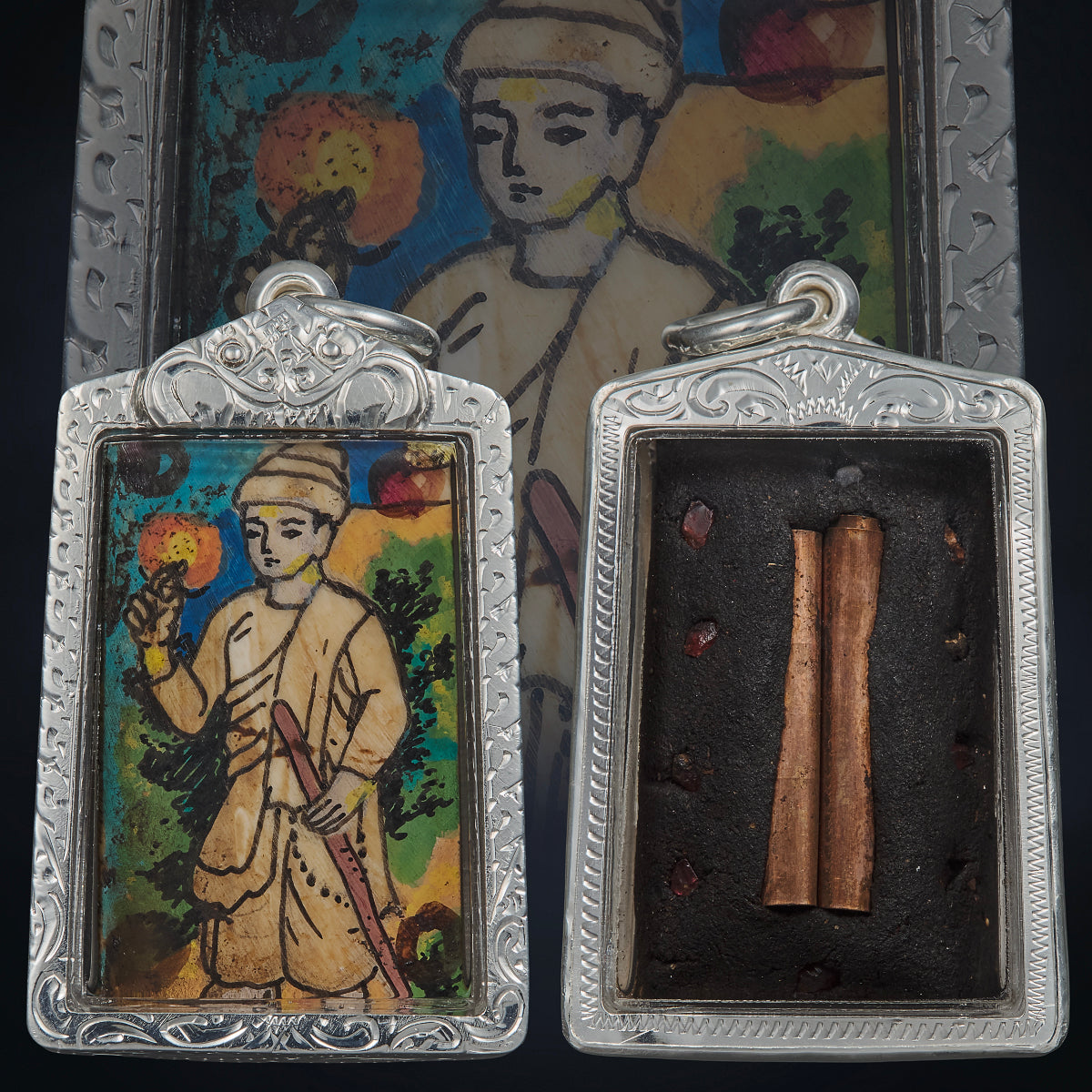
This particular batch used materials gathered specifically for Burmese-style Wizza consecration work.
The front image panels were made using nga chang graden material, selected because older practitioners believed certain dense organic relic materials could hold mantra force exceptionally well during prolonged chanting.
The paints used for the images were collected from nine Burmese temples. These were not chosen for appearance alone. In Burmese occult understanding, temple pigments and sacred paints absorb years of offerings, incense, oil smoke, chanting, and ritual atmosphere. Por Sala Tan believed these carried accumulated field energy from the temples themselves.
Embedded into the rear are paired Burmese Salika Takruts created for metta and social harmony. In older Burmese-derived practice, paired Takruts were sometimes viewed as balancing channels — one stabilising speech and intention while the other strengthened reception from others.
The black ritual compound on the back contains 108 herbs combined during consecration. Older Wizza traditions often used large herbal combinations to represent completeness across elemental correspondences and planetary influences.
Most important are the embedded Pathat Sivali relic components visible on the rear.
Among Burmese and Northern practitioners, Sivali-related relic insertions were strongly associated with uninterrupted movement, business continuity, food, support, financial survival, and the ability to continue receiving assistance wherever one travelled. Because of this, these pieces became especially valued among traders, businessmen, travelers, and practitioners seeking career expansion.
Ritual
The consecration process followed a full-day temple ritual involving monks together with lay practitioners connected to the lineage.
Por Sala Tan emphasised closure of the four elemental forces through the Na Ma Pa Ta invocation system. At the same time, the Burmese Wiccha mantra Sa Ta Pa Wa was repeatedly used throughout the ceremony.
Students familiar with Ajarn Satien’s rings will immediately recognise the same mantra structure and yantra current being used there as well. This reflects the shared Burmese Wizza influence present across certain Northern ritual circles.
The ceremony involved continuous chanting, elemental invocation, herbal smoke offerings, and repeated empowerment of the Takruts and image panels until the final sealing stage.
According to older practitioners, the purpose was not simply to “activate” the amulet, but to stabilise the relationship between the image, the mantra current, and the wearer.
Blessings and Effects
These pieces were traditionally carried for guidance, protection, business continuity, mental clarity, and spiritual direction.
Among older users of Burmese Wizza amulets, one of the most valued effects was not sudden wealth alone but “path opening.” Obstacles slowly begin shifting. Right people appear at proper timing. Travel becomes smoother. Negotiations become easier. One’s thinking becomes more stable under pressure.
The embedded Sivali current also gave these amulets a strong reputation for sustaining business activity and attracting opportunities connected to livelihood.
Some practitioners used them during meditation because the Wizza lineage placed heavy emphasis on internal cultivation together with worldly function. The amulet was viewed as a support tool for stabilising intention and maintaining discipline.
The paired Salika Takruts added another layer associated with speech, persuasion, approachability, and smoother interpersonal interaction.
Modern Application
Today, these pieces remain highly suitable for people involved in business, sales, entrepreneurship, negotiation, consulting, travel, and leadership roles where mental steadiness and interpersonal guidance matter heavily.
They are also well suited for individuals undergoing uncertain life transitions where clearer judgment and steadier momentum are needed.
Many practitioners continue using Wizza-related amulets during meditation, journaling, manifestation work, or before major meetings because of the lineage’s strong connection to mental focus and directional clarity.
The compact sizing also makes them easy to carry daily without drawing attention.
Personal Notes
Personally, Bo Bo Aung and Bo Min Aung have been part of my altar practice since my Golden Mile days. Those who visited my old shop would probably remember seeing these Burmese masters placed prominently near the front counter together with other Wizza figures.
Over the years I noticed that many people approached these masters differently from ordinary amulets. Some would sit quietly in front of the altar before business meetings. Others prayed before travel or major financial decisions.
Even during difficult business periods, the presence connected to these lineages always felt extremely stabilising to me.
That calm, guiding atmosphere is something I still associate strongly with authentic Burmese Wizza practice today.
Physical Details
Each piece is individually hand-painted and fitted with paired Burmese Salika Takruts on the rear together with embedded ritual compounds and Sivali-related relic materials.
The imagery varies slightly from piece to piece due to the handmade nature of the batch. Small differences in facial expression, paint layering, and linework are normal and part of the original commissioning process.
These were never commercial-scale productions and were only commissioned during a limited five-year period before Por Sala Tan permanently discontinued the line in BE 2549.
Recommended Pairing
These pair especially well with baramee-oriented pieces, Sivali amulets, Rahu currents connected to destiny movement, or older Northern protection items used for travel and business stability.
For practitioners focused on meditation and cultivation, they also combine naturally with Wizza lineage rings or elemental pieces carrying Na Ma Pa Ta or Sa Ta Pa Wa mantra systems.
-
Free Shipping for Singapore| $15 Worldwide | $60 USA For Items Below $350