
OOBThaiAmulets
Por Sala Tan
Por Sala Tan
Couldn't load pickup availability
PST01
Summary
The Paneng Naman Prai Salika Roon Reak by Por Sala Tan stands as one of the earliest and most closely guarded NMP creations from his northern lineage. This first batch was never widely circulated and was created in extremely limited numbers, with fewer than ten pieces completed during the original consecration. Within the inner circle of collectors around Fang and Chiang Mai, this batch became known for its unusually concentrated yin current due to the incorporation of fresh paneng sod relic essence combined with the legendary 5 Prai NMP formula personally prepared and empowered by Por Sala Tan himself.
Most examples from this original batch were retained by Por Sala Tan and later used as master pieces to awaken and empower the later green-coloured 2nd batch NMP 5 Prai. Because of this, senior collectors regard the Roon Reak as the “mother current” behind many later salika and NMP workings associated with his lineage.
This piece was never intended for casual ownership. It was prepared for experienced devotees who understood both attraction wiccha and the discipline required to balance strong yin ritual objects with proper baramee support.
Historical Background
During the late stages of Por Sala Tan’s active years, many of his close disciples and followers began requesting stronger salika and maha saneh pieces for business, negotiation, and social influence. At the time, northern Thailand was seeing increasing interest in NMP-style workings from both local practitioners and dealers crossing over from Chiang Mai, Fang, Tachilek, and the Burmese border regions.
Por Sala Tan approached the matter carefully.
He believed attraction wiccha was not simply about lust or romance, but about “opening pathways” between people. In his teachings, he often explained that certain individuals naturally repel opportunity due to karmic heaviness, poor social stars, or blocked speech energy. Salika workings were meant to soften these barriers and restore natural receptiveness between the wearer and the world around them.
For this first batch, Por Sala Tan gathered a small quantity of paneng sod relic essence with exceptionally heavy yin properties. These were then merged into the 5 Prai NMP formula during a private ritual cycle conducted only for trusted insiders. The batch size remained extremely small, and most pieces never entered open circulation.
Years later, when the green 2nd batch NMP 5 Prai became known among collectors, many outside dealers began mixing unrelated oils into amulets and marketing them under Por Sala Tan’s name. I still remember visiting him during that period. He was visibly upset and unusually stern when speaking about it. He told me directly that if I ever intended to alter his items or mix outside substances into them, then I should never buy from him again.
That trip ended differently from what I expected.
I ended up taking nearly every item he had available at the time, including this very piece.
Origins of the Materials
The heart of this amulet lies in the original 5 Prai NMP formula combined with concentrated paneng sod essence gathered during the early ritual cycles of Por Sala Tan’s lineage work.
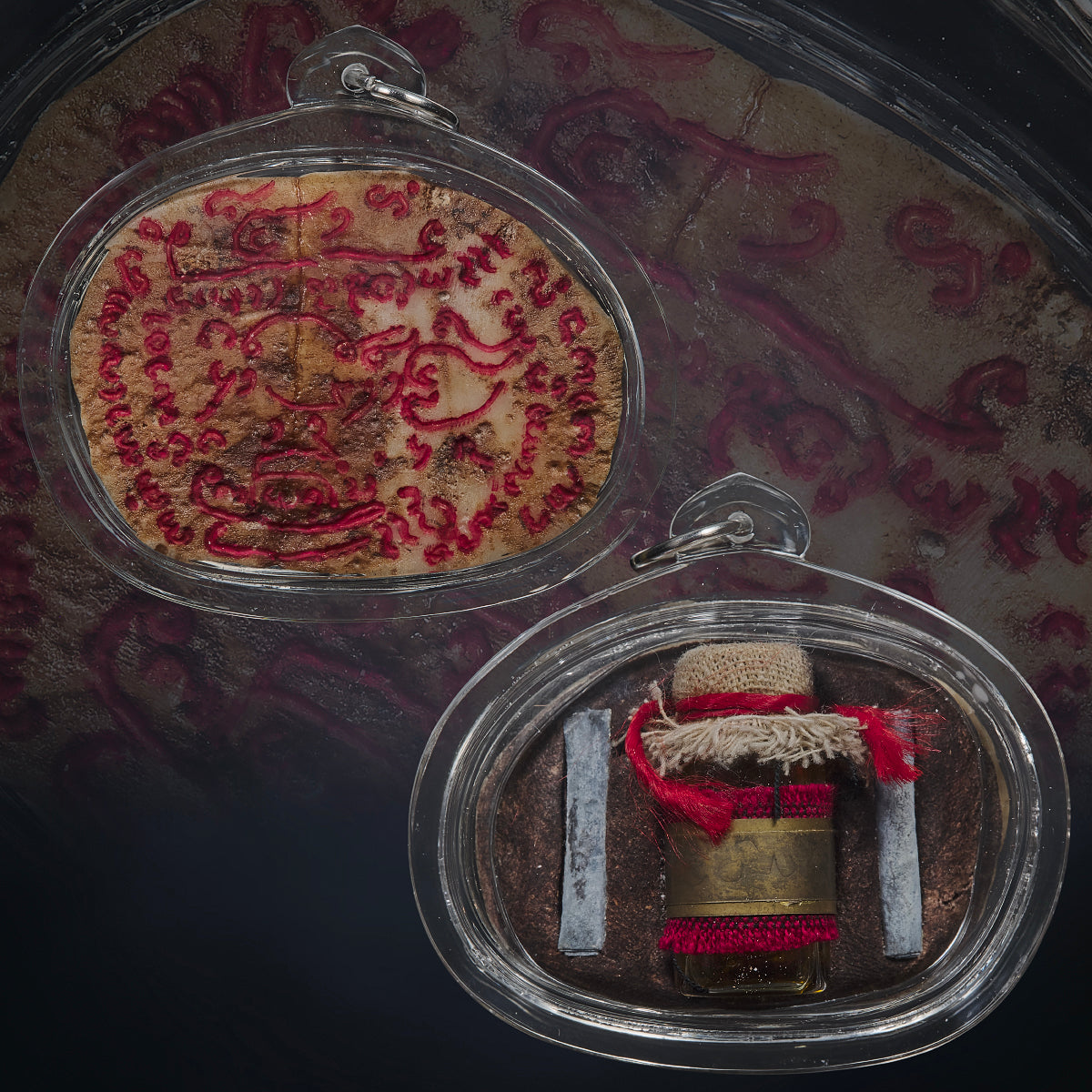
The salika face itself was prepared using sacred powders and ritual compounds layered with red sacred inscriptions. These inscriptions were hand-finished during chanting sessions and awakened repeatedly through breath empowerment and mantra recitation.
Behind the salika rests the NMP vessel itself, sealed and wrapped in traditional cloth bindings. The bottle was prepared as a living ritual core, not simply a symbolic inclusion. Within northern practice, sealed NMP vessels act as spiritual anchors that continuously radiate attraction current and social influence over time.
Two takruts were added to stabilize and direct the flow of the energies within the casing. Por Sala Tan frequently used paired takruts in stronger yin pieces as a way of harmonising attraction energy with the wearer’s personal fate and elemental balance.
Ritual
The consecration for this first batch followed an older northern format rarely performed openly.
Por Sala Tan conducted the chanting during nighttime hours while maintaining extended meditation cycles over the prepared materials. The salika invocation was repeatedly awakened together with attraction mantras linked to speech, persuasion, and emotional receptiveness.
The paneng sod current was introduced only after the main empowerment phase was completed. This stage was considered the most sensitive part of the ritual. According to older practitioners around Fang, the atmosphere during these rites often became unusually heavy and silent, with many participants avoiding unnecessary conversation during the empowerment process.
After completion, the pieces were not immediately distributed. Most remained on Por Sala Tan’s altar and continued receiving smoke offerings, candle rites, and periodic mantra reinforcement over many years.
Blessings & Effects
This batch is traditionally associated with strong salika influence, attraction energy, social opening, customer return, and emotional receptiveness.
Collectors who kept these pieces near business counters or negotiation spaces often associated them with increased customer flow, smoother conversations, and unusual repeat support from benefactors. The energy is especially suited for industries relying on trust, emotional engagement, hospitality, persuasion, and relationship-building.
Por Sala Tan himself often explained that powerful attraction items should not make a person reckless or arrogant. Their purpose was to create openness, timing, and harmony between individuals.
This batch also carries a very noticeable yin presence. Experienced wearers frequently describe the energy as “alive,” particularly during nighttime meditation or when travelling alone.
Modern Application
I personally left this piece for a period of time at my Thai wrappers business, and the effects during that period were memorable. The atmosphere around the business became unusually active. Customers lingered longer, conversations flowed naturally, and the overall energy of the space felt continuously “fed.” The business prospered steadily during that phase, and many unexpected opportunities appeared through casual interactions and repeat clients.
On my final trip before Por Sala Tan retired from active practice, I visited him again. By then he had already slowed down considerably. During that visit he handed this piece back to me and calmly mentioned that it should continue serving another owner now that he was retiring.
That moment stayed with me because it reflected how he viewed these objects — not as merchandise, but as living ritual companions that moved through different stages of people’s lives.
Due to the strength of the yin current, this piece is traditionally kept inside a bag, pocket, drawer, or business location. It is not intended to be worn openly around the neck for extended periods.
Senior devotees usually pair such pieces with strong baramee amulets such as Somdej, Prah Kring, or high-merit Buddhist images to maintain energetic balance while carrying the attraction current properly.
Physical Details
The salika is housed inside a clear oval casing with red sacred inscriptions covering the front face. The reverse contains the original sealed NMP vessel wrapped in traditional ritual cloth with stabilizing takruts positioned beside it.
Small-batch handmade characteristics can still be seen throughout the piece, especially within the inscription work and preparation marks surrounding the ritual components.
Fewer than ten original pieces from this first batch were completed.
Recommended Pairing
This piece pairs exceptionally well with strong baramee-oriented amulets.
Somdej lineages help stabilize and elevate the spiritual current surrounding the wearer, while Prah Kring pieces strengthen protection, authority, and overall energetic grounding. Together, the combination creates a more complete balance between attraction, opportunity, authority, and spiritual composure.
-
Free Shipping for Singapore| $15 Worldwide | $60 USA For Items Below $350