Stockbox: PST01
Summary
This early Payakaokam carving traces back to Tachilek, Myanmar during the early B.E. 2500s, in a period when the northern borders remained fluid and mountain communities, traders, monks, and wandering mystics moved between territories with little restriction. The piece was consecrated by an elderly Lersi who was regarded as one of Por Sala Tan’s earlier spiritual teachers and influences. Over the decades, this very carving became known within the circle for its use in Ong Krut blessings connected to smaller ceremonial batches of Payakaokam made by Ac Lek and several northern arjans.
Por Sala Tan himself preserved this piece carefully for many years and would occasionally place it near bottles of metta namman during consecration sessions. Among those familiar with his altar practices, this carving was regarded as one of the stronger old-world seneh anchors connected to Myanmar lineage blessing methods.
Historical Background
The atmosphere of Tachilek in the early B.E. 2500s was vastly different from modern times. Villagers, traders, monks, forest practitioners, and wandering ascetics crossed between Northern Thailand, Shan State, and border settlements freely. Knowledge moved orally through temple stays, cave retreats, forest camps, and local ceremonies. Many of the old Lersi lineages operating in these regions did not formally record their practices, yet their influence spread quietly through disciples and ritual objects that later surfaced in Northern Thailand.
The elderly Lersi connected to this carving was known for his mastery in attraction rites, namman consecrations, and invocation ceremonies linked to Payakaokam manifestations. Por Sala Tan would later reference this elder as one of the men who deeply influenced his understanding of seneh energies and spiritual attraction work during his younger years travelling across the northern borderlands.
This carving eventually remained within Por Sala Tan’s own collection and became part of his ritual altar usage for many years.
Origins of the Material
The material used for this carving came from an alpha male gaduk chang gathered from the forest regions surrounding the Tachilek area. Local villagers regarded this chang as unusually dominant during its lifetime, known for leading territory routes and fathering many offspring across the region.
Among old mountain communities, such relics were already believed to naturally carry attraction and commanding energies due to the life force and dominance displayed during the animal’s lifetime. When the chang eventually passed, only a very small amount of relic material was harvested. Part of this batch was handed to the elderly Lersi while another portion eventually reached Por Sala Tan.
Several pieces were created from this material, most of them intended for seneh and metta usage within local circles rather than public release.
The aged surface and dense coloration seen today reflect decades of altar exposure, oil absorption, incense smoke, and repeated consecration contact.
Ritual
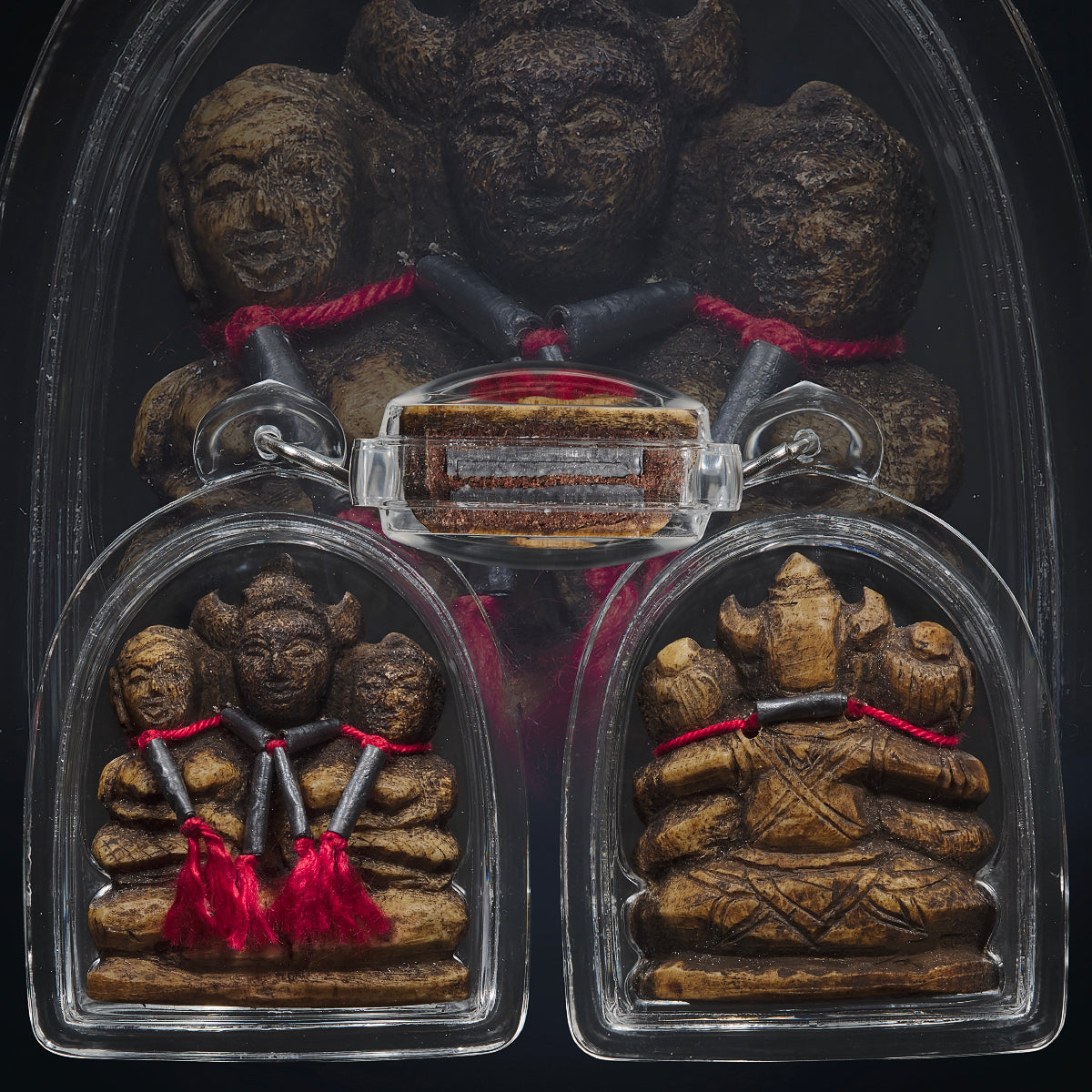
During the original consecration, the Lersi entered meditation together with Por Sala Tan while invoking the Payakaokam current. Both practitioners later described witnessing the manifestation of the Payakaokam accompanied by two celestial attendants standing beside the central figure.
Because of this shared meditative vision, the final carving was intentionally shaped with the central Payakaokam flanked by two accompanying entities. The imagery was not chosen for decoration but as a direct representation of what appeared during ritual concentration.
Following the carving process, the piece continued to receive repeated empowerment through Ong Krut blessing sessions used for later northern batches associated with Ac Lek and nearby arjans. This repeated ritual usage significantly strengthened the item over time, especially in the area of social attraction, personal magnetism, and interpersonal influence.
Por Sala Tan would also occasionally position this carving beside metta oils during chanting sessions to further charge the oils with attraction energy.
Blessings and Effects
The primary strength of this piece lies in maha seneh and social desirability. Wearers traditionally used such items when seeking stronger presence, smoother social interactions, improved romantic opportunities, or enhanced personal magnetism in business and daily life.
Among older practitioners, attraction was never viewed purely through romance alone. Seneh was understood as the ability to naturally draw support, affection, attention, trust, and opportunities from others. In business settings, this often translated into smoother negotiations, easier networking, repeat customers, and stronger favour from benefactors.
Por Sala Tan himself openly attributed part of his colourful younger years and extensive social connections to items and rituals connected to this lineage of seneh practice.
From personal experience, older Myanmar-consecrated attraction pieces tend to carry a noticeably “warm” and socially active energy when compared to later commercial-era items. The effect is often subtle initially, but over time many users notice increased conversations, easier rapport, and stronger memorability in social environments.
Modern Application
This piece suits individuals working in people-facing environments where personal presence matters greatly. Business owners, sales professionals, livestream hosts, negotiators, property agents, social media personalities, and individuals frequently meeting new people often gravitate toward old seneh items of this nature.
Because of its compact size, it can be kept inside a work bag, altar pouch, vehicle, office drawer, or worn directly on the neck. Some practitioners prefer placing it near perfumes, namman, or personal grooming items during chanting sessions.
For individuals with quieter personalities or difficulty naturally standing out socially, this lineage of Payakaokam is traditionally valued for helping strengthen confidence and personal attraction.
Physical Details
The carving measures approximately 2 inches in height and features the Payakaokam seated centrally with two accompanying celestial attendants. The aged material shows deep natural grain patterns and dense coloration developed through decades of ritual handling and altar storage.
The reverse carving displays the rear form of the seated figure with visible old hand-finishing characteristics consistent with early northern border-region craftsmanship.
The attached takruts and red ritual cords remain part of the original ritual structure associated with the consecration format used during that era.
Recommended Pairing
This piece pairs exceptionally well with baramee-oriented amulets and authority-based wear. Wa Tanoo pieces, Somdej, and Phra Kring are particularly suitable combinations as they help stabilise and elevate the attraction energy into a more commanding and respected form.
Many older practitioners preferred balancing strong seneh items together with protection or baramee wear so that attraction naturally carried weight, credibility, and long-term influence in both personal and professional environments.