
OOBThaiAmulets
Por Sala Tan
Por Sala Tan
Couldn't load pickup availability
PST05
Wua Tanu
Por Sala Tan
B.E. 254x , Older Batch
Mainstream artifact
Approx. 2 Inches
Sacred Craftsmanship
This approximately 2-inch Wua Tanu Mini Bucha belongs to an older B.E. 254x period of Por Sala Tan's work. It was individually prepared as a working protective artifact, following the traditional Wua Tanu methods preserved through forest practitioners and older wicha lineages.
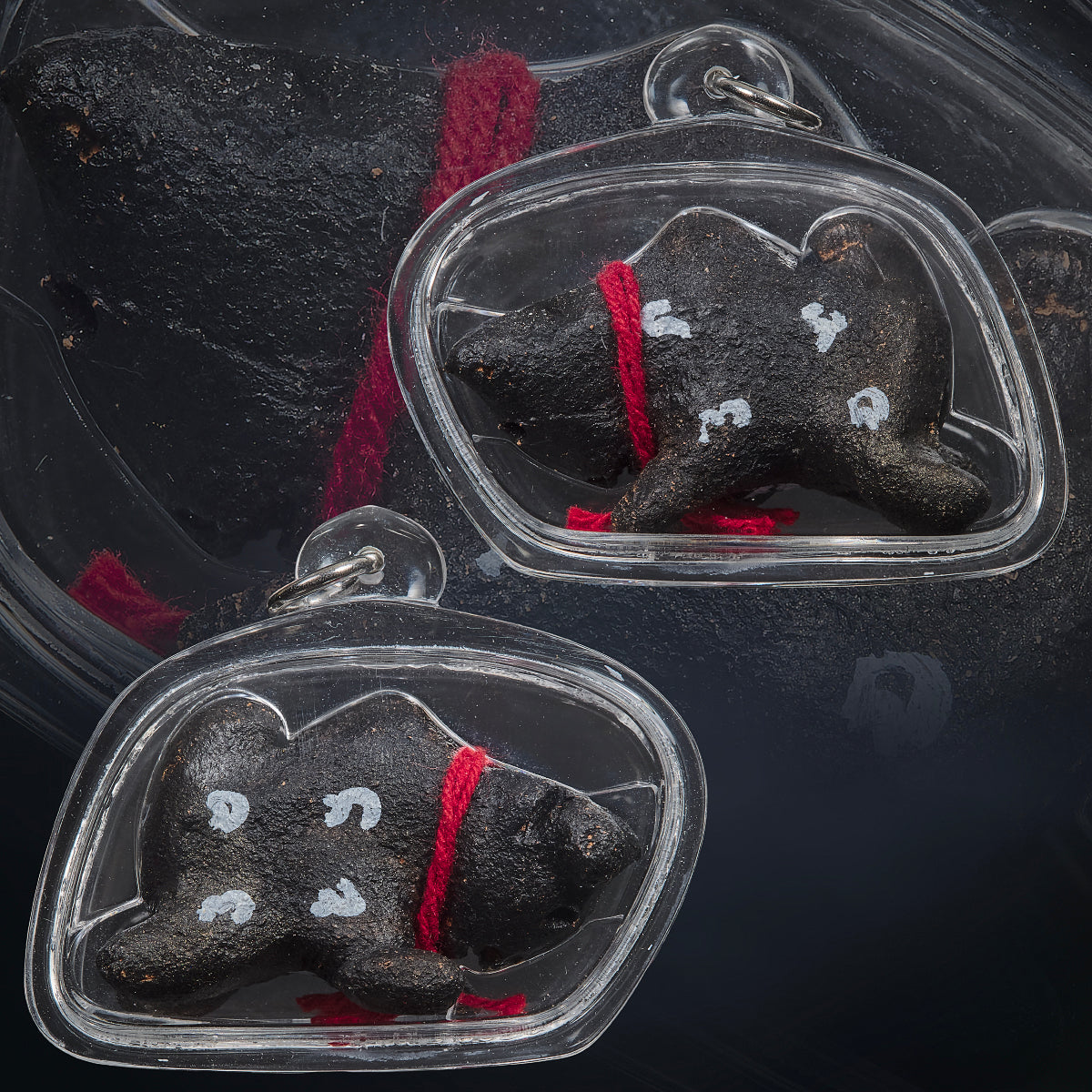
The dark body, individually applied sacred markings and red ritual cord reflect its practical handmade construction. Natural differences in the sacred materials, surface, inscriptions, bindings and finishing mean that no two examples from these older preparations are completely identical.
Personal Experiences Shared by Luksits
Among Por Sala Tan's luksits, Wua Tanu has long been regarded as a dependable form of protective wicha, particularly during periods when a person feels surrounded by hostility, jealousy or unexplained obstacles.
Some owners carried Wua Tanu when entering unfamiliar places or environments they considered spiritually heavy. Others kept one close during periods of business rivalry or personal conflict, particularly where they suspected that another person's resentment or ill intention was affecting them.
A recurring description is not necessarily that something dramatic occurs, but that troublesome circumstances seem to lose their ability to reach the keeper. Situations may calm, confrontation may be avoided, or the individual may receive an instinctive feeling to withdraw from a particular person or place.
For this reason, Wua Tanu is also valued by luksits who carry strong Saneh, Prai or other Barang artifacts. It provides the defensive side of their practice, establishing a protective boundary around the keeper.
Summary
The Wua Tanu is one of the established guardian forms within Thai protective wicha.
Por Sala Tan's Wua Tanu was prepared principally for protection, deflection and reversal of harmful influences. Rather than being created as a decorative animal image, it was treated as a practical spiritual tool.
This example belongs to an older B.E. 254x batch and measures approximately 2 inches, placing it within the Mini Bucha category while remaining compact enough to carry.
The traditional purpose of the piece centres upon resisting hostile wicha, curses, malicious intention and unwanted spiritual interference. Certain preparations were additionally worked for return-to-sender, in which harmful influence directed towards the keeper is believed to be deflected rather than allowed to settle.
Historical Background
Wua Tanu has a long history within Thai folk-wicha traditions as a guardian and counteracting talisman.
Despite occasionally being translated loosely as a "spiritual arrow", its imagery is associated with the Wua — the bull or ox form — and its character is grounded, forceful and defensive.
Different masters maintained their own formulas for creating Wua Tanu. Some relied primarily upon sacred woods; others incorporated metals, herbs, takruts, cords or unusual natural relics.
Por Sala Tan's interpretation reflects his background in forest practice.
His approach placed considerable importance upon the qualities of the original materials. Objects connected with powerful natural events or spiritually significant locations were selected, prepared and subsequently brought together through protective kata and meditation.
The older B.E. 254x examples therefore represent an earlier expression of his protective wicha, made primarily as working artifacts rather than ornamental collector pieces.
Origins of the Materials
Lightning-Struck Relics
One of the important materials associated with Por Sala Tan's Wua Tanu work is lightning-struck relic material.
Within traditional wicha, lightning represents an exceptionally sudden and concentrated natural force. Material surviving a lightning strike is consequently regarded as carrying an unusually forceful character.
Por Sala Tan incorporated such relics where the intended Wua Tanu required a particularly reactive protective quality.
The material was not considered complete simply because it had been struck by lightning. It still required preparation and consecration before becoming part of the finished protective system.
Takien & Payoom Wood
Sacred woods including Takien and Payoom were also used within Por Sala Tan's Wua Tanu tradition when appropriate material became available.
Such trees occupy an established place within Thai folk belief and are traditionally associated with strong natural and spiritual presence.
Their role within Wua Tanu is therefore connected with establishing a firm, grounded guardian character.
Sacred Herbs & Protective Powders
Selected herbs and powders could be incorporated to reinforce the protective construction.
Their functions traditionally concerned grounding, breaking hostile influence, strengthening spiritual boundaries and preventing unwanted energies from attaching themselves to the keeper.
Takruts & Sacred Cord
Protective takruts containing yant and kata were incorporated into certain preparations to direct particular branches of the wicha.
Sacred cords and bindings served an equally practical ritual purpose, helping to bind and stabilise the completed construction.
The bright red cord visible around this Wua Tanu remains an important part of its old handmade character.
Ritual
Por Sala Tan's preparation began with the selection of materials suitable for the intended protective function.
The various relics were then worked through his own system of kata, meditation and protective wicha. Where takruts were incorporated, their inscriptions provided additional ritual formulas within the completed structure.
The objective was to establish a defensive presence capable of resisting harmful influence before it could properly affect the keeper.
Certain preparations were further directed towards reversal.
This principle is important. Return-to-sender wicha is traditionally understood not as deliberately initiating an attack against another person, but as preventing hostile influence from remaining with its intended target.
What approaches is rejected; what does not belong to the keeper is not retained.
This became one of the characteristics for which Por Sala Tan's Wua Tanu work was particularly valued.
Blessings and Effects
The central function is protection and spiritual defence.
Wua Tanu is traditionally associated with resistance against hostile wicha, curses, malicious intention and unwanted spiritual interference. It is also used for strengthening personal boundaries when the keeper is exposed to difficult people or environments.
Another important quality is Klaew Klad — avoidance of danger. Rather than confronting every threat directly, protective wicha may manifest through circumstances that prevent the keeper from being present when trouble occurs or through an instinctive warning that something is wrong.
The older Wua Tanu tradition is also associated with:
- Protection — strengthening the keeper's defensive boundary.
- Klaew Klad — avoidance of danger and harmful situations.
- Reversal — breaking or deflecting hostile influence.
- Return to Sender — traditionally reflecting directed negativity away from the keeper.
- Anti-Wicha — resistance against hostile occult workings.
- Environmental Protection — useful when entering spiritually heavy locations.
- Stability — balancing stronger Saneh, Prai and Barang practices.
Lightning-associated material was particularly valued for the reactive aspect of this protective character.
Modern Application
Although originating from older forest-wicha traditions, the purpose of Wua Tanu remains readily understandable in modern circumstances.
A business owner facing intense rivalry may keep one within the workplace. Someone whose profession exposes them to conflict, jealousy or difficult interpersonal environments may carry it as a traditional protective artifact.
It is equally appropriate for those who regularly enter unfamiliar or spiritually significant places, including forests, abandoned locations, hospitals or cemeteries.
Collectors working with strong Saneh or Prai artifacts may also use Wua Tanu as a counterbalance. Attraction-oriented wicha is concerned with drawing attention towards the keeper; Wua Tanu establishes the protective boundary around what is being drawn in.
At approximately two inches, this example is particularly practical because it can function either as a compact Mini Bucha or as a portable guardian piece.
Physical Details
This is an older B.E. 254x Wua Tanu Mini Bucha by Por Sala Tan, measuring approximately 2 inches. The figure has a compact, heavily formed animal body with a dark aged surface and subtle traces of the underlying material visible through natural wear. Sacred characters have been individually applied in pale pigment across both sides of the body, while a vivid red sacred cord is bound around the neck. Its rough contours, irregular surface and uncomplicated construction retain the characteristic appearance of an older handmade working artifact. The piece is now protected within a fitted clear casing.
Recommended Pairing
For general daily use, Wua Tanu pairs naturally with a Somdej, Phra Kring, Phra Chaiwat or another mainstream Buddha-form amulet. This allows the Buddhist image to remain the merit-centred foundation while Wua Tanu serves its specialised protective role.
It is particularly complementary to Khun Paen, Saneh and Prai pieces. The attraction artifact focuses upon Metta, relationships and drawing opportunities, while Wua Tanu provides protection and spiritual boundaries.
For practitioners, a Lersi may also form a balanced combination: Lersi for wisdom, discipline and guidance, and Wua Tanu for defensive strength.
Personal Notes
This smaller 2-inch B.E. 254x example has the character I associate strongly with Por Sala Tan's older working pieces.
It is not highly refined or decorative. The body remains dark and roughly formed, the sacred characters were applied directly onto the surface, and the red cord remains prominently visible around the neck.
That simplicity is part of its appeal.
The emphasis was upon the wicha and materials rather than appearance. Wua Tanu was intended to perform a specific job: protect the keeper, establish a boundary, resist hostile influence and prevent unwanted forces from remaining attached.
For collectors of Por Sala Tan's older work, this compact Mini Bucha represents that philosophy particularly well — a straightforward protective artifact from the B.E. 254x period, prepared around Klaew Klad, spiritual defence, reversal and return-to-sender wicha.
-
Free Shipping for Singapore| $15 Worldwide | $60 USA For Items Below $350