
OOBThaiAmulets
Por Sala Tan
Por Sala Tan
Couldn't load pickup availability
PST05
Wish-Granting Spirit
Por Sala Tan
Barang artifact
2 inches
Sacred Craftsmanship
Each artifact was individually prepared by hand from natural Nang, sacred powders, handwritten inscriptions, takruts and relic fragments. Differences in texture, colour, markings and the positioning of the embedded materials therefore make every piece unique.
Personal Experiences Shared by Luksits
Collectors who have carried Por Sala Tan's wish-granting artifacts often speak positively of their experiences, particularly when asking for help with a realistic objective that they were already actively pursuing.
One account concerns a local man who wanted to secure a good job opportunity.
He made a wish to the artifact, asking for assistance in opening the right opportunity and allowing the process to move favourably.
At the same time, he continued putting in his own effort. He worked hard, actively pushed for the opportunity and prepared himself carefully for the interview rather than simply waiting for something to happen.
Eventually, he managed to secure the interview.
He subsequently performed well and obtained the job he had hoped for.
The man associated the favourable outcome with the assistance of the wish-granting spirit, but his experience also illustrates an important principle behind these artifacts: the wish and the keeper's own effort work together.
The spirit may help circumstances move, bring an opportunity closer or allow the right people to cross the keeper's path. The keeper must still recognise that opportunity and act upon it.
This practical relationship between assistance and personal effort is one reason collectors of Por Sala Tan's wish-granting pieces often speak highly of them.
Summary
This Wish-Granting Spirit artifact was prepared by Por Sala Tan following an encounter with a female spirit during trance.
Por Sala Tan understood that the spirit meant no harm. Her intention was instead to help human beings, allowing her to accumulate merit and good karma through beneficial service.
Por Sala Tan agreed to facilitate this arrangement and created a physical artifact through which the spirit could remain connected with the keeper.
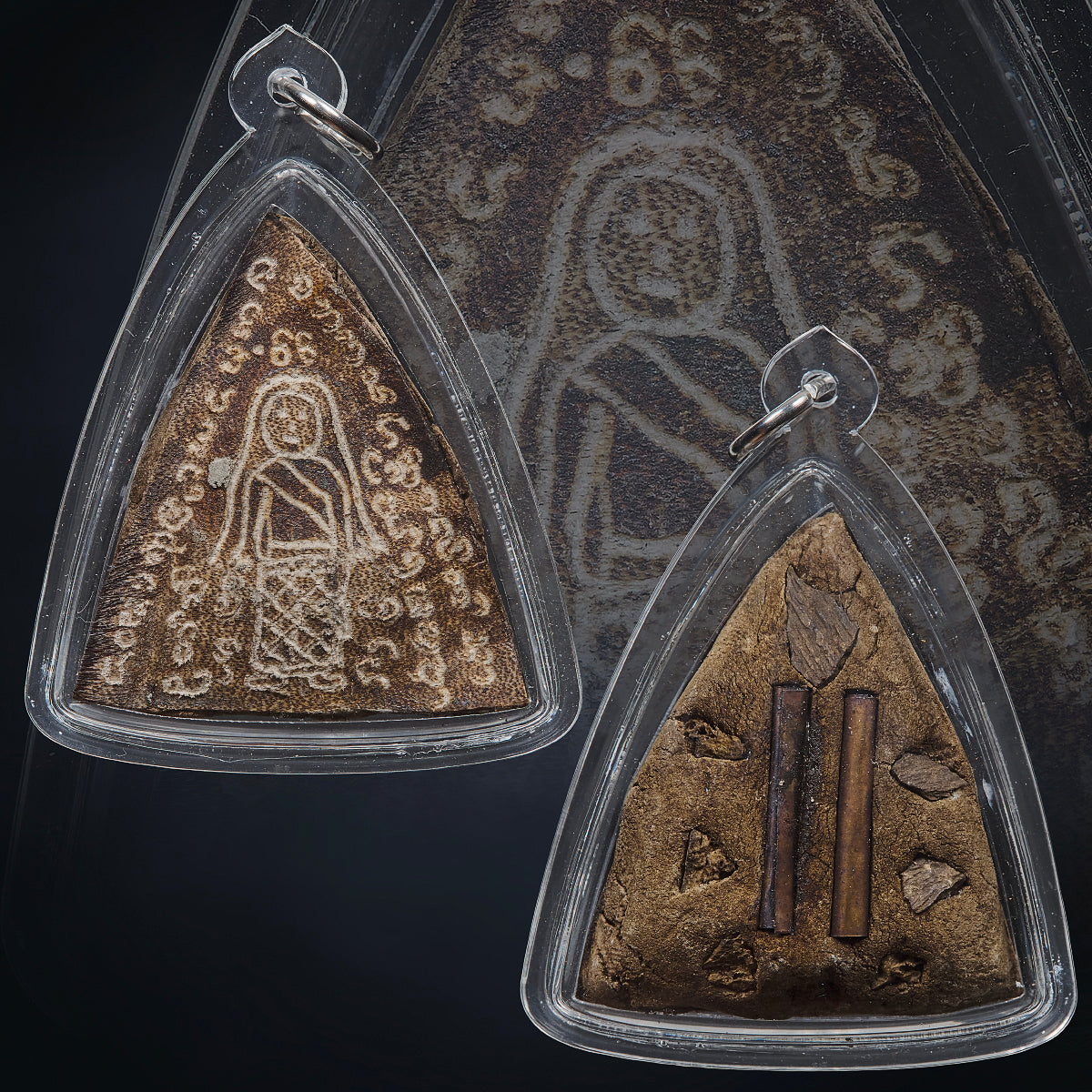
The front consists of Nang Tua Ngern Tua Thong, personally drawn and inscribed by Por Sala Tan with the image of the spirit and sacred yant.
The reverse contains a specially prepared body of Por Sala Tan's sacred powders, into which two takruts and multiple sacred relic fragments were embedded.
The artifact is principally associated with wish fulfilment, opening opportunities, Metta, assistance, benefactors and overcoming periods of stagnation.
Its character is not one of passive miracle. The traditional principle is to make a sincere request, continue working towards the objective, and allow the spirit to assist in bringing favourable circumstances into alignment.
Historical Background
Spirit-assisted artifacts form a specialised branch of Southeast Asian folk wiccha.
Within these traditions, spirits are not universally regarded as harmful or unsettled. Some are understood to seek a better spiritual condition through beneficial association with human beings, religious practice or the accumulation of merit.
Por Sala Tan's encounter with this particular spirit was understood within that framework.
While in trance, he became aware of a female spirit who expressed the desire to assist people rather than trouble them.
Her motivation was also connected with her own spiritual progression. By helping people achieve beneficial aims, she would have the opportunity to participate in good actions and accumulate merit.
Por Sala Tan accepted the arrangement.
The resulting artifact therefore belongs to a form of spirit practice centred upon cooperation and reciprocal benefit, rather than forceful command.
The keeper receives assistance towards reasonable intentions; the spirit receives opportunities to perform beneficial actions.
Origins of the Materials
Nang Tua Ngern Tua Thong
The front was prepared from Nang of the Tua Ngern Tua Thong.
The Thai name Tua Ngern Tua Thong carries the literal imagery of “silver and gold”.
For Por Sala Tan, however, the importance of the material came from the specific wiccha applied to it, rather than from claiming that every piece of Tua Ngern Tua Thong material inherently possesses identical sacred properties.
The Nang provided the physical surface upon which Por Sala Tan personally drew the image of the wish-granting spirit and wrote the surrounding sacred inscriptions.
The naturally textured material remains clearly visible beneath the hand-drawn design.
Sacred Powders
The reverse was constructed from a specially prepared mixture of Por Sala Tan's own sacred powders.
These powders were blended with the intention of strengthening Metta, Maha Saneh and favourable attraction, creating the ritual foundation into which the remaining sacred components could be placed.
Within the wish-granting construction, Metta is particularly important because many worldly wishes ultimately depend upon other people — an employer giving an opportunity, a customer agreeing to a transaction, a senior offering assistance or someone simply being willing to listen.
Takruts
Two takruts were embedded vertically into the sacred-powder body.
These form part of the internal ritual structure of the artifact, carrying additional wiccha alongside the handwritten work upon the Nang.
Their prominent placement on the reverse also makes the construction of the piece clearly visible.
Sacred Relic Fragments
Surrounding the takruts are multiple fragments of sacred relic material embedded directly into the reverse.
These fragments were deliberately incorporated into the sacred-powder body rather than merely placed loosely behind the artifact.
Together with the takruts, they form an important part of the internal ritual construction prepared by Por Sala Tan.
The combination of sacred powders, takruts and relic fragments creates the physical foundation behind the hand-drawn spirit image on the front.
Ritual
The ritual history of this piece began before the physical artifact was made.
During trance, Por Sala Tan encountered the spirit and became aware of her intention to assist people. Once he had determined that her purpose was not harmful, he agreed to help establish a suitable connection.
The Nang Tua Ngern Tua Thong was selected as the principal ritual face.
Por Sala Tan personally drew the image of the spirit upon the Nang and surrounded it with sacred yant and inscriptions.
He then prepared his sacred-powder mixture for the reverse. Two takruts and multiple sacred relic fragments were embedded directly into this powder body, creating the internal ritual foundation of the piece.
The completed artifact was then worked through kata and Por Sala Tan's spirit-associated wiccha.
The purpose was to establish a stable arrangement through which the spirit could assist the keeper in beneficial worldly matters while gaining merit through those acts of assistance.
Blessings and Effects
The principal traditional function of this artifact is wish fulfilment through assistance and opportunity.
Its associated qualities include:
- Wish Fulfilment — supporting reasonable intentions towards completion.
- Opening Opportunities — encouraging favourable circumstances to arise.
- Metta Maha Niyom — encouraging goodwill and favourable treatment.
- Benefactor Support — attracting assistance from people able to help.
- Career Progression — supporting interviews, employment and advancement.
- Business Opportunity — encouraging useful contacts, customers and commercial openings.
- Removing Stagnation — helping situations that have remained stuck begin moving.
- Maha Saneh — strengthening personal magnetism and receptiveness from others.
- Timely Assistance — traditionally associated with help arriving when genuinely needed.
- Favourable Encounters — encouraging meetings with people relevant to the keeper's objective.
The important principle is that the spirit is understood to assist rather than replace effort.
A person seeking employment must still apply and attend the interview. A business owner must still work on the business. Someone seeking advancement must still demonstrate ability.
The artifact represents assistance in bringing the opportunity within reach.
Modern Application
The Wish-Granting Spirit is particularly suited to situations where the keeper has a clear objective but requires circumstances to open.
Someone searching for employment may ask for the opportunity to meet the right employer.
A salesperson may request serious customers or an important introduction.
A business owner facing stagnation may ask for new opportunities and helpful connections.
Someone seeking career progression may ask for recognition or assistance from the right senior person.
It may also be carried when approaching important interviews, negotiations, applications or decisions.
The traditional approach is straightforward:
Set the intention, make the request, continue putting in genuine effort, and act when the opportunity appears.
Physical Details
This triangular Wish-Granting Spirit artifact is constructed with Nang Tua Ngern Tua Thong on the front and Por Sala Tan's prepared sacred-powder composition on the reverse. The natural brown Nang carries a hand-drawn seated female spirit surrounded extensively by sacred yant and inscriptions. The reverse consists of aged brown sacred powder containing two prominent vertical takruts and multiple visible sacred relic fragments embedded throughout the material. The handmade powder surface displays natural cracking, irregularities and tonal variation, while the different relic fragments remain individually visible around the takruts. The complete artifact is preserved within a fitted clear protective casing.
Recommended Pairing
For employment and career intentions, the Wish-Granting Spirit may be paired with a Metta or baramee-oriented amulet, particularly where success depends upon interviews, recognition or assistance from senior people.
For business, it pairs naturally with a wealth or Chok Lap piece. The spirit artifact concentrates upon opening opportunities and obtaining assistance, while the accompanying wealth piece supports financial movement.
A Salika is particularly suitable where communication matters, adding eloquence and favourable speech to the opportunity-oriented character of the spirit artifact.
For balanced daily wear, a mainstream Buddha-form amulet may serve as the principal spiritual foundation while the Wish-Granting Spirit retains its specialised role.
Personal Notes
What makes this piece particularly interesting is the idea of mutual progress behind its creation.
According to Por Sala Tan, the spirit was not seeking to harm anyone. She wanted to help people because those beneficial actions would allow her to accumulate good karma and merit.
Por Sala Tan therefore gave that intention a physical structure.
The construction itself reflects the seriousness of the preparation: Nang Tua Ngern Tua Thong bearing his hand-drawn spirit and sacred yant on the front, with his sacred powders, two takruts and multiple sacred relic fragments forming the ritual body behind it.
The employment story also illustrates how I understand this type of artifact.
The local man made his wish, but he did not remain at home expecting a job to appear. He worked hard, pushed for the interview and took responsibility for performing when the opportunity arrived. Eventually, he secured the position.
That is the character of this piece.
The keeper makes the wish and puts in the effort. The spirit assists in opening the path.
-
Free Shipping for Singapore| $15 Worldwide | $60 USA For Items Below $350