
OOBThaiAmulets
Por Sala Tan
Por Sala Tan
Couldn't load pickup availability
PST08
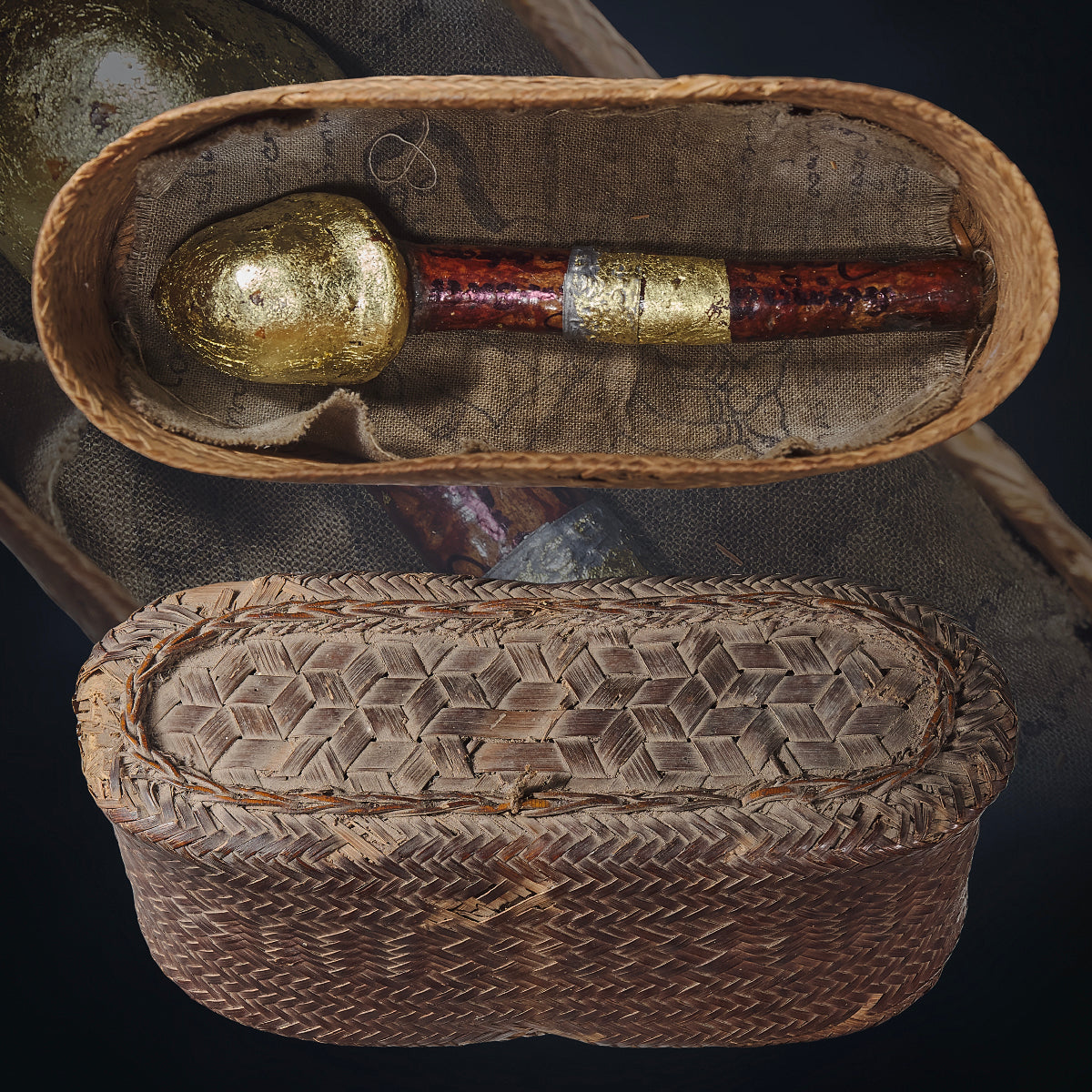
Palakit Hua Met Maha Saneh
Por Sala Tan
5.5 Inches
Mainstream Artifact
Sacred Craftsmanship
The Phayant is not merely packaging for the Palakit. It is itself a separate sacred object and may traditionally be used independently.
Each Palakit was individually prepared from natural Mai Rak and hand worked, inscribed and gold foiled. Variations in the grain of the wood, carving, yantra, surface and gold leaf are therefore part of the individual character of each artifact.
Personal Experiences Shared by Luksits
Among Por Sala Tan's luksits, this type of Palakit was particularly associated with people whose daily lives depended upon customers, communication and personal interaction.
Some kept the complete artifact close to the cashier counter or in a customer-facing area of a business. Others carried it personally when attending meetings, approaching customers, negotiating or entering situations where favourable interaction was important.
Feedback commonly centred upon people appearing more receptive, conversations becoming easier and customers being more willing to remain, enquire or engage.
For those carrying it personally, experiences were also associated with Metta, personal magnetism and opposite-sex attraction. Rather than describing its character purely as romantic, luksits regarded the piece as strengthening the owner's overall presence — helping the individual to be noticed, received favourably and remembered.
The Yin Tong Phayant was also sometimes used separately when the full Palakit was not convenient to carry.
Summary
The Palakit Hua Met Maha Saneh combines three important elements within one working set: specially selected Mai Rak, the Palakit form itself, and Por Sala Tan's old Lanna Yin Tong wicha.
Its principal direction is Metta Maha Niyom and Maha Saneh — goodwill, personal charm, attraction, persuasive presence and favourable human interaction.
For business owners, it was traditionally kept where customers were received or payments were made. For individual use, it could be carried when meeting people, conducting business or seeking stronger personal attraction.
The accompanying Yin Tong Phayant extends the same direction of wicha and may also be used independently.
Historical Background
Palakit belongs to a long-standing family of Thai sacred objects whose outward form carries ideas of fertility, generative power, prosperity and protective force. Different masters developed their own interpretations, materials and ritual methods according to lineage.
Por Sala Tan's example places particular emphasis upon Maha Saneh and Metta Maha Niyom.
The choice of Mai Rak reinforces this direction. In Thai, rak is closely associated with the idea of love or affection, and the wood has consequently acquired an important place within certain traditional preparations concerned with attraction, harmonious relationships and gaining the goodwill of others.
The addition of Yin Tong introduces another established attraction current. Yin Tong imagery traditionally represents the interaction and attraction between male and female principles and is consequently encountered in wicha concerned with Saneh, affection and interpersonal attraction.
Por Sala Tan's method reflects the Lanna teachings he encountered during his earlier period of learning, rather than treating the Palakit simply as a carved symbolic object.
Origins of the Materials
The foundation is Mai Rak, but the importance lies equally in how the wood was selected.
Por Sala Tan specifically required the highest upward-growing branch of the chosen tree. Within this preparation, upward growth carried an auspicious symbolism — movement, development and the raising of one's circumstances rather than decline or stagnation.
A single selected branch became the body of the Palakit.
After carving, sacred yantra were applied to the wood and sections were covered with gold leaf. The small metal binding was likewise prepared with yantra before being secured around the body.
The accompanying cloth carries the hand-drawn Yin Tong yantra, prepared according to the old Lanna method retained by Por Sala Tan.
Ritual
The preparation began with the selection of the correct Mai Rak tree and its upward-growing branch.
After the branch had been brought back, Por Sala Tan carved the Palakit Hua Met, inscribed the appropriate sacred yantra and applied gold leaf. The metal component was then bound around the body as part of the completed ritual structure.
Separately, the Yin Tong Phayant was drawn by hand according to the old yantra form Por Sala Tan had learnt from an earlier Lanna master.
The completed Palakit and Phayant therefore function as a related pair, while retaining the possibility of being used individually.
Blessings and Effects
Within Por Sala Tan's tradition, the principal qualities associated with this piece are:
- Metta Maha Niyom — goodwill, kindness and favourable reception.
- Maha Saneh — attraction, charm and personal magnetism.
- Opposite-sex attraction — strengthening romantic attention and personal appeal.
- Business and sales — encouraging customer interaction and smoother commercial dealings.
- Persuasive presence — supporting communication, negotiation and the ability to gain attention.
- Relationship harmony — softening interactions and encouraging warmer responses between people.
- Opportunity — helping create favourable circumstances through improved human relationships.
Its emphasis is therefore strongly interpersonal. The traditional understanding is that opportunities arise because people become more receptive to the keeper, communication becomes easier and relationships develop more favourably.
Modern Application
For a business, the Palakit may traditionally be positioned near a cashier counter, reception area or customer-facing space.
This follows the older principle of placing Metta and Saneh objects where interaction and exchange actually occur.
It may also be carried personally for sales appointments, meetings, negotiations, customer visits or social situations where confidence and favourable reception are important.
For those seeking personal attraction, it may be carried discreetly as an individual sacred object.
The Yin Tong Phayant can likewise be kept with the Palakit or used separately when required.
Physical Details
A hand-carved Palakit Hua Met made from a single specially selected upward-growing branch of Mai Rak. The wooden body carries sacred yantra, gold-leaf application and a small metal binding prepared with yantra. The set includes a hand-drawn Yin Tong Phayant based upon an old Lanna form learnt by Por Sala Tan during his earlier period of study. The artifact is preserved together in its traditional woven container.
Recommended Pairing
As this is principally a Metta Maha Niyom and Maha Saneh working piece, it pairs naturally with an artifact concerned with Baramee, authority or stable fortune.
The Palakit may then support attraction, customer response and interpersonal relationships, while the accompanying piece strengthens authority and stability.
For business use, this creates a balanced traditional combination: Metta to bring people closer, Saneh to strengthen favourable interaction, and Baramee to establish confidence and respect.
-
Free Shipping for Singapore| $15 Worldwide | $100 USA All products