
OOBThaiAmulets
Por Sala Tan
Por Sala Tan
Couldn't load pickup availability
PST08
Suer
Por Sala Tan
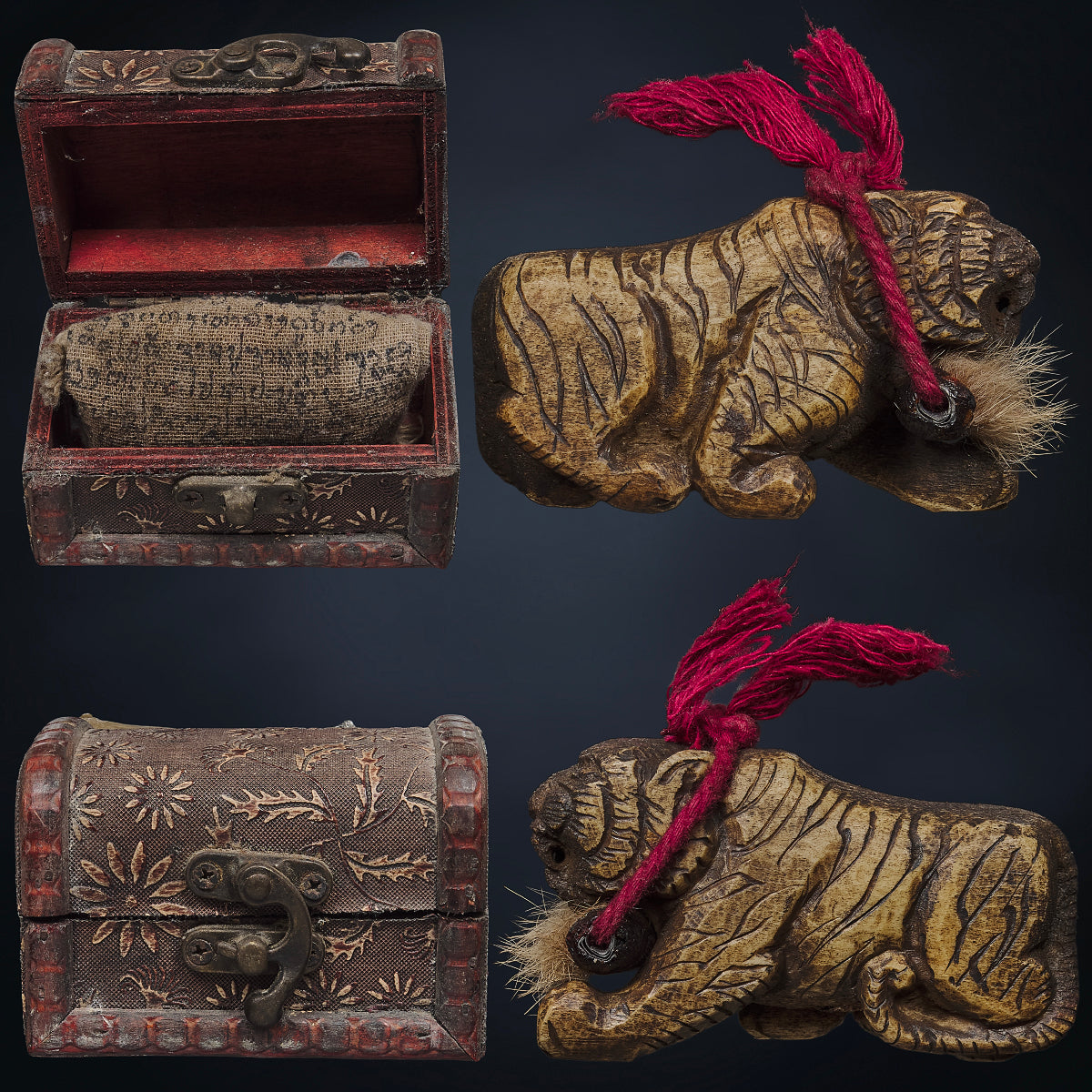
Suer: 2.5 Inches length
Chest: 3.5 Inches length
Barang Artifact
Sacred Craftsmanship
Each artifact was individually carved from old sacred material. Natural differences in the Graduk Suer, carving, patina, relic attachment and ceremonial Sai Sin make every surviving piece individually distinct.
Personal Experiences Shared by Luksits
I personally managed to acquire this particular Suer through one of Por Sala Tan's luksits, who had obtained it from an elderly villager who originally collected the piece from Por Sala Tan.
For many years, the villager kept the Suer hanging at the front of his agricultural field.
According to the account passed down with the piece, wild animals did not wander into the cultivated area and there were no incidents of animals harming the family's livestock. The villager consequently regarded the Suer as the guardian of the land rather than simply an artifact to be kept inside the house.
Similar experiences have been related by devotees carrying artifacts made from the same type of material. Rather than describing aggression, they commonly speak of feeling safer and becoming more confident when confronted with difficult circumstances.
Some explained that when problems arose, they found themselves more willing to face the situation directly, work through it and move forward rather than becoming overwhelmed by fear or uncertainty.
For this reason, such Suer pieces became particularly respected among followers who wanted protection, courage and Baramee, whether carried personally or kept within a home, field or place of business.
Summary
This is an exceptionally rare Suer Roop by Por Sala Tan, carved from Graduk Suer formerly belonging to a Lersi who practised Suer Wicha.
After the Lersi's Ascension and subsequent cremation, Por Sala Tan incorporated a piece of the Lersi's relic beneath the carving and tied the Suer with Sai Sin retained from the cremation ceremony. A protective takrut associated with protection and Nang Suer completes the piece.
Only a handful of Suer of this substantial size were made.
Its traditional emphasis is protection, Baramee, courage, territorial guardianship and controlled authority. Its earlier use at the entrance of an agricultural field also gives this particular piece an especially meaningful history as a guardian of land and livestock.
Historical Background
The Suer occupies an important position throughout Thai and wider Southeast Asian sacred traditions.
For generations, forest monks, Lersi and traditional practitioners lived and travelled through landscapes where encounters with wild animals were genuine dangers. Among these animals, the Suer naturally became one of the strongest symbols of the forest.
Its character came to represent alertness, endurance, courage, territorial command and the ability to remain composed in dangerous surroundings.
These associations gradually entered traditional Wicha. Suer imagery became established within yantra, Sak Yant, takrut, carved effigies and other sacred objects.
Within traditional forest Wicha, however, the Suer does not represent uncontrolled aggression.
Its deeper character is strength held under discipline.
A Suer does not need to continually display its power. Its presence itself establishes territory. It observes before acting, recognises danger and responds decisively only when necessary.
This distinction is particularly important to understanding Por Sala Tan's Suer.
The intention is not simply to make others fearful. Rather, it represents possessing sufficient presence, courage and Baramee that unnecessary confrontation may be discouraged before it develops.
Origins of the Materials
The principal material is Graduk Suer formerly belonging to a Lersi who was himself a practitioner of Suer Wicha.
This provenance gives the material particular significance within the history of the artifact. Rather than Por Sala Tan simply obtaining old Graduk Suer and subsequently consecrating it, the material was already associated with an earlier practitioner whose own path involved the Wicha represented by the finished carving.
After the Lersi had Ascended, Por Sala Tan used portions of the remaining material to carve Suer Roop.
Following the Lersi's cremation, a piece of his relic was preserved and attached beneath the Suer.
The Sai Sin came from the same cremation ceremony, maintaining another physical connection with the Lersi. A takrut associated with protection and Nang Suer was then incorporated into the completed artifact.
The result brings together three interconnected elements: the Suer material, the Wicha of its former Lersi keeper, and the Lersi's own relic after cremation.
Ritual
The construction of this Suer followed the passing of the Lersi and therefore carried a strong lineage character.
Por Sala Tan carved the Suer from the Lersi's remaining Graduk Suer, preserving the material within the form most closely associated with the Lersi's own practice.
After the cremation ceremony, a surviving piece of the Lersi's relic was placed beneath the carving.
Sai Sin from the cremation ceremony was tied around the Suer's neck, together with a takrut carrying the intended qualities of protection and Nang Suer.
The finished artifact therefore did not depend upon a single material or ritual component. Its significance came from the continuity between the original practitioner, his Suer Wicha, his remaining materials and Por Sala Tan's subsequent preparation of the completed piece.
Blessings and Effects
The principal quality of this Suer is protection through controlled strength.
Traditional qualities associated with the piece include protection against harmful influences, courage during difficult circumstances, strengthening of Baramee and greater firmness when dealing with opposition.
Its territorial character is particularly noteworthy.
The history of this individual piece being hung at the entrance of a field reflects the older understanding of Suer as a guardian of boundaries — protecting an area, household, livestock or place of livelihood.
For the individual keeper, the same symbolism becomes personal. The Suer represents the courage to confront difficulties without unnecessary aggression, the confidence to defend one's position and the presence to discourage those who may attempt to take advantage.
It is therefore as much an artifact of self-command as external protection.
Modern Application
In contemporary circumstances, the meaning of territorial protection extends naturally beyond agricultural land.
The Suer may be kept within a home, office, shop or business premises, particularly where the keeper wishes to establish a strong protective presence over the space.
For business owners, its symbolism concerns guarding what has already been built while maintaining the confidence required to deal with competition and difficult situations.
For individuals, it is particularly suited to periods requiring courage — professional disputes, demanding negotiations, difficult decisions or circumstances where one must remain composed while facing sustained pressure.
Its older association with fields and livestock can therefore be understood more broadly today as protection over one's territory, livelihood and responsibilities.
Physical Details
A substantial hand-carved Suer Roop made from old Graduk Suer, with deeply incised markings defining the body, head and characteristic stripes of the animal. Beneath the carving is a relic of the Lersi associated with the original material. Sai Sin retained from the Lersi's cremation ceremony is tied around the Suer's neck together with a protective takrut associated with Nang Suer. Only a handful of Suer Roop of this larger size were created by Por Sala Tan.
Recommended Pairing
This Suer is already a strongly structured Baramee and protection artifact and may be kept entirely on its own.
When placed within a home or business, it may be positioned as the principal guardian piece rather than surrounded by numerous spirit-based artifacts.
For personal use, it may be paired with Metta Maha Niyom when the keeper requires both authority and smoother interpersonal relations. The Suer provides firmness, courage and protection, while the Metta element softens interaction with customers, colleagues and those in positions of influence.
For those already working with strong spirit-based pieces, pairing with a Buddha or Baramee-focused artifact can provide a more balanced structure.
Above all, this Suer should be understood through the character of the animal itself: quiet strength, disciplined courage and the ability to protect one's territory without unnecessary confrontation.
-
Free Shipping for Singapore| $15 Worldwide | $100 USA All products