
OOBThaiAmulets
Por Sala Tan
Por Sala Tan
Couldn't load pickup availability
Summary
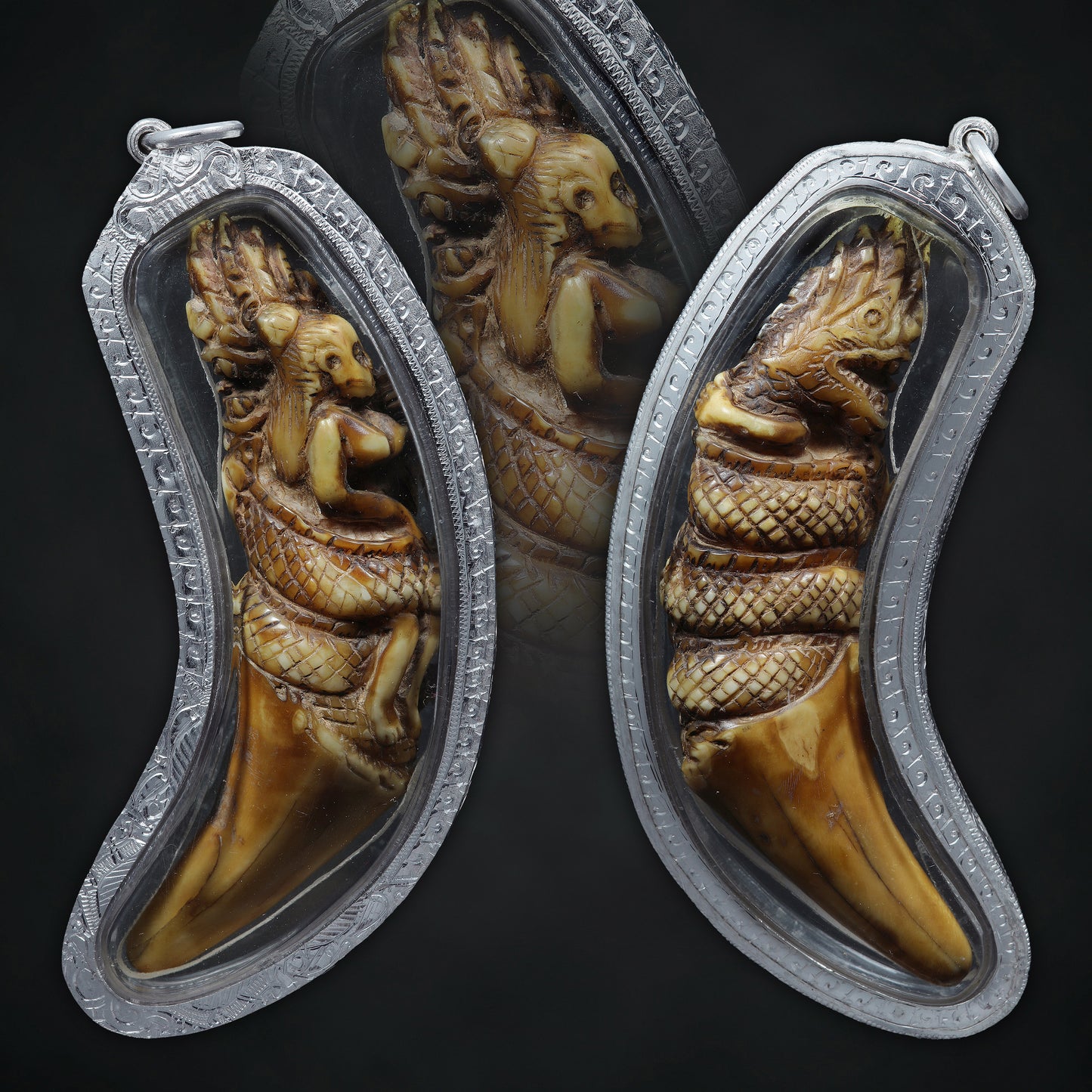
This amulet depicts a rare half-union form: the Naga (Payanak) manifested in serpent form, paired with his consort manifested in human form. While most Naga representations show either dual-serpent or dual-deva imagery, this piece preserves one half of the sacred union — a configuration associated with influence, attraction, and the harmonisation of worldly and unseen currents. The piece originates from the Mekong River region of Nong Khai, bordering Laos, and was preserved through prolonged water-based elemental cultivation.
Historical Background
The Mekong River has long been regarded as one of the primary Naga domains in mainland Southeast Asia. Practitioners operating along this river lineage traditionally focused on water-based cultivation rather than fire or cemetery rites. This piece was carried for decades by one of the oldest river-lineage Lersis in the Nong Khai region, a practitioner known for deep elemental work rather than object creation.
In his advanced age, the Lersi passed this piece directly to Por Sala Tan, expressing that it should remain preserved rather than altered. This transfer was not transactional; it was a custodial handover rooted in lineage recognition and continuity.
Origins of the Material
The amulet is carved from Keow Mii, a dense, naturally vitrified river-associated material traditionally linked to long-term elemental exposure. Keow Mii pieces are seldom carved aggressively; instead, they are shaped minimally to preserve their accumulated field.
The material’s association with water currents, river sediment, and prolonged submersion aligns precisely with Naga-lineage practices, where material memory is considered more important than ritual layering.
Ritual History
No additional consecration ritual was performed after Por Sala Tan received the piece.
This was a deliberate decision. The original Lersi had already subjected the amulet to repeated water-based elemental rites, working through the Four Elements using the Na Ma Pa Ta framework, with water as the dominant carrier. These rites were not single-event consecrations but cumulative practices performed over many years along the Mekong.
As such, the piece is considered ritually complete within its own lineage context.
Blessings and Effects
The energetic function of this amulet centres on:
-
Seneh and personal magnetism
-
Sales, persuasion, and convincing luck
-
Smooth resolution in disputes and court-related matters
-
Reduced friction with authority figures
-
Avoidance of danger through situational awareness rather than force
The half-union configuration is especially associated with influence that works quietly — attraction that invites rather than compels.
Modern Application
In contemporary use, this piece is suited for individuals who rely on presence rather than dominance:
-
Sales professionals and negotiators
-
Business owners managing multiple income streams
-
Individuals operating in regulated or authority-sensitive environments
-
Those seeking to stabilise both primary and secondary sources of wealth
Its function is not aggressive expansion, but steady inflow, acceptance, and reduced obstruction.
Physical Details
-
Form: Naga (serpent) with consort in human manifestation
-
Material: Keow Mii
-
Origin: Mekong River region, Nong Khai (Laos border)
-
Preservation: Silver casing
-
Lineage: River-based Lersi transmission → Por Sala Tan
Recommended Pairing
For optimal balance, this piece is best paired with an amulet that carries strong baramee-uplifting qualities, such as Somdej, Phra Kring, or equivalent baramee-focused images. This pairing stabilises the attraction and wealth aspects while reinforcing moral authority and long-term standing.
-
Free Shipping for Singapore| $15 Worldwide | $60 USA For Items Below $350