
OOBThaiAmulets
Por Sala Tan
Por Sala Tan
Couldn't load pickup availability
PST05
Lersi Ser Ming Pai
Por Sala Tan
Mainstream artifact
1.5 Inches
Sacred Craftsmanship
Each image was individually prepared and finished by hand from sacred materials. Natural differences in casting, patina, embedded relics and surface character therefore make every surviving piece unique.
Personal Experiences Shared by Luksits
Amongst Por Sala Tan's learning students, Lersi Ser Ming Pai was regarded differently from an ordinary protective amulet.
Students who received these pieces were encouraged to keep them close during meditation and wiccha practice, particularly when learning required prolonged concentration and discipline.
Some students spoke of becoming calmer during meditation and finding it easier to remain with their practice without the mind wandering as quickly. Others described moments of intuition during meditation — an impression that a particular method should be continued, adjusted or approached differently.
Rather than describing this as a voice giving instructions, they often understood it as subtle guidance arising during practice.
For students working through difficult periods of training, the image also served as a reminder of the teacher lineage behind the wiccha. The presence of Lersi Ser Ming Pai represented wisdom and direction, while the tiger aspect represented the courage and discipline required to continue.
This is why Por Sala Tan did not widely distribute the batch. Its intended value was most meaningful to those who were actively learning, meditating and developing their practice.
Summary
This Lersi Ser Ming Pai was created by Por Sala Tan as a specialised Wai Kru student piece, rather than a general release.
Its principal purpose is guidance during meditation and the strengthening of spiritual discipline.
The body combines auspicious sacred metals with old takruts originating from masters connected to Por Sala Tan's lineage. The base contains both Lersi Ser Ming Pai relics and tiger relics, establishing the two complementary qualities central to the artifact:
Lersi — wisdom, knowledge and guidance.
Tiger — authority, courage, protection and discipline.
At approximately 1.5 inches, the image remains compact enough for daily wear while retaining the presence of a small Roop Lor teacher image.
Historical Background
Lersi Ser Ming Pai
Within Por Sala Tan's practice, Lersi Ser Ming Pai occupies an important position as a teacher form connected with the tiger.
Lersi traditions throughout Thailand and neighbouring regions preserve the image of the hermit practitioner as a guardian of sacred knowledge. Lersi represents the disciplined transmission of wiccha from teacher to student and the responsibility of preserving what has been learned.
Lersi Ser Ming Pai introduces the character of the tiger into this teacher tradition.
The tiger represents more than physical strength. Within wiccha it is associated with command, courage, alertness, protection and the ability to remain firm under pressure.
Combined with Lersi wisdom, the result is therefore not uncontrolled aggression but disciplined authority.
For a student, this distinction is important. Knowledge alone is insufficient without the concentration and discipline necessary to apply it correctly.
Origins of the Materials
Auspicious Sacred Metals
The body was cast from a mixture of highly auspicious metals selected for the creation of the teacher image.
Rather than functioning simply as casting material, the metal body became the foundation into which the lineage materials could be incorporated and subsequently consecrated.
Takruts from Past Masters
Particularly important were takruts collected from various earlier masters associated with Por Sala Tan's lineage.
Their inclusion establishes continuity between generations of teachers.
Within the construction of a Wai Kru artifact, this is especially meaningful. The piece does not represent Por Sala Tan alone but acknowledges the masters through whom knowledge and wiccha were transmitted.
Lersi Ser Ming Pai Relics
Relics associated with Lersi Ser Ming Pai were embedded within the base.
These form the central teacher element of the piece and reinforce its intended purpose of supporting meditation, learning and spiritual direction.
Tiger Relics
Tiger relics were placed together with the Lersi materials.
Within this construction, they represent strength, protection, command and disciplined courage.
The combination creates an intentional balance: the Lersi provides direction, while the tiger provides the strength to follow that direction.
Ritual
The batch was created during Wai Kru, the traditional ceremony of paying respect to teachers and lineage masters.
For Por Sala Tan, this was particularly appropriate for a Lersi artifact intended for students.
Wai Kru is fundamentally concerned with gratitude, lineage and transmission of knowledge. Students acknowledge the teachers who came before them, while the teacher lineage is invited and honoured through ritual.
During the ceremony, the Lersi Ser Ming Pai images were brought into this lineage environment together with their old takrut materials and embedded relics.
Por Sala Tan directed the chanting towards meditative guidance, discipline, protection and connection with the teacher lineage.
Once the ceremony was completed, the pieces were retained primarily for learning students rather than distributed broadly.
Blessings and Effects
The principal purpose of this Lersi Ser Ming Pai is guidance within practice.
Traditional qualities associated with the piece include:
- Meditative Guidance — supporting intuition and direction during practice.
- Concentration — helping the practitioner maintain a steadier mind.
- Wisdom — encouraging clearer judgement and understanding.
- Discipline — strengthening persistence in study and spiritual training.
- Wiccha Development — supporting students engaged in learning traditional practice.
- Protection — carrying the guarding character associated with the tiger.
- Baramee — strengthening personal spiritual presence and confidence.
- Authority — encouraging calm command rather than aggressive dominance.
- Courage — helping the practitioner remain steady when encountering difficulty or uncertainty.
Its character is therefore considerably broader than protection alone.
The central idea is teacher guidance supported by tiger strength.
Modern Application
Although originally intended for Por Sala Tan's learning students, the qualities represented by Lersi Ser Ming Pai translate naturally into modern situations requiring concentration, discipline and leadership.
A practitioner may keep the image nearby during meditation, chanting or study.
Someone learning a demanding skill may use it as a teacher-lineage piece, particularly when patience and repeated practice are required.
For business owners or leaders, the tiger element may be appreciated for its traditional association with authority, decisiveness and commanding presence, while the Lersi aspect encourages judgement before action.
The piece is particularly suited to those who prefer an artifact concerned with inner development first, outward authority second.
Physical Details
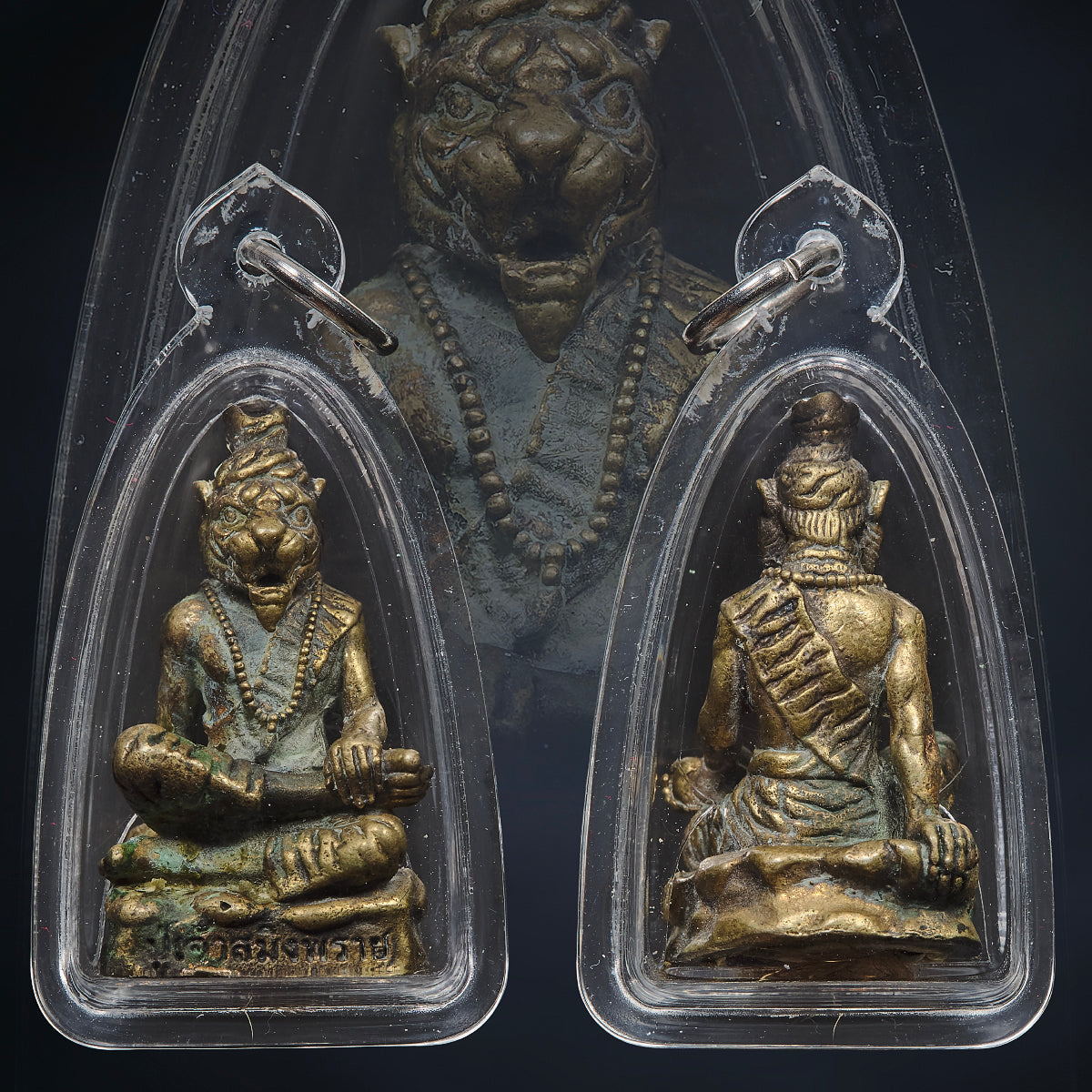
This Lersi Ser Ming Pai measures approximately 1.5 inches and is cast in an aged sacred mixed-metal composition. The front depicts the tiger-faced Lersi seated in meditation, wearing traditional robes and prayer beads, while the reverse reveals the draped garment and seated posture. Natural oxidation and green-brown patination remain visible across the old metal surface. The base contains Lersi Ser Ming Pai relics and tiger relics, while old takrut material from masters connected with Por Sala Tan's lineage forms part of the sacred construction. The piece is preserved within a fitted clear protective casing.
Recommended Pairing
For meditation and wiccha study, Lersi Ser Ming Pai may be worn alone so that its teacher-oriented purpose remains the principal focus.
It pairs particularly naturally with a mainstream Buddha-form amulet where the wearer wishes to establish a broader Buddhist and baramee foundation.
For leadership, a suitable authority-oriented piece can reinforce the tiger aspect, although this is generally unnecessary because Lersi Ser Ming Pai already combines wisdom and command within a single artifact.
Students of wiccha may instead pair it with another teacher or lineage piece connected with the particular practice they are studying.
Personal Notes
What distinguishes this Lersi Ser Ming Pai is who Por Sala Tan intended it for.
It was not created primarily for collectors, nor was it widely released amongst general luksits. Por Sala Tan reserved the batch for students who were actually learning from him.
That decision explains the construction.
The old takruts connect the image with past masters. The Lersi relics represent the teacher and transmission of knowledge. The tiger relics provide courage, protection and disciplined authority. Finally, the Wai Kru ceremony places the entire artifact within the context of respect for lineage.
Por Sala Tan himself favoured this Lersi form, and its purpose was very practical: to help guide and direct the student during meditation and practice.
For me, this makes the piece especially representative of the teacher-student side of Por Sala Tan's wiccha.
It was not simply made to carry power.
It was made to help the student learn how to develop it.
-
Free Shipping for Singapore| $15 Worldwide | $60 USA For Items Below $350